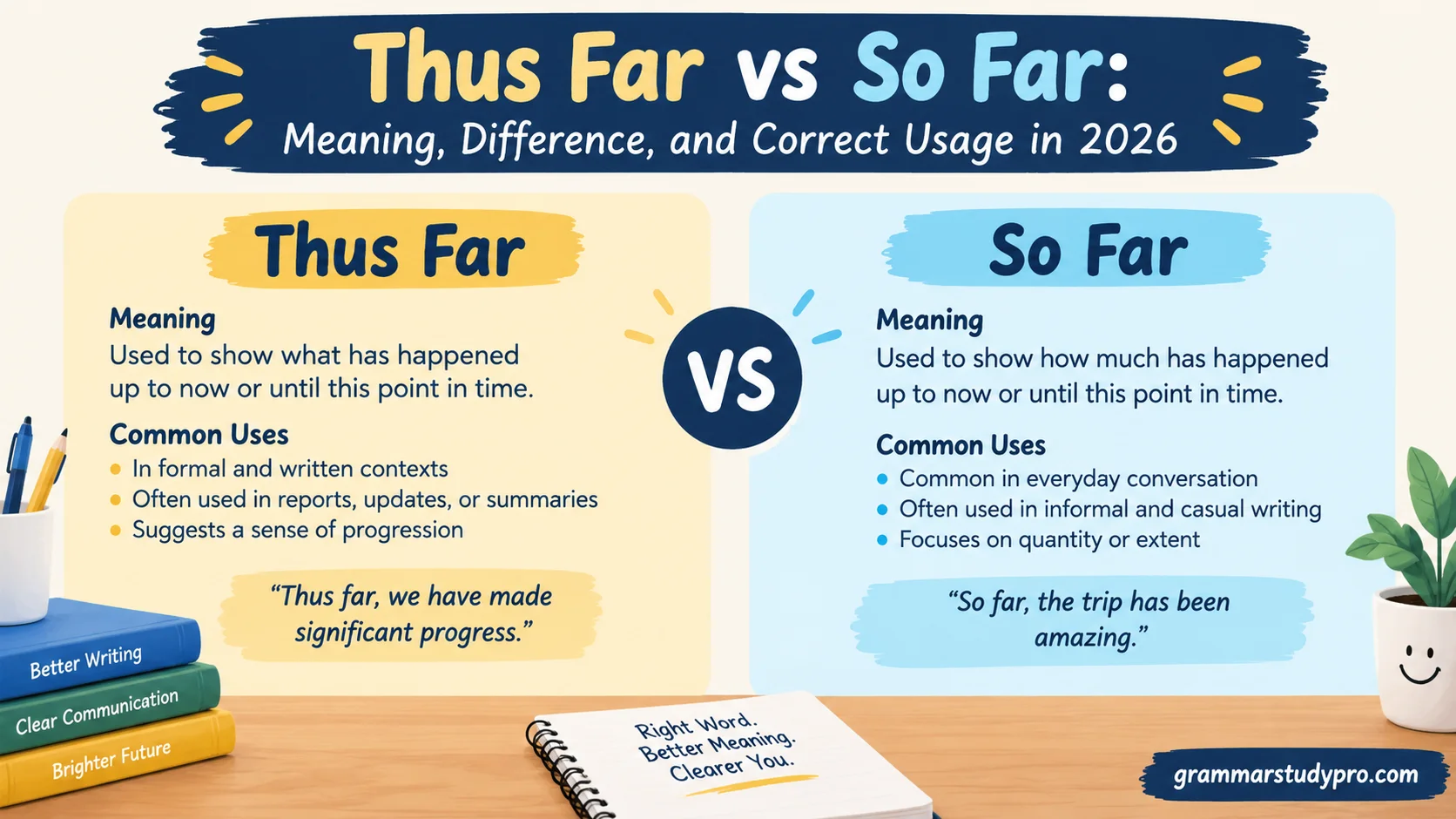
Thus Far vs So Far can seem confusing because both phrases mean up to this point or until now, but their tone changes with the situation and audience. At first glance, they look almost identical, yet so far sounds more natural in everyday speech, casual emails, Zoom calls, and informal messages. In contrast, thus far often sounds polished and professional in formal writing, academic contexts, research papers, business writing, reports, and presentations. Both phrases follow standard English grammar, so choosing between them depends more on context than strict grammar correctness. For example, writers, students, native speakers, and advanced English users might pause when deciding which phrase fits a sentence. Think of it like choosing between a tuxedo and sweatpants: both have their place, but the setting matters.
From a linguistic perspective, thus far is a timeless expression that bridges tradition and modernity. English constantly evolves while maintaining its roots through historical dramas, dusty books, and old-timey expressions. Its etymology, cultural shift, longevity, and lexical choice show how traditional expressions coexist with modern English in today’s fast-paced, emoji-filled world. The phrase can add clarity, precision, nuance, and semantic depth to professional communication, while so far offers familiarity, fluency, and flexibility in everyday conversations. I’ve noticed that people often prefer simpler expressions in casual settings, where tone and audience expectations matter more than strict formality. Understanding these stylistic differences improves communication skills and helps you feel confident when speaking or writing.
Consider these examples: “We have completed three chapters so far” sounds natural in everyday updates, while “The results are encouraging thus far” suits academic writing and formal reports. Both phrases work, but word choice, writing style, communication style, and sentence structure affect how readers interpret them. Also, avoid writing thusfar or sofar as single words. The correct spelling keeps both expressions separate: thus far and so far. Remembering this simple rule helps prevent spelling mistakes and improves proofreading, editing, and grammatical accuracy. When you understand the meaning, usage, and grammatical context, you can choose the appropriate expression for your intended audience and communicate naturally in both casual and professional situations.
Quick Answer: Thus Far vs So Far
Thus far and so far both usually mean “up to now,” “until now,” or “up to this point.” The main difference is their tone. So far is common in everyday speech and writing, while thus far generally sounds more formal or analytical.
For example:
- So far: The project has gone well so far.
- Thus far: The project has gone well thus far.
Both sentences are grammatically correct. They communicate the same basic message, but the second sounds more formal.
Choose so far for casual conversations, routine updates, and most everyday writing. Use thus far when its more formal tone suits the document or audience.
One important detail: so far can also describe physical distance, as in “The airport is so far away.” In that context, you cannot automatically replace it with thus far.
Comparison Overview
The easiest way to understand thus far vs so far is to compare their meanings, tones, and common uses side by side.
| Feature | So Far | Thus Far |
| Main meaning | Up to now | Up to now |
| Grammatical role | Adverbial expression | Adverbial expression |
| Tone | Neutral and conversational | More formal or analytical |
| Everyday conversations | Very common | Less common |
| Workplace communication | Natural and appropriate | Suitable for formal updates |
| Academic writing | Common and acceptable | Useful when a formal tone fits |
| Describing progress | Yes | Yes |
| Describing physical distance | Yes, in other constructions | Not normally |
| Spelling | Two words | Two words |
| General recommendation | Best default for everyday English | Useful when a more formal style fits |
The most important distinction is register, which means the level of formality in your language.
For example, a coworker might ask, “How’s the new software working so far?” That sounds natural and friendly. In a formal report, a writer might say, “The software has performed reliably thus far.”
Neither expression is inherently better. The right choice depends on the sentence, audience, and tone you want to create.
What Does “So Far” Mean?
Definition of So Far
So far means until now or up to the present point. People use it to describe something that has happened, how much progress someone has made, or what they have experienced during an ongoing period.
The Cambridge Dictionary defines so far as “until now.” Its examples include statements about money raised, films, and experiences. See the definition in the Cambridge English Dictionary
Consider this example:
I’ve read four chapters so far.
The sentence tells you that four chapters are complete at the current point. It doesn’t necessarily mean the reader has finished the book. More chapters may remain.
You can use so far to talk about:
- Progress: We’ve finished three assignments so far.
- Experiences: The vacation has been wonderful so far.
- Results: The experiment hasn’t produced clear results so far.
- Achievements: She has won five matches so far.
- Developments: Two candidates have applied for the position so far.
In each example, the phrase connects what has happened with the present moment.
Examples of So Far in Sentences
Here are more examples showing how so far works in everyday American English.
| Example sentence | What it means |
| The new restaurant has impressed us so far. | The experience has been positive up to now. |
| We’ve saved $800 so far. | The current savings total is $800. |
| No one has reported a problem so far. | No problems have been reported up to this point. |
| How are you liking your new class so far? | What is your experience of the class up to now? |
| The team has scored 12 goals so far. | The team has scored 12 goals during the period being discussed. |
Notice that so far works with both positive and negative statements. It can describe success, uncertainty, a lack of progress, or an experience that may change.
For example, saying “The treatment seems effective so far” describes the results observed up to now. It doesn’t guarantee that the treatment will remain effective in the future.
That distinction matters. So far describes the situation up to the present; it doesn’t promise what will happen next.
When Should You Use So Far?
Use so far whenever you want to express an idea clearly without making your sentence sound overly formal.
It works especially well in these situations:
- Conversations: “How’s your day going so far?”
- Text messages: “So far, everything’s good!”
- Work updates: “We’ve completed six orders so far.”
- School assignments: “I’ve written 500 words so far.”
- Customer communication: “We haven’t received your payment so far.”
The final example is grammatically possible, but “We haven’t received your payment yet” may sound more natural when you’re expecting a payment. Word choice depends on the precise meaning, not just grammatical correctness.
You can also use so far in formal writing. A business report doesn’t automatically require thus far. If so far communicates the point clearly and matches the document’s tone, there’s no need to replace it.
What Does “Thus Far” Mean?
Definition of Thus Far
Thus far means up to this point, until now, or up to the present moment. It describes the same general idea as so far when discussing progress, events, results, or experiences.
The defines the expression as meaning “as far as this or until now.” It also provides examples involving accomplishments and problems.
English meaning – Cambridge Dictionary
For example:
The investigation has uncovered no new evidence thus far.
This sentence means that the investigation hasn’t uncovered new evidence up to the current point. It doesn’t tell you whether investigators will discover anything later.
The phrase often appears in formal reports, academic discussions, official statements, and analytical writing. Its more formal tone comes partly from the word thus, which the Cambridge Dictionary labels as formal in relevant uses.
English meaning – Cambridge Dictionary
However, thus far isn’t reserved exclusively for experts or academics. Anyone can use it when the expression suits the situation.
Examples of Thus Far in Sentences
| Example sentence | Why it works |
| The committee has identified three major concerns thus far. | Summarizes findings up to the present. |
| The research has produced encouraging results thus far. | Describes results observed during an ongoing study. |
| We have completed two phases of the project thus far. | Reports progress in a structured process. |
| No significant errors have appeared thus far. | Describes the current status of a review. |
| The proposal has received broad support thus far. | Summarizes responses received up to now. |
These examples sound relatively formal because of their subject matter and phrasing. Yet the expression itself doesn’t make a sentence professional automatically.
For example, “My sandwich has been delicious thus far” is grammatically correct. In casual conversation, though, it might sound amusingly stiff. “My sandwich has been great so far” is more natural.
That contrast captures the difference nicely: the meaning stays the same, but the voice changes.
When Should You Use Thus Far?
Choose thus far when a formal or analytical tone fits your purpose.
Common situations include:
- Research summaries: “The findings support the initial hypothesis thus far.”
- Business reports: “The department has met its quarterly targets thus far.”
- Official updates: “No further changes have been announced thus far.”
- Project reviews: “The team has completed all scheduled milestones thus far.”
- Analytical writing: “The evidence gathered thus far points toward a different conclusion.”
You can also use thus far to refer to the discussion or information presented earlier.
For example:
“The arguments presented thus far reveal two distinct approaches.”
Here, thus far refers to the arguments covered up to that point in the discussion. It helps connect the current statement with the preceding material.
Use the expression naturally rather than inserting it simply to make your writing sound sophisticated. Clear writing beats unnecessary formality every time.
Main Differences Between Thus Far vs So Far
Although these expressions often share a meaning, several practical differences can help you decide which one to use.
Difference in Tone and Formality
The biggest difference between thus far and so far is their usual tone.
So far sounds neutral, direct, and conversational. Thus far often sounds more formal, deliberate, or analytical.
Compare these sentences:
- “The launch has gone well so far.”
- “The launch has gone well thus far.”
Both communicate that the launch has gone well up to the present. The first sounds like a natural conversation between coworkers. The second fits more comfortably into a formal project report.
This distinction is a matter of style rather than a strict grammar rule. You can use so far in an academic paper or thus far in conversation if the context supports it.
Difference in Everyday Usage
In everyday American English, so far is generally the more natural option.
Imagine asking a friend about a new job. You’d probably say, “How’s it going so far?” rather than “How’s it going thus far?”
The second question is understandable, but it may sound unusually formal for a casual conversation.
Here are a few natural conversational examples:
- “The movie is pretty good so far.”
- “I’ve finished two chapters so far.”
- “So far, everything is working perfectly.”
- “We’ve had a busy morning so far.”
You don’t need to avoid thus far completely. Just recognize that ordinary conversations rarely need a formal-sounding alternative when a simple expression works.
Difference in Professional and Academic Writing
Both expressions can work in professional and academic settings. The best choice depends on the document’s purpose and tone.
Use so far for a straightforward progress update:
“The team has completed 70% of the testing so far.”
Choose thus far if it fits a more formal summary:
“The evidence collected thus far supports the proposed explanation.”
Neither sentence is automatically more accurate or professional than the other. The second example simply uses a style that often appears in analytical writing.
A practical rule is to consider your readers. If you’re writing a friendly client email, so far will usually sound natural. If you’re summarizing findings in a formal report, thus far may fit the surrounding language.
Difference in Meaning and Context
When both expressions refer to the present point in time, their meanings usually overlap. However, so far has additional uses that thus far doesn’t normally share.
Consider these examples:
- “The trip has been enjoyable so far.” — Describes the experience up to now.
- “The hotel is so far from the airport.” — Describes distance.
In the second sentence, so intensifies far, meaning the hotel is a considerable distance away. It doesn’t mean “until now.”
You also see this distinction in phrases such as “You can only go so far.” Depending on context, that can refer to a limit or the extent to which someone can proceed.
The key lesson: Don’t replace words based on appearance alone. Check what the entire phrase means in its sentence.
Can You Use Thus Far and So Far Interchangeably?
Yes. You can often use thus far and so far interchangeably when both mean “up to now.” The main difference is usually the tone rather than the information the sentence conveys.
For example:
- So far: We’ve received 25 applications so far.
- Thus far: We’ve received 25 applications thus far.
Both sentences tell readers that 25 applications have arrived up to the current point. Neither expression changes the number or the basic meaning.
However, consider this sentence:
“The office is so far from the train station.”
Here, so far describes distance. Replacing it with thus far would not preserve the intended meaning.
When Interchanging the Phrases Works
You can generally substitute one for the other when the sentence describes:
- Progress on a project.
- Results obtained during an ongoing process.
- Experiences up to the present.
- Events or developments that have occurred.
- Information gathered during an investigation.
For example, “The team hasn’t encountered any difficulties so far” and “The team hasn’t encountered any difficulties thus far” both work.
When You Should Choose Carefully
Sometimes, the issue isn’t grammar but naturalness.
Consider a casual conversation:
“How’s the new apartment working out so far?”
Changing the question to “How’s the new apartment working out thus far?” makes it sound more formal than most casual conversations require.
The reverse can happen, too. In a formal report, thus far may blend more smoothly with the surrounding language. Still, so far remains acceptable if it matches the writer’s style.
Thus Far vs So Far: Correct Grammar and Punctuation
Both expressions can appear at the beginning, middle, or end of a sentence. Their position depends on emphasis and sentence structure.
Can You Start a Sentence With So Far?
Yes. You can begin a sentence with so far, especially when summarizing progress or introducing an update.
Examples:
- So far, the project has stayed within budget.
- So far, we’ve received positive feedback.
- So far, no one has identified the source of the error.
When so far introduces the sentence, a comma often helps separate the introductory phrase from the main clause.
You can also place it at the end:
- The project has stayed within budget so far.
- We’ve received positive feedback so far.
- No one has identified the source of the error so far.
In many short sentences, the final position sounds especially natural.
Can You Start a Sentence With Thus Far?
Yes. Thus far can introduce a sentence when you want to summarize information or describe progress.
Examples:
- Thus far, the evidence supports the original conclusion.
- Thus far, the team has completed three testing phases.
- Thus far, the committee has identified two possible solutions.
The comma after an introductory thus far helps readers recognize the transition into the main statement.
You can also place the phrase at the end:
- The evidence supports the original conclusion thus far.
- The team has completed three testing phases thus far.
- The committee has identified two possible solutions thus far.
The best position depends on rhythm, emphasis, and the surrounding sentences.
Which Verb Tenses Work With Thus Far and So Far?
Both expressions commonly appear with the present perfect tense because that tense connects past activity with the present.
For example:
- We have completed four chapters so far.
- We have completed four chapters thus far.
- The company has received 100 applications so far.
- The company has received 100 applications thus far.
The present perfect emphasizes what has happened up to the current point.
However, you don’t have to use the present perfect every time. The simple present can describe a current condition:
- Everything looks good so far.
- The situation remains stable thus far.
The important thing is to choose a tense that matches your intended meaning. Neither expression requires one particular verb tense in every sentence.
Common Mistakes to Avoid When Using Thus Far vs So Far
A few simple corrections can make your writing clearer and more natural.
Assuming Thus Far Is Grammatically Better
Some writers assume thus far must be more correct because it sounds formal. That’s not true.
Both expressions are correct when they communicate “up to now.”
Less natural for a casual conversation:
“Your presentation has been excellent thus far.”
More conversational:
“Your presentation has been excellent so far.”
The first sentence isn’t wrong. The second simply fits everyday conversation more naturally.
Assuming So Far Is Only Informal
Although so far often sounds conversational, it also works in professional and academic writing.
For example:
“The study has produced consistent results so far.”
There’s no grammatical reason to replace so far with thus far just because the sentence discusses research.
Writing Thusfar as One Word
The standard spelling is thus far, with a space between the words.
- Correct: The investigation has made little progress thus far.
- Incorrect: The investigation has made little progress thusfar.
Treat it as a two-word expression in ordinary writing.
Using Thus Far to Describe Distance
Remember that so far can describe distance, but thus far generally refers to a point reached in time, progress, or discussion.
- Correct: The airport is so far away that we’ll need a taxi.
- Correct: We’ve traveled a long way thus far.
The second sentence uses thus far to summarize the journey up to the present point. It doesn’t describe how far away a destination is.
Treating the Expressions as Identical in Every Context
The phrases overlap in meaning, but their uses aren’t identical.
For example, “So far, so good” is a common expression meaning that things have gone well up to now. You could rephrase it as “Things have gone well thus far,” but the result loses the familiar, conversational feel of the original idiom.
Choose expressions based on both meaning and natural usage.
Thus Far vs So Far: Examples in Different Contexts
The following examples show how the phrases work in daily life, education, business, and research.
| Context | Example With So Far | Example With Thus Far |
| Everyday life | The weekend has been relaxing so far. | The weekend has been relaxing thus far. |
| Education | I’ve completed four lessons so far. | I’ve completed four lessons thus far. |
| Workplace | We’ve processed 60 orders so far. | We’ve processed 60 orders thus far. |
| Research | The results look promising so far. | The results look promising thus far. |
| Customer service | We haven’t received your payment so far. | We haven’t received your payment thus far. |
| Project management | The team has met every deadline so far. | The team has met every deadline thus far. |
| Travel | The trip has been enjoyable so far. | The trip has been enjoyable thus far. |
The examples illustrate the shared meaning, but some versions sound more natural than others in everyday speech.
For instance, “We haven’t received your payment yet” may be more idiomatic than either option in a payment reminder. Meanwhile, thus far can suit a formal project report if the surrounding language has a similar tone.
A Practical Example: Choosing the Right Phrase at Work
Imagine a project manager preparing two messages about the same software rollout.
Message to a coworker:
“Testing has gone smoothly so far. We haven’t found any major bugs.”
Formal project report:
“Testing has proceeded smoothly thus far. The team has identified no major defects.”
Both messages describe the same general situation. The first feels direct and conversational, while the second uses a more formal style.
The choice doesn’t depend on a rule that requires one phrase for emails and another for reports. It depends on the audience, the purpose, and the voice of the writing.
Alternatives to Thus Far and So Far
Sometimes another expression communicates your meaning more precisely. Here are four useful alternatives.
Until Now
Until now means up to the present moment. It can sometimes suggest that a situation is changing or about to change, depending on the context.
Example: “Until now, we’ve handled every request internally.”
This wording can draw attention to a contrast between the past situation and a new development.
Up to Now
Up to now is a straightforward alternative that emphasizes progress or events through the present.
Example: “Up to now, the team has met every deadline.”
It works in both conversational and professional writing, although so far often sounds shorter and more natural.
To Date
To date often appears in reports, business updates, and formal summaries. It refers to the current point in time.
Example: “To date, the company has received 150 applications.”
This expression works particularly well when reporting totals, milestones, or accumulated results.
Up to This Point
Up to this point emphasizes a specific stage in a process, discussion, or explanation.
Example: “Up to this point, the evidence supports the original theory.”
It’s useful when a writer wants to connect a conclusion to the information already presented.
These alternatives overlap with thus far and so far, but they aren’t perfect substitutes in every sentence. Consider the context before making a change.
FAQs
1. What is the difference between thus far and so far?
Thus far and so far have the same basic meaning: up to this point or until now. However, so far sounds more natural in everyday conversations, while thus far often suits formal writing and professional communication.
2. Is thus far more formal than so far?
Yes, thus far generally sounds more formal and polished. You’ll often see it in academic papers, business reports, presentations, and professional documents. So far is more common in casual conversations, emails, and everyday writing.
3. Can I use so far in academic writing?
Yes. So far is grammatically correct and works in academic writing when it fits the context. For example, “The research has produced encouraging results so far” is clear and natural. You can use thus far if you prefer a more formal tone.
4. Is thusfar one word or two words?
Thus far is always written as two separate words. Writing thusfar as one word is a spelling mistake. The same rule applies to so far; avoid writing it as sofar.
5. Which phrase is better for professional writing?
Both phrases are correct, but thus far may suit formal reports, research papers, and professional presentations. So far works well when you want a simpler, more conversational style. Choose the phrase that best matches your audience and purpose.
Conclusion
Understanding Thus Far vs So Far helps you choose words that match your writing style and audience. Both phrases mean “up to this point” or “until now,” so the main difference lies in tone and context.
Use so far for natural everyday communication and thus far when you want a more formal or polished sound. Most importantly, remember to write both expressions as two words.