If you are learning By Which or In Which, this simple guide can help you choose the right preposition and avoid common mistakes.
The main difference between these two phrases becomes clear when you consider the context and the function of the sentence. If you have ever paused mid-sentence, wondering whether to write by which or in which, you are not alone. These prepositional expressions are commonly confused in formal English because they look similar and sound formal. The small preposition changes their meanings, so understanding the logic behind each phrase helps you never mix them. By which usually explains a method, process, or means and answers how something happens, while in which usually describes a location, situation, or circumstances connected with where or when something happens. A useful guide is to ask a question before making your choice. When answering “how,” by which may be appropriate because it indicates a method of doing, process of doing, or means of doing something.
When explaining where or when, in which often works because it describes the location of something or a situation in which an event occurs. For example, “The system was achieved by careful planning” highlights the means, while “The goal was achieved in a difficult situation” focuses on the circumstances. Similarly, “The building is situated in the city” identifies its location, whereas “The building is situated by the river” shows its nearby position. The preposition match must naturally fit the verb and its function, because the relationship between the words and ideas affects what can properly happen in the sentence. Learners, writers, and students can use these phrases to connect clauses with relative pronouns and convey thoughts clearly.
I once helped a student who wrote a letter about a condition that occurs in her city. She was unsure how to write the sentence properly, so we examined the context, verb, and what the expression talks about. This approach helped improve her grammar, writing, and clarity. The same rules can help English learners today: study clear examples, notice common expressions, and use plain English during practice. With practice, your sentences can sound proper, complete, and easy for readers to understand. The good news is that once you recognize the pattern, the difference becomes much easier to understand.
Quick Answer
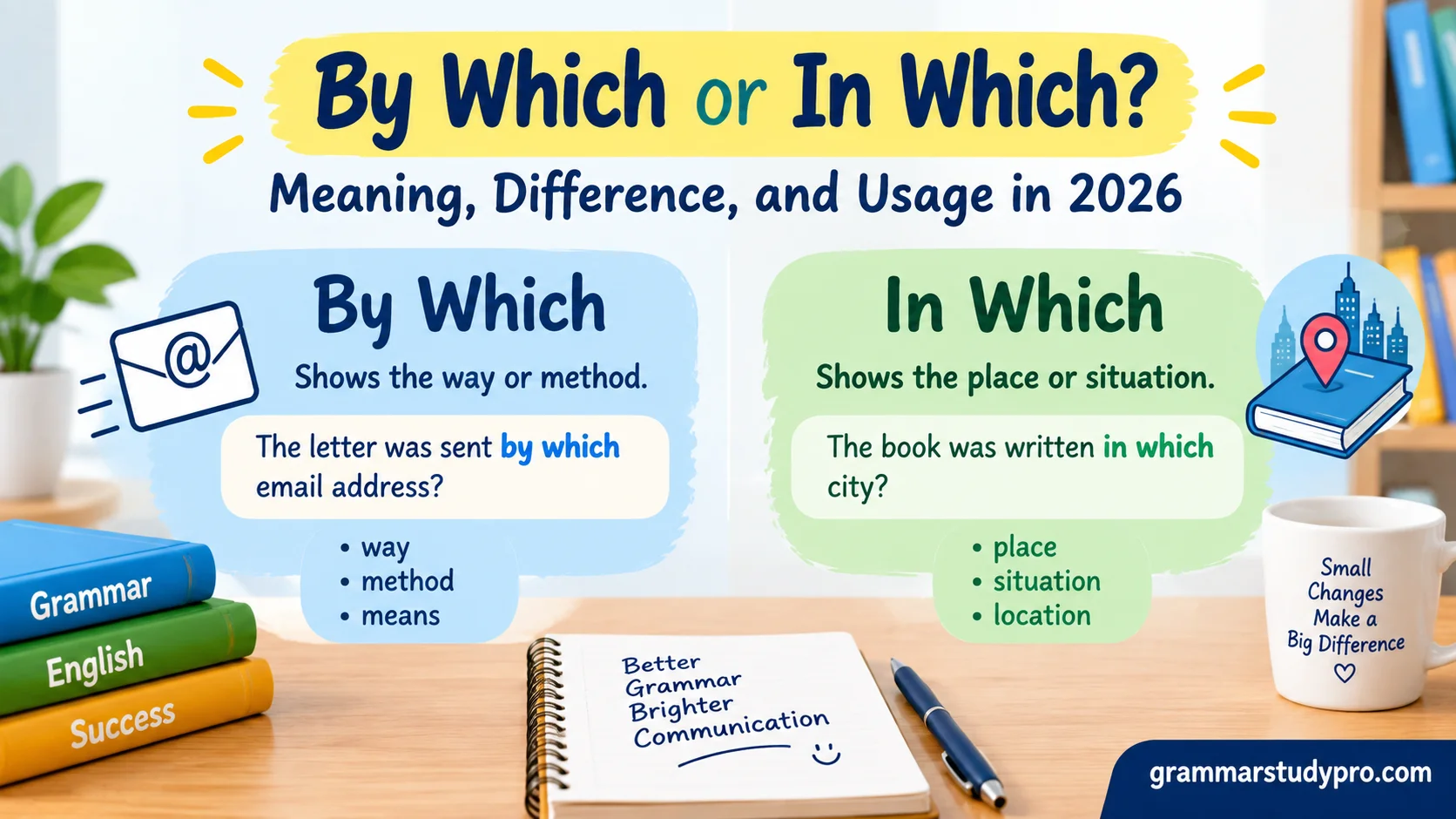
“By which” generally refers to the method, means, process, mechanism, or standard used to do something.
“In which” generally refers to the place, situation, period, condition, environment, or context in which something happens.
A simple way to remember the distinction is:
- By which = how
- In which = where, when, or in what situation
Compare these examples
The process by which the company verifies customers is automated.
The sentence describes the process or method used for verification.
The system in which customer records are stored was recently updated.
The sentence describes the system or environment containing the records.
Another useful pair makes the distinction even clearer:
The method by which we solved the problem was efficient.
The room in which we solved the problem was crowded.
In the first sentence, the question is “How did we solve it?”
In the second, the question is “Where did we solve it?”
That’s the basic rule. However, some sentences require closer attention because nouns such as system, process, and way can take different prepositions depending on the intended meaning.
Comparison Overview
| Feature | By Which | In Which |
| Basic idea | Method or means | Place, situation, time, or context |
| Main question | How? By what means? | Where? When? In what situation? |
| Common relationship | Method, process, mechanism | Location, environment, period, condition |
| Typical nouns | method, process, means, mechanism, criteria, procedure | room, place, situation, year, period, environment, report |
| Formality | Often formal | Often formal |
| Common alternative | how, through which, using which | where, when |
| Example | The method by which it works | The room in which it works |
The important point is that which itself doesn’t create the difference. The prepositions by and in establish different relationships.
Think of which as pointing backward to a noun. The preposition tells you how that noun connects to the rest of the sentence.
The underlying sentence test
Take this sentence:
The method by which the company collects data is efficient.
Remove the relative construction and rebuild the basic relationship:
The company collects data by this method.
That naturally gives you by which.
Now consider:
The office in which the company collects data is secure.
The underlying relationship is:
The company collects data in this office.
That gives you in which.
This simple reconstruction method works surprisingly well.
Main Differences Between By Which and In Which
The clearest way to understand by which vs. in which is to examine what each preposition contributes to the sentence.
By Which Means “By What Means?”
The phrase by which commonly introduces a relative clause explaining how something happens or is accomplished.
For example:
The process by which the material is recycled reduces waste.
The relative clause explains the process through which recycling occurs.
Similarly:
Scientists studied the mechanism by which the virus enters cells.
Here, by which introduces an explanation of the mechanism involved.
Common ideas associated with by which include:
- method
- means
- process
- mechanism
- procedure
- system of operation
- standard or criterion
- basis for evaluation
When you can naturally ask “How?”, by which may be appropriate.
In Which Means “In What Place, Situation, or Context?”
The phrase in which normally identifies the setting or context where something happens.
For example:
The building in which she works was renovated last year.
The building represents a physical location.
But the setting doesn’t have to be physical.
They faced a situation in which neither option seemed practical.
Nobody is physically sitting “inside” a situation. Here, in describes the circumstances surrounding an event.
The same pattern appears with time:
2024 was the year in which the company launched its new product.
The year provides a time frame.
So in which can refer to:
- Physical locations
- Situations
- Circumstances
- Conditions
- Time periods
- Environments
- Documents
- Systems viewed as contexts
- Fields or settings
What Does “By Which” Mean?
By which consists of the preposition by followed by the relative pronoun which.
It commonly appears in formal written English when the writer wants to connect a noun with a process or means.
By Which for Methods
This is perhaps the most familiar use.
The method by which the samples were analyzed produced reliable results.
The phrase tells us how the samples were analyzed.
A less formal alternative might be:
The method used to analyze the samples produced reliable results.
Or:
How the samples were analyzed produced reliable results.
However, these alternatives don’t always have exactly the same structure or emphasis.
By Which for Processes
Use by which when the noun represents a process that explains how something occurs.
Researchers examined the process by which plants convert light into chemical energy.
The phrase doesn’t identify a location. Instead, it identifies the mechanism or process involved.
Another example:
The process by which applications are reviewed takes several days.
The question behind the relative clause is:
How are applications reviewed?
By Which for Mechanisms
Technical and scientific writing frequently uses by which to describe mechanisms.
The mechanism by which the device regulates temperature is relatively simple.
The mechanism explains how regulation occurs.
This is especially useful when explaining:
- Engineering systems
- Biological processes
- Chemical reactions
- Software systems
- Financial procedures
- Manufacturing processes
By Which for Criteria and Standards
There’s another important use that sometimes gets overlooked.
By can identify the standard or criterion used to judge something.
The criteria by which applicants are evaluated are published on the website.
The sentence means that applicants are evaluated according to those criteria.
Likewise:
The standards by which safety is measured have changed.
Here, by which doesn’t describe a physical method. It describes the basis for evaluation.
By Which for Means
The construction can also describe the means used to achieve an outcome.
The system provides a mechanism by which users can report errors.
The mechanism gives users a means of reporting errors.
This is common in professional and technical writing because it allows writers to describe a process precisely without repeatedly using vague words such as way.
What Does “In Which” Mean?
In which combines in with the relative pronoun which.
It normally introduces the place, time, situation, environment, or context associated with an action or event.
In Which for Physical Places
This is the easiest use to recognize.
The room in which the meeting took place was small.
The relationship is straightforward:
The meeting took place in the room.
Therefore:
The room in which the meeting took place…
You could also say:
The room where the meeting took place…
Both can be grammatical. The choice often depends on style and context.
In Which for Situations
English also uses in with abstract circumstances.
We found ourselves in a situation in which every decision carried a risk.
The situation isn’t a container in a literal sense. Still, English commonly treats circumstances as contexts that people can be in.
Other examples include:
They entered a phase in which costs increased rapidly.
She described a period in which demand was unusually high.
The company faced conditions in which expansion became difficult.
These examples show why reducing in which to “physical location” isn’t enough.
In Which for Time
In which can refer to a particular period.
2020 was the year in which the project began.
The nineteenth century was a period in which industrialization accelerated.
The underlying relationship is:
The project began in 2020.
So the preposition in remains appropriate when the relative clause describes something occurring during a year, decade, century, or broader period.
In Which for Documents and Texts
Writers also use in which when something appears within a document, report, chapter, article, or other text.
The report in which these figures appear was published yesterday.
The information appears in the report.
Likewise:
The chapter in which the author introduces this argument is particularly important.
The argument appears in the chapter.
Here, in expresses containment within a text rather than physical containment.
In Which for Environments
Another common use appears in scientific, technical, and professional writing.
The environment in which the software operates affects its performance.
The software operates in that environment.
Similarly:
The conditions in which the experiment was conducted were carefully controlled.
The conditions describe the circumstances surrounding the experiment.
By Which or In Which: The Preposition Determines the Meaning
One of the biggest mistakes learners make is assuming that the noun automatically determines the correct phrase.
It doesn’t.
The intended relationship matters more.
Consider system.
The system by which payments are processed has been redesigned.
Here, the system represents a method or mechanism.
Now compare:
The system in which payment records are stored has been redesigned.
Here, the system functions as a context or environment containing the records.
The noun hasn’t changed. The relationship has.
This distinction is crucial.
Another example: “process”
Consider:
The process by which the material is manufactured is efficient.
The sentence focuses on how manufacturing occurs.
Now compare that with:
The process in which the company is currently involved has several stages.
This sentence treats the process as a broader context or activity in which the company participates.
The intended meaning determines the preposition.
By Which vs. In Which Examples
The following examples show the distinction across several common contexts.
| Meaning | Example | Why |
| Method | The method by which the data was analyzed was reliable. | Describes how analysis occurred |
| Mechanism | The mechanism by which the device operates is complex. | Explains how it works |
| Process | The process by which waste is recycled saves energy. | Describes how recycling occurs |
| Criteria | The standards by which performance is judged are clear. | Identifies the basis of evaluation |
| Procedure | The procedure by which claims are processed has changed. | Describes the procedure |
| Place | The office in which she works is downtown. | Identifies location |
| Time | The year in which the project began was significant. | Identifies a period |
| Situation | The circumstances in which they met were unusual. | Describes context |
| Document | The report in which the data appears is available. | Identifies where information appears |
| Environment | The environment in which the software runs matters. | Identifies operating context |
By Which vs. Through Which
Although by which and through which sometimes overlap, they aren’t always interchangeable.
By which often emphasizes a method or means.
The procedure by which applications are reviewed has changed.
Through which can emphasize a channel, route, intermediary, or passage.
The platform through which customers submit applications has changed.
The first sentence focuses on the procedure. The second focuses on the platform serving as a channel.
A useful distinction
Ask yourself whether you’re emphasizing:
- the method used → by which
- the channel or route something passes through → through which
Context can allow some overlap, so this isn’t an absolute rule.
By Which vs. How
This distinction deserves special attention because by which often has a meaning close to how.
Compare:
The method by which the machine works is difficult to explain.
with:
How the machine works is difficult to explain.
Both can communicate a similar idea. However, their grammatical structures differ.
In the first sentence, by which connects the relative clause to the noun method.
In the second, how introduces the clause directly.
Avoid “the method how”
A common nonstandard construction is:
❌ The method how we solved the problem was effective.
In standard English, use:
✅ The method by which we solved the problem was effective.
Or simplify it:
✅ How we solved the problem was effective.
The second version can sound more natural in everyday English.
In Which vs. Where
Where is often a natural alternative to in which when the antecedent refers to a physical place.
Compare:
The restaurant in which we ate was crowded.
The restaurant where we ate was crowded.
Both work.
In everyday conversation, where often sounds lighter and more natural.
In formal writing, however, in which can fit smoothly into a more formal construction.
Don’t replace every “in which” with “where”
The substitution doesn’t always work naturally.
For example:
They faced a situation in which nobody knew what to do.
Replacing in which with where may be possible in some varieties of English, but it changes the style and can sound less precise.
Similarly:
The report in which the figures appear…
Here, where isn’t normally the best replacement because a report isn’t primarily a physical location.
The broader lesson is simple:
Use “where” when you genuinely mean a place or location.
In Which vs. When
Time expressions create another useful comparison.
The year in which she graduated was memorable.
The year when she graduated was memorable.
Both constructions can work.
In which has a more formal relative-clause structure. When often sounds more natural in conversational English.
The choice depends on context, tone, and sentence structure rather than a rigid rule that one form is always correct.
Preposition Placement: By Which vs. Which … By
English allows prepositions to appear in different positions.
The formal version is:
The method by which they solved the problem was efficient.
A more conversational construction can be:
The method which they solved the problem by was efficient.
The second version uses preposition stranding.
Preposition stranding is common in English, particularly in informal speech.
Formal doesn’t automatically mean better
It’s tempting to assume that moving the preposition before which always produces superior English. That’s not the case.
Compare:
The company developed a system by which customers can submit requests.
The company developed a system that customers can use to submit requests.
The second version is often easier to read.
Good writing isn’t about making every sentence sound formal. It’s about choosing the structure that communicates the idea clearly.
Common Mistakes With By Which and In Which
These expressions create several predictable errors.
Mistake: Using “in which” for a method
❌ The method in which we solved the problem was efficient.
If you’re describing how the problem was solved, use:
✅ The method by which we solved the problem was efficient.
Or use the simpler:
✅ The way we solved the problem was efficient.
Mistake: Using “by which” for a location
❌ The room by which we held the meeting was crowded.
If the room is the location, use:
✅ The room in which we held the meeting was crowded.
Or:
✅ The room where we held the meeting was crowded.
Mistake: Using “method how”
❌ The method how the system works…
Use:
✅ The method by which the system works…
Or:
✅ How the system works…
Mistake: Confusing a standard with a location
The criteria in which applicants are evaluated…
This is generally not the intended relationship.
The criteria represent the standard used for evaluation:
The criteria by which applicants are evaluated…
The difference is subtle but important.
Formal vs. Everyday English
Both by which and in which are legitimate constructions. Their frequent appearance in formal writing doesn’t make them mandatory whenever you want to sound intelligent.
In many cases, simpler wording improves readability.
Formal
The mechanism by which the system determines eligibility is complex.
Simpler
The system uses a complex process to determine eligibility.
Likewise:
Formal
The building in which the organization operates was constructed in 1920.
Everyday
The building where the organization operates was built in 1920.
Neither style is automatically superior.
The right choice depends on your audience and purpose.
Where these phrases commonly appear
You may encounter by which and in which frequently in:
- Academic papers
- Scientific research
- Technical documentation
- Legal documents
- Business reports
- Government publications
- Formal essays
- Professional analysis
In casual conversation, speakers often choose shorter alternatives such as how, where, when, that, or the way.
By Which and In Which in Academic Writing
Academic writing often needs precise relationships between ideas. That’s where these constructions become particularly useful.
Consider:
Researchers investigated the mechanism by which temperature influences the reaction.
The phrase identifies a specific causal mechanism.
Now consider:
Researchers conducted the experiment in an environment in which temperature remained constant.
The phrase identifies the experimental context.
These sentences demonstrate an important principle:
Academic precision often comes from choosing the right preposition rather than using bigger words.
A sentence doesn’t become scholarly merely because it sounds complicated.
By Which and In Which in Technical Writing
Technical writers use by which to describe systems and mechanisms.
Examples include:
The algorithm describes the process by which the data is sorted.
The mechanism by which the sensor detects movement relies on changes in pressure.
Meanwhile, in which commonly describes the operating environment:
The environment in which the software runs affects its performance.
The conditions in which the device operates must remain stable.
Technical readers care about these distinctions because confusing a mechanism with an environment can create genuine ambiguity.
Case Study: One Noun, Two Different Meanings
Consider the word system.
It can describe a method or an environment.
Example A: Method
The system by which employees are evaluated rewards consistent performance.
Here, the system tells us how employees are evaluated.
Example B: Environment
The system in which employee records are stored requires regular maintenance.
Here, the system is the environment or framework containing the records.
The same noun works with different prepositions because the intended relationship changes.
This is why memorizing lists of nouns isn’t enough. You need to understand the meaning of the entire sentence.
Another Case Study: The Word “Way”
The word way creates an interesting complication.
You can say:
The way in which she explained the issue was clear.
You can also say:
The way that she explained the issue was clear.
And in ordinary English:
The way she explained the issue was clear.
The last version is often the most natural.
With way, writers sometimes use in which because they want a formal relative-clause construction. However, that doesn’t mean the longer version is always preferable.
Practical lesson
If a simpler construction communicates the same idea, don’t add complexity merely for appearance.
Other Useful “Preposition + Which” Constructions
Understanding by which and in which becomes easier when you see the broader pattern.
| Construction | Typical meaning | Example |
| by which | Method or means | The process by which it works |
| in which | Place or context | The environment in which it operates |
| through which | Channel or route | The platform through which requests pass |
| with which | Instrument or tool | The tool with which it was repaired |
| to which | Direction or relationship | The standard to which it conforms |
| for which | Purpose or reason | The purpose for which it was created |
| on which | Surface, basis, or time | The date on which it occurred |
These constructions follow the same broad principle.
The preposition carries meaning.
Once you identify the relationship, the correct construction becomes much easier to select.
How to Choose Between By Which and In Which in 10 Seconds
When you’re editing a sentence, use this quick process.
Ask what the relative clause is explaining
If it explains how something happens, consider by which.
The process by which the product is manufactured…
If it explains where something happens, consider in which.
The factory in which the product is manufactured…
If it explains when something happens, in which may fit with a time period.
The year in which production began…
If it explains the circumstances, in which may describe the situation.
The conditions in which the experiment occurred…
Use the “simple sentence” test
Remove which and rebuild the relationship.
Ask:
Did it happen by something?
If yes, by which may be correct.
Ask:
Did it happen in something?
If yes, in which may be correct.
This isn’t a perfect mechanical rule because English depends on context. Still, it’s an excellent editing shortcut.
By Which or In Which: Practice Questions
Choose the correct phrase for each sentence.
- The process ___ the company manufactures its products has changed.
- The building ___ the company manufactures its products is expanding.
- The criteria ___ candidates are evaluated are published online.
- The year ___ the company was founded remains important.
- The system ___ customers submit applications was updated.
- The mechanism ___ the device controls temperature is sophisticated.
- The environment ___ the software operates affects its performance.
- The situation ___ they found themselves was unexpected.
- The procedure ___ refunds are issued has changed.
- The report ___ these figures appear was released yesterday.
Answers
| No. | Answer | Reason |
| 1 | by which | Describes the manufacturing process |
| 2 | in which | Identifies the manufacturing location |
| 3 | by which | Identifies evaluation standards |
| 4 | in which | Identifies a time period |
| 5 | by which | Describes the method or system for submitting applications |
| 6 | by which | Describes the operating mechanism |
| 7 | in which | Identifies an operating environment |
| 8 | in which | Identifies circumstances |
| 9 | by which | Describes the procedure used |
| 10 | in which | Identifies the document containing the figures |
Notice the pattern: method and mechanism favor “by which,” while location, time, and context favor “in which.”
FAQs
What is the main difference between “by which” and “in which”?
By which usually refers to a method, means, or process and answers the question “how?” In which usually refers to a situation, location, or circumstances and answers “where?” or “when?”
When should I use “by which”?
Use by which when you want to explain the way something happens or the method used to achieve a result. For example, “This is the process by which the machine operates.”
When should I use “in which”?
Use in which when referring to a situation, place, condition, or period. For example, “This is the room in which the meeting took place.”
Can “by which” and “in which” be used interchangeably?
Usually, no. They have different functions, so replacing one with the other can change the meaning or make the sentence grammatically unnatural. Always consider the verb and context before choosing the preposition.
How can I remember the difference between them?
A simple trick is to connect by which with how and in which with where or when. If you are describing a method or process, think by which. If you are describing a situation, location, or time, think in which.
Conclusion
Understanding By Which or In Which becomes easier when you focus on the relationship between the preposition, verb, and context. Use by which for a method, process, or means, and use in which for a situation, location, or circumstances. With regular practice and clear examples, you can choose the correct expression naturally and make your English writing more precise and effective.