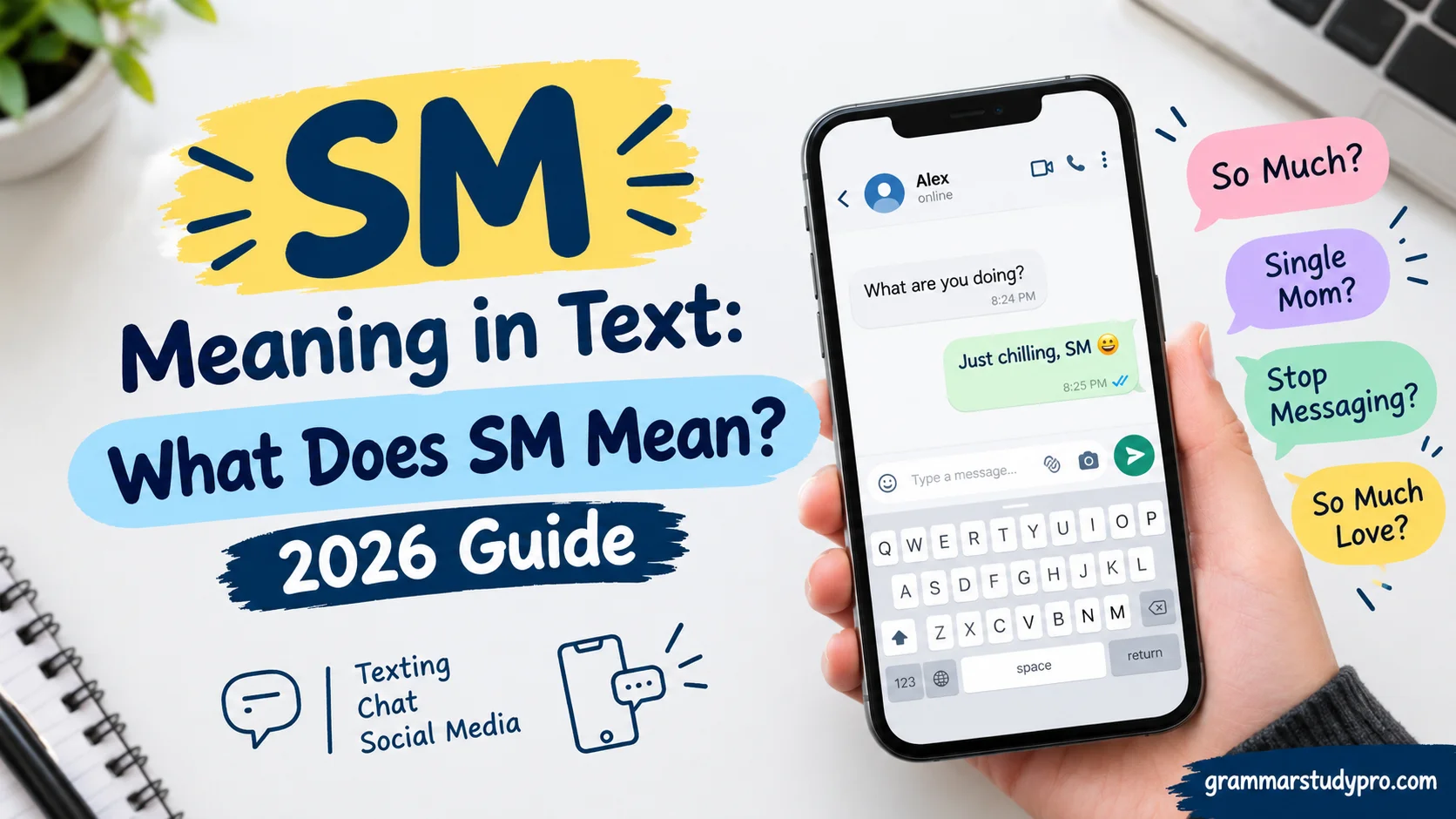
SM Meaning in Text usually means so much, a common abbreviation or acronym used in texting, online chats, and social media to express strong feelings or a large amount of something.
This shortened version of a familiar phrase uses just a few letters to communicate the magnitude, quantity, degree, or amount of a feeling. In modern digital communication, abbreviations help people compress longer thoughts, save time, and maintain conversational flow across digital platforms. For example, if you receive a message saying, “I love you SM,” it actually means “I love you so much.” This powerful expression adds emphasis and conveys affection, love, and other strong emotions. People also use SM to express gratitude, appreciation, happiness, excitement, and enthusiasm. The frequency and usage of this short expression depend on the context, tone, relationship, and situation.
The meaning in text may seem confusing because SM can have different meanings in informal communication, digital conversation, and online messaging. However, in everyday text messages, “so much” commonly describes emotional intensity or a significant amount of a feeling. For example, “Thank you SM” expresses gratitude, while “I miss you SM” communicates strong emotions and affection. This romantic expression can make messages feel more personal and impactful, especially when speaking to someone you love. To understand its meaning, consider the communication style, conversational tone, relationship dynamics, and other context clues before you interpret messages. These communication habits are common in informal language and everyday messaging, where people prefer quick, natural expressions.
A clear understanding of SM can help you avoid misunderstandings and improve message interpretation in real conversations. Although this abbreviation meaning is usually simple, its interpretation can shift depending on the platform, the person sending the message, and the overall communication context. When you see SM in online communication, check the surrounding words to determine whether it expresses emotion, intensity, or quantity. This detailed answer makes the language easier to understand and helps you use SM with greater clarity and accuracy. To explore this expressive language further, keep reading examples of common short forms and their meanings.
Quick Answer: What Does SM Mean in Text?
SM usually means “so much” in casual text messages and social media conversations. It’s an informal abbreviation that adds emphasis to a feeling, opinion, or statement.
Here are a few common examples:
- “I miss you sm.” = I miss you so much.
- “Thank you sm!” = Thank you so much!
- “I love this song sm.” = I love this song so much.
- “You’re helping me sm.” = You’re helping me so much.
SM can also mean social media, particularly in marketing and professional discussions.
For example, someone might write, “We need to improve our SM strategy.” In this context, they’re probably talking about their social media strategy.
The easiest way to understand SM is to read the entire message. If it expresses a feeling or reaction, “so much” often fits. If it discusses marketing or online platforms, “social media” may make more sense.
Comparison Overview
SM has several possible interpretations, but they don’t all appear equally often in everyday conversations. The surrounding words usually provide the strongest clue.
| SM meaning | Typical context | Example | Intended meaning |
| So much | Casual texting | “I appreciate you sm.” | I appreciate you so much. |
| Social media | Marketing and business | “Our SM campaign starts tomorrow.” | Our social media campaign starts tomorrow. |
| Send me | Certain informal conversations | “SM the picture.” | Send me the picture. |
| Something | Heavily abbreviated messages | Depends on the sentence | Possible interpretation when the wording supports it. |
Important: “So much” is a common interpretation in casual texting, while “social media” is a recognized abbreviation in digital marketing contexts. Meanings such as “send me” or “something” are less standardized and require stronger contextual clues.
Main Differences Between SM Meaning in Text
The main difference between SM’s meanings is the situation in which someone uses it. Two identical letters can communicate different ideas depending on the subject, sentence, and relationship between the people chatting.
| Feature | SM = So Much | SM = Social Media | SM = Send Me |
| Main purpose | Adds emphasis | Refers to online platforms | Makes a request |
| Common setting | Personal messages | Work, marketing, and content discussions | Informal, context-dependent chats |
| Typical wording | “I love it sm.” | “Check our SM accounts.” | “SM the link.” |
| Tone | Emotional or emphatic | Usually practical or professional | Direct and conversational |
| How to identify it | Look for a feeling or reaction | Look for marketing or platform-related words | Look for a request to receive something |
For example, “I love this sm” clearly expresses enthusiasm. By contrast, “Our SM manager scheduled three posts” points toward social media.
The letters alone don’t tell the whole story. Context determines which meaning makes sense.
What Does SM Stand for in Texting?
SM is a short form whose meaning depends on how someone uses it. In everyday messaging, it often replaces “so much,” but professional conversations can give it a different meaning.
Unlike an abbreviation with one fixed definition, SM needs a little context. The sentence usually tells you whether the writer is emphasizing a feeling, discussing an online platform, or using shorthand familiar to a particular group.
SM Means “So Much”
The most common texting use of SM is “so much.” People add it to a statement to make the emotion or degree stronger.
Consider these examples:
- “I appreciate you sm.” = I appreciate you so much.
- “This movie is good sm.” = This movie is so good.
- “I miss my friends sm.” = I miss my friends so much.
- “That made me laugh sm.” = That made me laugh so much.
SM can emphasize positive or negative feelings. For instance, “I’m tired sm” communicates a strong feeling of tiredness, although “I’m so tired” sounds more natural in standard written English.
The key is its function: SM adds emphasis without changing the basic message. It gives casual writing a quick, conversational feel.
SM Means “Social Media”
In business and marketing conversations, SM can stand for “social media.” People may use it as shorthand when discussing online content, brand accounts, audience engagement, or promotional campaigns.
For example:
- “Our SM strategy needs an update.”
- “She manages the company’s SM accounts.”
- “The SM calendar is ready for next week.”
- “Let’s review the SM campaign results.”
Here, replacing SM with “so much” would make the sentence confusing or grammatically incorrect. The business topic points toward social media instead.
In formal reports, client proposals, and presentations, writing “social media” in full is usually clearer, especially when introducing the term to readers who may not know the abbreviation.
Other Possible Meanings of SM
Some writers use SM as shorthand for “send me,” but this interpretation isn’t standardized across all texting communities.
For example, someone might write, “SM the link when you get a chance.” A friend familiar with that shorthand might understand the request as “Send me the link.”
Other abbreviations can appear in particular workplaces, hobbies, and specialist communities. In those cases, the meaning may have little connection to everyday texting.
Keep these distinctions in mind:
- So much: A common interpretation in informal personal messages.
- Social media: A context-specific abbreviation in marketing and online-business discussions.
- Send me: A possible informal interpretation that depends on shared understanding.
- Specialized meanings: Definitions tied to a particular subject, organization, or community.
Don’t assume every possible expansion is equally common. If one interpretation doesn’t fit the sentence, look for a more sensible one.
SM Meaning in Text on Snapchat, Instagram, TikTok, and WhatsApp
SM can appear across many messaging and social platforms. However, the platform alone doesn’t determine its meaning. The words surrounding the abbreviation matter much more.
What Does SM Mean on Snapchat?
On Snapchat, SM commonly means “so much” when someone uses it in a personal message or reaction.
For example:
- “I miss you sm 😭”
- “That Snap was funny sm.”
- “Thank you sm for the pictures!”
- “I love this filter sm.”
In each example, SM emphasizes a feeling or reaction. It doesn’t introduce a separate idea.
Snapchat conversations often include short replies, emojis, and informal spellings. SM fits that style because it saves a little typing while keeping the message easy to understand.
However, don’t automatically read it as flirting. A friend saying “I appreciate you sm” may simply be expressing gratitude.
What Does SM Mean on Instagram?
On Instagram, SM can appear in direct messages, comments, captions, and replies to Stories.
Someone might comment:
- “This outfit is cute sm.”
- “I love your pictures sm.”
- “Thank you sm for the support!”
- “I want to visit this place sm.”
These examples use SM to mean “so much.” The abbreviation intensifies the person’s reaction rather than referring to an Instagram feature.
In professional Instagram discussions, however, SM may mean “social media.” A creator or marketing manager might write, “We need to improve our SM content plan.”
The distinction is straightforward: personal reactions often point toward “so much,” while discussions about marketing activities may point toward “social media.”
What Does SM Mean on TikTok?
TikTok users may use SM in comments or messages to express strong reactions to videos, songs, jokes, and trends.
For example:
- “This sound is addictive sm.”
- “I laughed sm at this video.”
- “I need this outfit sm.”
- “This edit is beautiful sm.”
In these sentences, SM communicates intensity. The writer could use the full phrase “so much,” but the shorter form suits informal online conversation.
A TikTok comment can also be playful or exaggerated. Someone writing “I need this sm” may simply mean they really like an item or idea, not that they literally need it.
What Does SM Mean on WhatsApp and in Regular Text Messages?
In everyday messages, SM often appears when people express affection, appreciation, excitement, or frustration.
Here are a few realistic examples:
Friendship
“Thanks sm for helping me with the assignment.”
Meaning: “Thanks so much for helping me with the assignment.”
Family
“I miss everyone sm.”
Meaning: “I miss everyone so much.”
Romantic conversation
“I wish you were here sm ❤️”
Meaning: “I wish you were here so much.”
Frustration
“This traffic annoys me sm.”
Meaning: “This traffic annoys me so much.”
Notice that SM doesn’t automatically make a message positive. It simply strengthens the statement. The emotion comes from the words around it.
How to Tell What SM Means in a Text Message
When an abbreviation has several meanings, guessing can lead you in the wrong direction. Fortunately, a few simple clues usually help you interpret SM correctly.
Check the Words Around SM
Start by reading the complete sentence. If SM follows a phrase expressing love, gratitude, enjoyment, or frustration, “so much” may fit naturally.
For example:
- “I love this sm.” → “I love this so much.”
- “Thanks sm.” → “Thanks so much.”
- “I hate waiting sm.” → “I hate waiting so much.”
Now consider a different message:
“Can you update the SM calendar?”
The phrase “update the calendar” suggests a work task. In a marketing conversation, SM likely means “social media.”
A useful rule: Choose the interpretation that makes the whole sentence clear and natural.
Consider the Topic of the Conversation
The subject can reveal the intended meaning even when the sentence is short.
| Conversation topic | Example | Most likely interpretation |
| Affection | “I miss you sm.” | So much |
| Appreciation | “Thank you sm!” | So much |
| Entertainment | “This song is good sm.” | So much |
| Marketing | “Our SM plan is ready.” | Social media |
| Requesting a file | “SM the document.” | Possibly send me, if the sender uses that shorthand |
The last example needs more caution because “send me” isn’t a universally recognized meaning of SM. If you’re unsure, ask what the sender means rather than treating a guess as fact.
Look at the Message’s Tone
Tone provides another useful clue. A warm message, an excited reaction, or an expression of frustration often supports the “so much” interpretation.
For instance, “I love this sm 😂” communicates enthusiasm. By contrast, “Our SM campaign needs new creative assets” sounds like a work-related discussion.
Emojis may help you understand the emotion, but they aren’t definitive evidence. A heart emoji doesn’t automatically mean romance, and a laughing emoji doesn’t always indicate happiness.
Consider Your Relationship With the Sender
People often develop their own shorthand with friends, relatives, coworkers, and partners. If someone regularly uses SM to mean “so much,” that habit can help you interpret future messages.
However, personal habits vary. Someone who works in digital marketing might use SM differently when discussing a campaign than when texting a friend.
If the meaning remains unclear, a simple question works well: “Do you mean ‘so much’ here?” There’s no need to turn two letters into a mystery.
Examples of SM in Text Messages and Conversations
Examples make texting abbreviations easier to understand because they show how the meaning works inside a complete sentence.
SM Examples Between Friends
Friends often use SM to emphasize appreciation, excitement, or an everyday reaction.
| Text message | Meaning in standard English |
| “Thanks sm for waiting!” | Thanks so much for waiting! |
| “That was funny sm 😂” | That was so funny! |
| “I want to go there sm.” | I want to go there so much. |
| “You helped me sm today.” | You helped me so much today. |
| “I miss our old school sm.” | I miss our old school so much. |
The abbreviation makes these messages feel casual and quick. You can use the full phrase instead without changing the meaning.
SM Examples in Romantic Conversations
In romantic messages, SM can add emphasis to affectionate statements. Still, the surrounding words—not the abbreviation itself—create the romantic tone.
| Text message | What the sender means |
| “I miss you sm ❤️” | I miss you so much. |
| “I love talking to you sm.” | I love talking to you so much. |
| “You make me happy sm.” | You make me so happy. |
| “I wish I could see you sm.” | I wish I could see you so much. |
| “You mean so much to me.” | A complete expression of affection without the abbreviation. |
Notice that the third example sounds more natural when rewritten as “You make me so happy.” This is an important point: texting shorthand doesn’t always translate word for word into the smoothest standard English sentence.
If someone sends you “I miss you sm,” you can respond naturally with “I miss you too” or “I can’t wait to see you.” You don’t need to copy the abbreviation to match their tone.
SM Examples Showing Gratitude and Excitement
SM is useful when someone wants to make appreciation or enthusiasm more emphatic.
- “Thank you sm for the birthday wishes!”
- “I’m excited for the concert sm.”
- “You helped me so much today.”
- “I appreciate your support sm.”
- “I love this new book sm.”
The first and fourth examples express gratitude. The second and fifth communicate enthusiasm. In each case, SM emphasizes the statement.
It can also strengthen negative reactions. For example, “I’m worried sm about tomorrow” means the person feels very worried. The abbreviation doesn’t decide whether the emotion is positive or negative.
SM Examples in Social Media and Work Discussions
In a professional conversation, SM may refer to social media rather than “so much.”
Consider this short exchange:
Alex: “Who handles our SM accounts?”
Jordan: “Maya manages Instagram and TikTok.”
Here, the discussion clearly concerns social media accounts.
More examples include:
- “Please update the SM content calendar.”
- “Our SM campaign needs new images.”
- “The team reviewed the SM analytics.”
- “We need a stronger SM presence.”
These are understandable in a workplace where people already use SM as shorthand. For an unfamiliar audience, however, spelling out “social media” avoids confusion.
Is SM Flirty, Friendly, or Romantic?
SM isn’t inherently flirty or romantic. It simply adds emphasis when someone means “so much.” The message’s wording and the relationship between the people determine how it comes across.
Consider these examples.
Friendly: “Thanks sm for helping me study!”
This is ordinary appreciation. There’s no clear romantic message.
Affectionate: “I miss you sm ❤️”
This communicates affection, but the meaning could be romantic or platonic depending on the relationship.
Potentially flirty: “I love talking to you sm 😉”
The wording and winking emoji may suggest flirtation, especially if the two people already have a playful dynamic. Still, one message doesn’t prove romantic interest.
Professional: “Thank you sm for your help with the project.”
The sender is expressing gratitude, although the abbreviation may be too casual for a formal work message.
A useful principle is to avoid interpreting feelings from one abbreviation alone. Look at the full conversation, the sender’s usual communication style, and the relationship you share.
Is SM Formal or Informal?
When SM means “so much,” it belongs mainly to informal digital communication. It’s common in casual messages, but the shortened form isn’t suitable for every audience.
The abbreviation may save a few characters, yet those characters can make a difference in professional writing. A client, teacher, or hiring manager may prefer complete words and standard phrasing.
| Situation | Better wording | Why |
| Texting a close friend | “Thanks sm!” | Casual and quick |
| Messaging a partner | “I miss you sm.” | Informal and affectionate |
| Emailing a client | “Thank you so much for your help.” | Clear and professional |
| Writing a business report | “Our social media engagement increased.” | Specific and easy to understand |
| Writing an academic assignment | Use the complete phrase | Follows standard writing conventions |
You don’t need to avoid SM altogether. Just match your language to the situation.
For example, texting a friend “Thank you sm!” is perfectly understandable. In a formal email, “Thank you very much for your assistance” usually sounds more appropriate.
The exception is professional shorthand such as SM for social media. Even then, spell out the term when clarity matters, especially the first time you introduce it.
SM vs. SMH: What’s the Difference?
SM and SMH look similar, but they serve different purposes in texting.
- SM: Commonly means “so much” in informal messages.
- SMH: Means “shaking my head,” often expressing disbelief, disappointment, disapproval, or frustration.
Compare these examples:
| Abbreviation | Example | Meaning |
| SM | “I love this song sm.” | I love this song so much. |
| SM | “Thank you sm!” | Thank you so much! |
| SMH | “SMH, he forgot his keys again.” | I’m shaking my head in disbelief or frustration. |
| SMH | “You did that again? SMH.” | I’m disappointed or frustrated by what happened. |
SM usually intensifies a statement, while SMH communicates a reaction to someone’s behavior or a situation.
The tone of SMH can vary. It might express mild amusement, disbelief, or genuine annoyance. As with SM, context helps reveal the intended feeling.
For a related explanation, see
How to Reply When Someone Texts SM
The best response depends on the message, not the abbreviation itself. Once you understand what the sender means, reply as you normally would.
When SM Expresses Affection
Message: “I miss you sm ❤️”
Possible replies:
- “I miss you too ❤️”
- “Wish you were here!”
- “Can’t wait to see you.”
- “Aww, that’s sweet of you.”
Choose a response that reflects how you genuinely feel. You don’t have to match the sender’s level of affection if it doesn’t reflect your own feelings.
When SM Expresses Gratitude
Message: “Thank you sm for helping me!”
Possible replies:
- “You’re welcome!”
- “Anytime!”
- “Glad I could help.”
- “No problem at all.”
A simple response is usually enough. The abbreviation doesn’t require a special reply.
When SM Appears in a Work Conversation
Message: “We need to improve our SM strategy.”
If the conversation concerns marketing, the sender probably means social media.
Possible replies include:
- “Sure, let’s review our social media plan.”
- “Which platforms should we focus on?”
- “I’ll review the current content calendar.”
If you can’t tell what SM means, ask for clarification. It’s better to confirm the meaning than respond to the wrong request.
FAQs
1. What does SM mean in text?
SM usually means “so much” in text messages. People use it to express strong feelings, affection, gratitude, or the degree of something. For example, “I love you SM” means “I love you so much.”
2. What does SM mean when someone says “I love you SM”?
When someone texts “I love you SM,” they mean “I love you so much.” It adds emphasis to the message and shows strong affection. People often use this expression with romantic partners, close friends, and family members.
3. Does SM always mean so much?
No, SM can have different meanings depending on the context. In casual texting, it often means “so much,” but it can also refer to other terms in different conversations or online communities. Check the surrounding words to understand its intended meaning.
4. How do you use SM in a text message?
You can use SM to express feelings or emphasize a statement. Here are a few examples:
- “Thank you SM for your help!”
- “I miss you SM.”
- “I love this song SM.”
- “I’m excited SM about our trip!”
These examples show how SM can communicate appreciation, affection, and excitement in casual conversations.
5. Is SM appropriate for formal messages?
SM is best suited to informal communication, such as text messages, social media posts, and chats with friends. In professional emails, academic writing, or formal messages, write “so much” instead to keep your language clear and appropriate.
Conclusion
The SM meaning in text is usually “so much,” a simple abbreviation that helps people express affection, gratitude, excitement, and other strong emotions. You might see it in messages such as “I love you SM” or “Thank you SM.” Although SM can have different meanings in other contexts, the surrounding words usually make its meaning clear. When texting friends or loved ones, SM offers a quick, casual way to add emphasis and make your messages feel more personal.