The To Fast or Too Fast question becomes easier when you understand its meaning, grammatical roles, and basic usage in English writing.
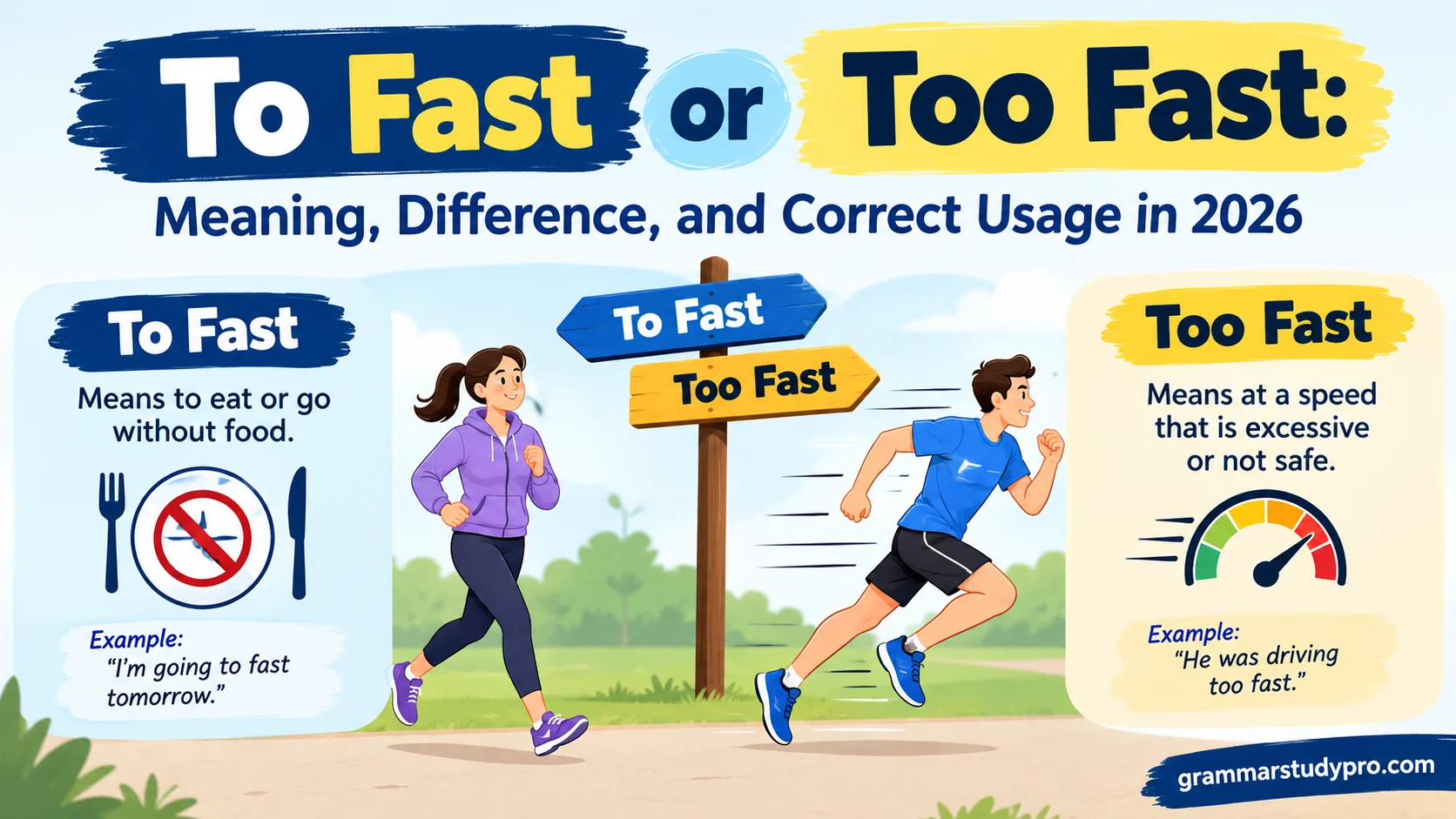
The to fast or too fast definition becomes clear when you separate to fast from too fast. To fast is a verb phrase meaning not to eat, while too fast is an adverb phrase describing extra speed or something excessively quick. As an instant takeaway, you can use to fast when talking about not eating, while you should use too fast for something moving very fast or more fast than needed. This common question often confuses English learners because to and too sound the same, although their meaning and usage are different.
The correct form for talking about speed is too fast in standard English. Here, too acts as an adverb of degree and expresses excess, a higher degree, or excessiveness. Something can be faster than acceptable, comfortable, expected, or appropriate for a particular situation. By contrast, to fast is usually incorrect when describing speed. However, its context can change its role because to fast may be the part of an infinitive verb with a different meaning, such as choosing to fast during a religious period. This distinction makes English writing, grammar, and sentence construction much clearer.
The short answer is that to fast connects with fasting, while too fast describes something happening quickly with excessive intensity. This small difference can change the sentence meaning and lead to spelling mistakes, incorrect usage, or a grammatically incorrect sentence. I find that asking learners to learn the simple rules first is an easy way to improve clarity and correctness. Check whether the sentence relates to eat, eating, or not to eat, or whether it describes being fast, very fast, or having extra speed. Clear examples, useful phrases, careful pronunciation, and basic grammar rules make the comparison easier and reduce common mistakes caused by pronunciation similarity.
Quick Answer
Use too fast when you mean excessively fast, faster than appropriate, or faster than someone can reasonably handle.
Use to fast when fast functions as a verb meaning to abstain from food.
| Expression | Correct meaning | Example |
| too fast | Excessively fast or at an unsuitable speed | “The car is going too fast.” |
| to fast | To abstain from food | “I need to fast before the test.” |
The easiest way to remember the difference is this:
Too fast = excessive speed.
To fast = the action of fasting.
If you’re talking about a car, runner, speaker, machine, video, or process moving at excessive speed, you generally want too fast.
If you’re talking about abstaining from food, to fast is the correct construction.
Comparison Overview
The difference becomes much easier when you see the two expressions side by side.
| Feature | Too Fast | To Fast |
| Word before fast | too | to |
| Main function | Modifies fast | Introduces the verb fast |
| Meaning | Excessively fast | Abstain from food |
| Related idea | Speed, pace, rate | Fasting |
| Example | “You’re walking too fast.” | “They decided to fast.” |
| Can describe movement? | Yes | No |
| Can describe excessive pace? | Yes | No |
| Can refer to abstaining from food? | No | Yes |
There’s an important grammatical detail hiding in this simple table.
In too fast, fast generally works as an adverb describing speed or manner. The word too modifies it by adding the idea of excess.
In to fast, to introduces the base-form verb fast. The phrase therefore means to abstain from food, not to move quickly.
The simplest test
Ask yourself:
Am I talking about excessive speed?
If yes, use too fast.
- “The car is going too fast.”
- “You’re typing too fast.”
- “The lesson is moving too fast.”
Am I talking about abstaining from food?
If yes, use to fast.
- “I plan to fast tomorrow.”
- “She needs to fast before the procedure.”
- “They chose to fast during the observance.”
That’s the entire distinction in practical terms.
Main Differences Between To Fast or Too Fast
The biggest difference between to fast and too fast isn’t pronunciation. It is meaning and grammatical function.
“Too Fast” Describes Excessive Speed
The word too often means more than is appropriate, desirable, necessary, or manageable.
Therefore, too fast doesn’t simply mean “fast.”
Compare these sentences:
- “The car is fast.”
- “The car is very fast.”
- “The car is too fast.”
Each sentence communicates something different.
Fast simply describes speed.
Very fast emphasizes a high level of speed.
Too fast says the speed has crossed a relevant limit or is unsuitable for the situation.
For example, a sports car might be very fast by design. Yet it could still be too fast for a particular road.
That distinction is one of the most useful things to understand about this expression.
“To Fast” Uses “Fast” as a Verb
In to fast, the word fast isn’t describing speed at all.
Instead, fast means to deliberately abstain from food for a period of time.
For example:
“I decided to fast tomorrow.”
Here, fast describes an action. The word to introduces that action in its infinitive form.
You can compare it with other infinitive constructions:
- to eat
- to sleep
- to exercise
- to pray
- to fast
The construction follows the same basic grammatical pattern.
The Meaning Changes Completely
Consider these two sentences:
“The runner started too fast.”
“The runner decided to fast.”
The first sentence concerns speed.
The second concerns abstaining from food.
The words differ by only one letter. Their meanings live in completely different neighborhoods.
What Does “Too Fast” Mean?
Too fast means that something happens at a speed or pace that exceeds what the speaker considers appropriate.
The exact limit depends on the context.
For example, a car traveling 50 miles per hour might be perfectly reasonable on one road. On another road, that same speed could be too fast.
Likewise, a person speaking quickly might be perfectly understandable to one listener but too fast for another listener.
The phrase therefore depends partly on an implied or stated standard.
“Too” Means More Than Appropriate
English uses too to express excess.
You can see the same pattern in:
- too loud
- too expensive
- too difficult
- too late
- too hot
- too slowly
- too quickly
- too fast
Consider:
“The music is loud.”
That describes volume.
“The music is too loud.”
Now the sentence says the volume has exceeded an acceptable level.
The same relationship appears in:
“She talks fast.”
versus:
“She talks too fast.”
The second sentence suggests that her speaking speed makes communication difficult or otherwise exceeds what the listener expects.
Cambridge’s grammar guidance describes this use of too as expressing an excessive degree.
Examples of “Too Fast”
Driving:
“You’re driving too fast.”
The speaker believes the vehicle’s speed is excessive for the circumstances.
Speaking:
“He talks too fast for new students.”
The speaking pace makes comprehension difficult.
Running:
“She started too fast and struggled near the end.”
The runner used an excessively rapid pace early in the race.
Technology:
“The video is playing too fast.”
The playback speed exceeds the desired rate.
Learning:
“The class is moving too fast for beginners.”
The pace of instruction exceeds what the learners can comfortably follow.
Machinery:
“The motor is spinning too fast.”
The machine is operating above an appropriate rate.
Notice the common thread. Every example involves speed, pace, or rate.
What Does “To Fast” Mean?
To fast means to abstain from food.
The word fast has existed as a verb for centuries. Modern English still uses it in religious, medical, personal, and other contexts.
For example:
“I need to fast before the procedure.”
Here, fast is an action. The sentence doesn’t say anything about speed.
Examples of “To Fast”
- “I plan to fast tomorrow.”
- “She needs to fast before the blood test.”
- “They decided to fast during the observance.”
- “He chose to fast for a day.”
- “You may be instructed to fast before certain medical tests.”
The phrase is grammatically correct whenever fast functions as a verb with this meaning.
“To Fast” Has Nothing to Do With Speed
This is the crucial point.
If someone writes:
“I want to fast.”
the sentence doesn’t mean:
“I want to move quickly.”
It means:
“I want to abstain from food.”
Likewise:
“She decided to fast.”
means she decided to abstain from food.
That semantic difference makes the spelling choice much easier.
To vs. Too: The Grammar Behind the Difference
Understanding to and too makes the distinction much more intuitive.
How “To” Works
To has several functions in English. One of the most important here is its role as an infinitive marker.
Examples include:
- to run
- to write
- to study
- to sleep
- to fast
In each case, to comes before the base form of a verb.
Therefore:
“I need to fast.”
follows a standard English pattern.
The word fast is the verb.
How “Too” Works
Too is an adverb.
In the relevant construction, it expresses an excessive degree.
Examples include:
- too fast
- too slow
- too expensive
- too difficult
- too loud
- too early
So:
“The car is too fast.”
uses too to modify the idea of speed represented by fast.
Cambridge’s grammar guidance also identifies too as an adverb with meanings including excessive degree and “also.”
“Too” Can Also Mean “Also”
Don’t confuse the relevant meaning of too with its second common meaning.
For example:
“I want to go too.”
Here, too means also.
That meaning has nothing to do with too fast.
In:
“The car is too fast.”
too means that the speed exceeds an appropriate level.
Context does the heavy lifting.
Why “Too Fast” Is Correct When Talking About Speed
Let’s break down a simple sentence:
“The driver was going too fast.”
The verb phrase was going describes the action.
The word fast tells us about the manner or speed of that action.
The word too modifies fast by indicating excess.
Together, too fast means the driver was traveling at an excessive speed.
Now remove too:
“The driver was going fast.”
The sentence remains grammatical. However, the meaning changes.
It now simply says the driver was traveling quickly.
There is no necessary suggestion that the speed was inappropriate.
Fast vs. Very Fast vs. Too Fast
This distinction deserves attention because writers often treat very and too as interchangeable.
They aren’t.
| Expression | What it communicates |
| fast | High speed |
| very fast | Emphasized high speed |
| too fast | Excessive or unsuitable speed |
| way too fast | Strongly excessive speed |
Consider a professional racing driver.
“The car is very fast.”
That’s a neutral description of impressive speed.
But:
“The car is too fast for this narrow track.”
Now the speed creates a problem within a particular context.
Very increases emphasis.
Too introduces excess.
That distinction appears throughout English:
- very expensive ≠ too expensive
- very loud ≠ too loud
- very difficult ≠ too difficult
- very early ≠ too early
Fast Can Be an Adjective, Adverb, Verb, or Noun
The word fast has more grammatical flexibility than many learners realize.
| Function | Example | Meaning |
| Adjective | “That’s a fast car.” | A car capable of high speed |
| Adverb | “The car moves fast.” | At high speed |
| Verb | “I decided to fast.” | Abstain from food |
| Noun | “They broke their fast.” | A period of fasting |
This explains why to fast can be completely correct.
The word isn’t locked into its speed-related meaning.
Fast as an Adjective
When fast describes a noun, it can function as an adjective.
“She owns a fast motorcycle.”
Here, fast tells us about the motorcycle.
Fast as an Adverb
When fast describes how an action happens, it can function as an adverb.
“She runs fast.”
It tells us about the speed of running.
Add too:
“She runs too fast.”
Now the phrase expresses excessive speed.
Fast as a Verb
As a verb, fast has a completely different meaning.
“She decided to fast.”
The action involves abstaining from food.
Fast as a Noun
You can also encounter fast as a noun:
“They broke their fast at sunset.”
Here, fast refers to the period of abstaining from food.
This broader grammatical picture makes the to fast vs. too fast distinction much easier to understand.
“Driving Too Fast” vs. “Driving To Fast”
This is one of the most common forms of the mistake.
Correct: Driving Too Fast
“He was driving too fast.”
The sentence says his speed was excessive or unsuitable.
Incorrect: Driving To Fast
“He was driving to fast.”
This spelling doesn’t correctly express the intended meaning.
The problem isn’t that to fast can never exist. It can.
The problem is that fast doesn’t mean “drive quickly” when used as a verb after to.
Compare:
“He was driving too fast.”
with:
“He decided to fast.”
The first concerns speed.
The second concerns abstaining from food.
“Way Too Fast” or “Way To Fast”?
The correct expression for excessive speed is:
way too fast
For example:
- “That car was going way too fast.”
- “The speaker talked way too fast.”
- “The video is playing way too fast.”
- “The process moved way too fast for proper testing.”
Here, way intensifies the phrase too fast.
The phrase way to fast doesn’t express that meaning.
Why “Way Too Fast” Works
Think of the structure like this:
way + too + fast
- way = strongly intensifies the degree
- too = expresses excess
- fast = expresses speed
The result is a stronger version of too fast.
“Too Fast for Me” vs. “To Fast for Me”
The correct phrase is:
too fast for me
For example:
“You’re walking too fast for me.”
The expression for me identifies the person for whom the speed is excessive.
You can use the same pattern in many situations:
- “You’re speaking too fast for me.”
- “The instructor is explaining this too fast for beginners.”
- “The children are running too fast for their parents.”
- “The course is moving too fast for new students.”
This construction is particularly useful because it makes the implied standard explicit.
Instead of simply saying something is fast, you’re saying it exceeds someone’s ability or preference to keep up.
The “Too Fast to…” Sentence Pattern
English commonly uses the structure:
too + adjective/adverb + to + verb
That creates an interesting situation because too and to can appear next to the same idea without causing an error.
Consider:
“The car was too fast to stop safely.”
Here:
- too fast = excessively fast
- to stop = infinitive phrase
Another example:
“She spoke too fast to understand.”
Again, the two words have completely different functions.
Too expresses excessive speed.
To introduces the verb understand.
Other examples include:
- “The machine was too fast to control.”
- “The runner started too fast to maintain that pace.”
- “The video played too fast to follow the details.”
- “The speaker talked too fast to take notes comfortably.”
This pattern proves why you shouldn’t choose between to and too simply by looking at neighboring words. You need to examine what each word is doing.
Can “To Fast” and “Too Fast” Appear in the Same Sentence?
Yes, English can place both expressions in the same sentence when their meanings are different.
For example:
“The instructions warned us not to move too fast while preparing to fast.”
The first expression relates to movement.
The second relates to abstaining from food.
The sentence may sound unusual because the two ideas don’t naturally belong together. Grammatically, however, the constructions demonstrate an important principle:
The same word can participate in different grammatical structures.
In normal writing, you probably won’t need such a sentence. Still, understanding it prevents an overly rigid rule such as “never use to fast.”
Common Mistakes With To Fast and Too Fast
The confusion tends to follow a few predictable patterns.
Mistake 1: Using “To Fast” for Excessive Speed
Incorrect:
“The driver was going to fast.”
Correct:
“The driver was going too fast.”
The intended meaning concerns excessive speed.
Mistake 2: Treating “Too” as a Fancy Version of “Very”
This can subtly change meaning.
“The engine is very fast.”
means the engine operates at high speed.
“The engine is too fast.”
suggests the speed is excessive for the relevant purpose.
The difference can matter in technical, professional, and everyday writing.
Mistake 3: Assuming “To Fast” Is Always Wrong
This rule is simply too broad.
Correct:
“I have to fast before the examination.”
Here, to fast is part of the infinitive construction have to fast.
The sentence means the person must abstain from food.
Mistake 4: Relying Entirely on Spell-Check
This mistake is easy to make because to and too are both legitimate English words.
A spell-checker may recognize either one as correctly spelled.
That doesn’t mean you’ve used the right word.
Grammar requires more than spelling. It requires context.
How to Remember “Too Fast” Easily
A few simple tests can save you from repeatedly making the same mistake.
Memory Trick: “Too” Means Extra
A popular memory aid is:
Too has an extra O because it means something extra.
So:
too fast = extra speed
This isn’t the grammatical reason for the spelling. It’s simply an easy way to remember it.
Replace “Too” With “Excessively”
This is an even more useful test.
Take:
“The car is too fast.”
Replace too with excessively:
“The car is excessively fast.”
If the meaning still works, too fast is probably what you need.
Try another:
“She speaks too fast.”
Becomes:
“She speaks excessively fast.”
The wording is less natural in casual conversation, but the underlying meaning remains clear.
Ask What “Fast” Means
If fast means abstain from food, use to fast.
If you’re describing excessive speed, use too fast.
This meaning-based test is more reliable than memorizing isolated spellings.
A Simple Decision Guide for To Fast or Too Fast
When you’re unsure, follow this sequence.
Step 1: Identify the meaning of “fast.”
Does it relate to speed?
- Yes → continue.
Does it mean abstaining from food?
- Yes → use to fast when the grammar requires an infinitive.
Step 2: If you’re talking about speed, ask whether the speed is excessive.
- Excessive → too fast
- Merely describing high speed → fast
- Strongly emphasizing high speed → very fast
Step 3: Look at the sentence structure.
If to introduces a verb, it may be the infinitive marker:
“I want to fast.”
If too modifies fast, it expresses excess:
“You’re going too fast.”
This three-step check works better than relying on how the words sound.
Examples: To Fast or Too Fast?
The following examples show how the correct choice changes with context.
| Sentence | Correct choice | Explanation |
| “You’re driving ___ fast.” | too | The speed is excessive. |
| “I need ___ fast before the test.” | to | Fast means abstain from food. |
| “She talks ___ fast.” | too | Her speaking speed is excessive. |
| “They decided ___ fast.” | to | Fast is a verb. |
| “The video is playing ___ fast.” | too | Playback speed is excessive. |
| “He plans ___ fast tomorrow.” | to | He plans to abstain from food. |
| “The runner started ___ fast.” | too | The initial pace was excessive. |
| “The machine is moving ___ fast.” | too | The machine’s speed is excessive. |
| “She wants ___ fast during the observance.” | to | Fast means abstain from food. |
| “The course is moving ___ fast.” | too | The pace exceeds what the learner can follow. |
Case Study: Why Context Changes the Correct Word
Imagine two people named Alex.
Alex A is driving a car.
A passenger says:
“You’re going too fast.”
The phrase concerns the vehicle’s speed. Too is correct because the passenger considers the speed excessive.
Now imagine Alex B preparing for a period of fasting.
Alex B says:
“I need to fast tomorrow.”
Here, fast functions as a verb. To introduces that verb.
The spelling difference is tiny. The semantic difference is enormous.
This is why proofreading by sound alone can fail. To and too are commonly pronounced alike in ordinary English speech. Writing forces you to reveal the grammatical relationship that speech can hide.
Related To and Too Confusions
The to fast or too fast problem belongs to a larger group of commonly confused words.
To vs. Too
“I went to the store.”
Here, to functions as a preposition.
“I want to go too.”
Here, too means also.
Too vs. Two
“The car is too fast.”
“I have two cars.”
The words sound alike in many varieties of English, but their meanings and spellings differ.
To Before a Verb
“I want to run.”
The word to introduces the verb run.
Compare that with:
“I run too fast.”
Here, too modifies fast.
The pattern becomes much easier once you identify the grammatical role of each word.
How to Use “Too Fast” in Everyday Writing
The expression works naturally in many settings.
In Conversation
“You’re walking too fast.”
“Can you slow down? You’re talking too fast.”
These are ordinary conversational uses.
In Academic Writing
“The reaction occurred too fast to measure accurately.”
The phrase describes a rate that exceeds the practical limit of the measurement process.
In Professional Writing
“The process is moving too fast to complete the required checks.”
Here, too fast describes a workflow whose pace creates a practical problem.
In Creative Writing
“The river rose too fast for anyone to cross.”
The phrase can also create tension by showing that an event is moving beyond someone’s ability to respond.
The expression itself isn’t informal or formal. Context determines the register.
When “Fast” Alone Is Better Than “Too Fast”
Not every sentence about speed needs too.
If you simply want to describe high speed, use fast.
“The train travels fast.”
If you want stronger emphasis without suggesting a problem:
“The train travels very fast.”
Use too fast when you want to communicate that the speed has exceeded a relevant boundary.
“The train is traveling too fast for the conditions.”
That distinction keeps your writing precise.
FAQs
Is “too fast” correct?
Yes, “too fast” is correct when you mean something is moving or happening at a speed that is more than necessary, comfortable, or appropriate. For example, “The car is going too fast.”
Is “to fast” ever correct?
Yes. “To fast” can be correct when fast is used as a verb meaning not to eat. For example, “She decided to fast during the religious period.”
What is the difference between “to fast” and “too fast”?
“To fast” means not to eat, while “too fast” describes excessive speed. The words have different grammatical roles and meanings, even though to and too sound the same.
Why do people confuse “to” and “too” in “too fast”?
People often confuse them because “to” and “too” have the same pronunciation in standard English. However, to can function as a preposition or part of an infinitive, while too can express excess or a higher degree.
Should I write “to fast” or “too fast” when talking about speed?
Use “too fast” when talking about speed. For example, “You are driving too fast.” Use “to fast” only when fast means not eating.
Conclusion
The difference between to fast and too fast becomes easy once you focus on meaning and context. Use “to fast” when you mean not to eat, and use “too fast” when something happens at an excessive speed. Remembering this simple distinction can help you avoid common spelling and grammar mistakes and make your English writing clearer.