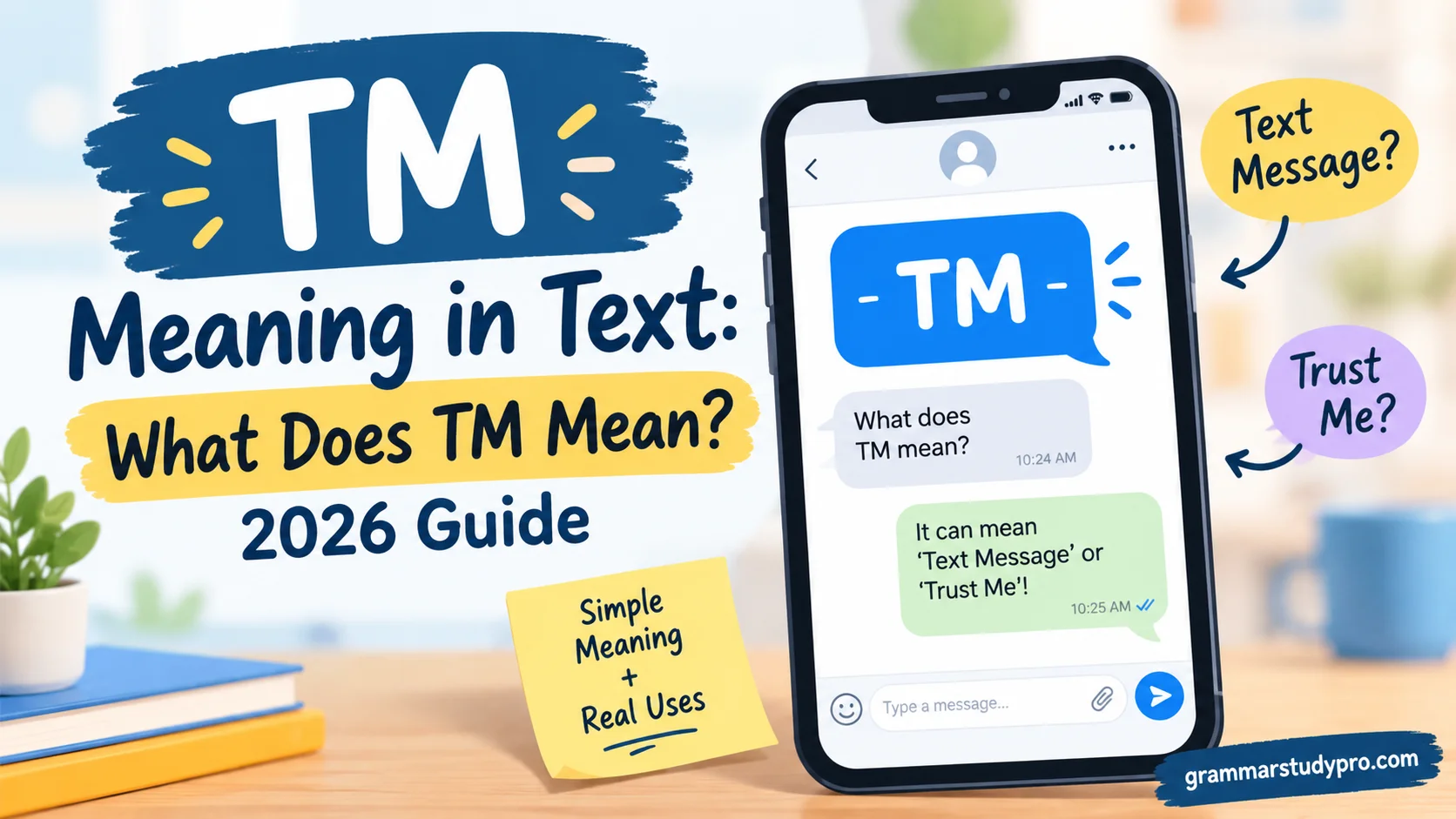
TM Meaning in Text depends on the conversation and platform, as it can mean Text Message, Trust Me, Too Much, or Trademark. The internet has changed modern communication, encouraging people to use abbreviations and short forms to save time while typing. These expressions appear in everyday texting, casual conversations, and online conversations. Understanding the context, conversation style, and sender’s intent helps you interpret the abbreviation correctly and avoid confusion.
In text messaging, mobile messaging, and messaging platforms, TM can refer to a Text Message or a message sent through text. People use this short form in chats, informal chats, and written messages to keep communication simple and quick. It appears in online messaging and social networking platforms such as TikTok, Snapchat, Instagram, and WhatsApp. These communication shortcuts help people type faster and share information through digital conversations and casual messaging. For example, “Send me the TM” might refer to a text message. Reading the entire message instead of guessing from two letters improves message interpretation, language interpretation, and messaging etiquette.
TM also has different uses depending on the situation. In informal language, online slang, and internet slang, Trust Me expresses trust, emphasizes honesty, or communicates a statement of trust. Too Much can describe an excessive amount or add emphasis to a reaction. In formal discussions and business-related discussions, Trademark relates to brand protection, brand identity, and intellectual property. These context-dependent meanings explain why the TM abbreviation has multiple interpretations across social media communication, online interaction, and texting habits. Understanding its abbreviation meaning, digital language, texting style, and communication trends helps you recognize the intended meaning in real-life applications, everyday conversations, smartphone messaging, and text-based communication.
Quick Answer:
TM most commonly means “tomorrow” when used as an informal texting abbreviation.
For example:
“I’ll call you tm.”
means:
“I’ll call you tomorrow.”
The abbreviation is documented as internet slang and text-message shorthand for tomorrow.
But TM doesn’t have one universal meaning. Depending on the conversation, it can refer to other expressions or to trademark.
| TM meaning | Typical context | Example |
| Tomorrow | Casual texting and planning | “See you tm.” |
| Trademark | Business, branding, intellectual property | “BrandName™” |
| Text message | Some conversations about messaging | “Send me a TM.” |
| Text me | Context-dependent casual shorthand | “TM when you arrive.” |
| Too much | Informal, community-specific slang | “That was TM.” |
| Trust me | Informal, context-dependent shorthand | “TM, it’s worth it.” |
The first two meanings deserve the most attention because they have clear, established usage. Other expansions appear in slang references, but they aren’t universal. Context should decide the interpretation rather than a generic abbreviation list.
What Does TM Mean in Texting?
In ordinary texting, tm can mean “tomorrow.” It works as a compact shortcut when people discuss something happening the following day.
You’ll usually see it in messages about:
- Plans
- Meetings
- School
- Work
- Appointments
- Deadlines
- Events
- Travel
- Deliveries
- Everyday errands
For example:
“Are you free tm?”
means “Are you free tomorrow?”
Likewise:
“I’ll send the file tm.”
means “I’ll send the file tomorrow.”
The pattern is easy to spot once you know what to look for. When tm appears near a time, date, plan, or future activity, “tomorrow” becomes the natural interpretation.
Examples of TM Meaning Tomorrow
| Text | Meaning |
| “See you tm.” | See you tomorrow. |
| “Can we talk tm?” | Can we talk tomorrow? |
| “I’ll finish it tm.” | I’ll finish it tomorrow. |
| “Are you working tm?” | Are you working tomorrow? |
| “Meeting tm at 10?” | Meeting tomorrow at 10? |
| “I’ll send it tm morning.” | I’ll send it tomorrow morning. |
This usage is informal. It belongs in a quick message much more naturally than in a formal report or business letter.
Why Do People Use TM for Tomorrow?
The reason is simple: texting rewards brevity.
Typing “tomorrow” takes several more keystrokes than “tm.” When you’re sending a quick message, that small shortcut can make the conversation feel faster and more casual.
The same basic idea explains abbreviations such as TMR and TMRW. People shorten familiar words because the surrounding conversation supplies the missing information.
Think of it like taking a shortcut through a familiar neighborhood. You remove some distance because you already know where you’re going.
TM, TMR, and TMRW
| Abbreviation | Meaning | Typical style |
| tm | Tomorrow | Very short |
| tmr | Tomorrow | Casual |
| tmrw | Tomorrow | Casual and often clearer |
| tomorrow | Tomorrow | Standard English |
There isn’t a formal rule requiring people to choose one version. Personal texting habits vary.
If clarity matters, spelling out tomorrow is always the safest option.
What Does TM Mean in a Text Message?
A message containing TM can have several interpretations. The sentence itself usually provides the strongest clue.
“I’ll see you tm.”
Here, tm almost certainly means tomorrow.
The verb “see” refers to a future meeting, so the time-related interpretation fits naturally.
“TM when you get home.”
This sentence can be more ambiguous.
Depending on the sender’s habits, TM could mean “text me.” In other words, the intended message could be “Text me when you get home.”
That’s why reading only the two letters isn’t enough. Look at the grammar around them.
“BrandName TM”
Here, the meaning changes completely.
The phrase likely refers to a trademark, particularly if the conversation involves branding, products, logos, or intellectual property.
TM Meaning as Trademark
Outside texting slang, TM commonly means “trademark.” Cambridge Dictionary lists TM as a written abbreviation for trademark.
A trademark can identify a business’s goods or services through a name, symbol, design, or phrase. In the United States, the USPTO explains that a person or business can use TM for goods to indicate a claimed trademark even without filing an application for federal registration.
For example:
FreshPeak™
The ™ tells readers that FreshPeak is being claimed as a trademark.
That’s completely different from:
“I’ll call you tm.”
The first concerns branding. The second concerns tomorrow.
What Does the ™ Symbol Mean?
The symbol ™ identifies a trademark claim.
According to the USPTO, you can use TM with goods even if you haven’t filed a trademark application. For services, the corresponding designation is SM. Once a trademark receives federal registration, the owner can use ® for the registered mark in connection with the registered goods or services.
That distinction matters because ™ does not mean federally registered.
TM vs. ™ vs. ®
| Mark | Meaning | Basic use |
| TM | Trademark | Indicates a claimed trademark for goods |
| ™ | Trademark symbol | Visual symbol representing a trademark claim |
| SM | Service mark | Used for services |
| ® | Registered trademark | Used for a federally registered trademark |
The USPTO specifically says that ® should not be used until the mark is registered. A pending application isn’t enough.
For authoritative U.S. trademark guidance, see the USPTO trademark basics guide.
How to Tell What TM Means From Context
Context is your best decoder.
When you encounter TM, don’t immediately expand it into the first definition that comes to mind. Instead, look at what the sender is talking about.
Check what comes before TM
If you see:
“See you tm.”
The preceding words establish a time-related context.
Tomorrow makes sense.
If you see:
“CoolBrand™”
The word before TM is a brand name.
Trademark makes sense.
Check what comes after TM
Consider:
“TM when you land.”
That structure may suggest “text me when you land.”
Now compare:
“I’ll call you tm.”
That sentence points toward tomorrow.
Check the conversation topic
If you’re discussing:
- Weekend plans → tomorrow may fit.
- A new company name → trademark may fit.
- Messaging someone → text me/text message may fit.
- A dramatic situation → another slang interpretation might fit.
The surrounding topic acts like a signpost.
A Simple Way to Decode TM
When you see TM, use this quick process:
- Read the whole sentence.
- Look for references to time or future plans.
- Check whether TM appears beside a brand or product.
- Consider whether the person is talking about texting.
- Look at the sender’s usual writing style.
- If two meanings still fit, ask what they meant.
That final step isn’t awkward. It can save you from an unnecessarily confusing conversation.
A simple “Do you mean tomorrow?” clears things up immediately.
TM Meaning in Social Media
The same contextual rule applies across social platforms.
You may encounter tm in:
- Instagram DMs
- Snapchat messages
- TikTok comments
- WhatsApp chats
- Discord conversations
- Facebook Messenger
- X replies
- Group chats
However, the platform itself doesn’t automatically give TM one fixed definition.
For example, a friend writing:
“See you tm 😂”
is probably using tm as shorthand for tomorrow.
A creator writing:
“My signature phrase™”
is using the trademark idea playfully.
Social media also encourages ironic uses of ™. Someone might attach the symbol to a funny phrase as though they’re claiming ownership of it. That’s a cultural use of the trademark symbol rather than a literal statement about legal registration.
TM Meaning on Instagram
On Instagram, tm can appear in ordinary DMs or comments where someone is shortening “tomorrow.”
For example:
“Coming tm?”
could mean:
“Coming tomorrow?”
However, Instagram also provides fertile ground for playful trademark-style usage.
Someone might write:
“Main character energy™”
The ™ isn’t necessarily a serious legal claim. It can simply add a humorous “this phrase belongs to me” effect.
The distinction comes from context.
TM Meaning on Snapchat
Snapchat conversations often favor short, fast messages. That makes abbreviations useful.
If someone says:
“See u tm”
the intended meaning is straightforward: see you tomorrow.
If the abbreviation appears in a joke, caption, or phrase rather than a scheduling conversation, the interpretation may change.
Again, the surrounding words do the heavy lifting.
TM Meaning on WhatsApp
WhatsApp doesn’t assign an official slang definition to TM. People use abbreviations according to their own language habits and communities.
In a conversation about plans:
“Let’s meet tm.”
naturally reads as “Let’s meet tomorrow.”
In another conversation, however, TM could carry a different meaning.
That flexibility is one reason short abbreviations can be both convenient and confusing.
TM Meaning in Different Conversations
The same two letters can behave differently depending on the setting.
Casual conversation
“I’ll see you tm.”
Meaning: Tomorrow.
Work chat
“Let’s discuss this tm.”
Meaning: Usually tomorrow if the conversation concerns scheduling.
Branding conversation
“Should we add TM to the name?”
Meaning: Trademark.
Messaging conversation
“Send me a TM when you’re ready.”
Meaning: Potentially text message, depending on the speaker’s terminology.
Specialized group
“Ask another TM.”
Meaning: Could be an internal abbreviation such as team member.
That last example shows why blindly memorizing slang lists can lead you astray. A workplace, gaming group, school, or organization may create its own shorthand.
TM vs. Text Me
One particularly tricky interpretation is “text me.”
Some slang references list TM as a possible abbreviation for “text me.”
Consider:
“TM when you arrive.”
If the sender means “Text me when you arrive,” the sentence works naturally.
Now compare:
“I’ll arrive tm.”
Here, “tomorrow” makes much more sense.
The grammatical position matters.
| Message | Likely interpretation |
| “I’ll see you tm.” | Tomorrow |
| “Are you free tm?” | Tomorrow |
| “TM when you get home.” | Potentially text me |
| “I’ll finish it tm.” | Tomorrow |
| “TM me when you’re free.” | Text me, depending on usage |
If the sentence sounds unnatural after expanding TM to “tomorrow,” test another plausible meaning.
TM vs. Trust Me and Too Much
You may also see websites and slang references list TM as “trust me” or “too much.” These uses exist in some online communities, but they aren’t universal meanings of TM.
For example:
“TM, you’ll love this.”
could be interpreted as “Trust me, you’ll love this.”
Likewise:
“That exam was TM.”
could be intended as “too much.”
But neither interpretation should automatically override “tomorrow.” The sentence has to support it.
Why These Meanings Cause Confusion
Short abbreviations often lose information.
“Tomorrow” has a clear dictionary meaning. TM strips away most of the word while leaving only two letters.
“Trust me” and “too much” create the same problem.
Once multiple phrases share the same shorthand, context becomes essential.
TM Meaning in Business and Branding
The trademark meaning deserves extra care because it has a legal dimension.
A trademark can help distinguish one business’s goods or services from those of others. The USPTO explains that trademark rights can arise through use, although federal registration provides broader protections in the United States.
That means TM isn’t simply decorative punctuation when used in a genuine branding context.
A company might use:
RiverStone™
to indicate that it is claiming RiverStone as a trademark.
The exact legal rights attached to a trademark depend on factors such as jurisdiction, use, registration, and the goods or services involved. Trademark law isn’t identical everywhere, so readers shouldn’t treat a general explanation as jurisdiction-specific legal advice.
Case Study: Why Context Changes the TM Meaning
Imagine two messages arriving five minutes apart.
Message A
“Can you finish the presentation tm?”
The conversation concerns a deadline.
Here, tm = tomorrow.
Message B
“We should protect the new brand name with TM.”
The conversation concerns intellectual property.
Here, TM = trademark.
Nothing about the letters changed. The subject changed.
That’s the central lesson behind the entire TM meaning in text question.
Common Mistakes People Make With TM
Assuming TM always means tomorrow
This works in many casual messages, but it fails around brands and intellectual property.
Assuming TM always means trademark
This creates an equally strange result in a sentence such as:
“I’ll call you trademark.”
Context matters.
Treating TM and ® as interchangeable
They’re not.
The USPTO distinguishes the trademark designation TM from the federal registration symbol ®.
Treating every slang website as equally authoritative
Internet slang changes quickly. Community-created meanings can spread without becoming universal.
Established dictionary definitions and official trademark guidance provide stronger evidence for formal meanings. Cambridge, for example, defines TM as a written abbreviation for trademark.
Using TM in formal writing
If you’re writing an email, report, application, or academic assignment, abbreviating “tomorrow” as tm can look overly casual.
Write:
“I’ll send the report tomorrow.”
instead of:
“I’ll send the report tm.”
Clarity usually wins.
Is TM Formal or Informal?
It depends on what TM means.
When tm means tomorrow, the usage is informal texting shorthand. It works well in casual messages but doesn’t belong in most polished professional writing.
When TM means trademark, the abbreviation has an established business and legal meaning. Cambridge specifically lists TM as a written abbreviation for trademark.
So the same letters can occupy completely different registers.
| Use | Formality |
| “See you tm.” | Informal |
| “I’ll finish it tm.” | Informal |
| “BrandName™” | Standard branding notation |
| “TM” in a trademark discussion | Formal/business context |
| “Tomorrow” in a business email | Standard and clear |
TM vs. Similar Texting Abbreviations
If you’re learning texting shorthand, TM isn’t the only abbreviation for tomorrow.
| Abbreviation | Meaning |
| TM | Tomorrow |
| TMR | Tomorrow |
| TMRW | Tomorrow |
| TTYL | Talk to you later |
| BRB | Be right back |
| BTW | By the way |
| TBH | To be honest |
| IDK | I don’t know |
These abbreviations aren’t interchangeable. TMRW, for example, makes “tomorrow” more obvious than TM because it retains more of the original word.
Is TM Rude in Texting?
No. TM isn’t inherently rude.
A short abbreviation can feel blunt if the entire message is abrupt. Yet that’s a matter of tone rather than the abbreviation itself.
Compare:
“See you tm!”
with:
“Whatever. tm.”
The first sounds friendly. The second could sound dismissive.
Punctuation, word choice, emojis, relationship, and conversation history all influence tone.
Does Capitalization Change the TM Meaning?
Usually, capitalization alone doesn’t settle the meaning.
You may see:
- tm
- TM
- Tm
In casual texting, capitalization often reflects a person’s typing habits rather than a different definition.
However, capitalization can sometimes provide a clue when you’re dealing with a formal acronym or a branded term. It still shouldn’t outweigh the sentence itself.
FAQs
What does TM mean in text messages?
TM usually means Text Message in texting contexts. However, it can also mean Trust Me, Too Much, or Trademark, depending on the conversation and the sender’s intent.
What does TM mean on social media?
On platforms like TikTok, Snapchat, Instagram, and WhatsApp, TM can have different meanings. The surrounding message helps you understand whether someone means a text message, expresses trust, or uses another interpretation.
Does TM mean Trust Me in texting?
Yes, TM can stand for Trust Me. Someone might use it to emphasize honesty or reassure another person. For example, “TM, everything will be fine” means “Trust me, everything will be fine.”
What does TM mean in business or formal writing?
In business communication, TM commonly refers to a trademark. The symbol ™ is used with a name, logo, or phrase to indicate a claimed trademark. Its legal meaning can depend on the country and circumstances.
How can I understand the correct meaning of TM?
Read the complete message and consider the topic, platform, and relationship with the sender. If the meaning remains unclear, ask the person what they meant. This simple step helps prevent misunderstandings.
Conclusion
Understanding TM Meaning in Text becomes easier when you consider the context. It can mean Text Message, Trust Me, Too Much, or Trademark, depending on how someone uses it. Although abbreviations make online conversations faster and more convenient, the same letters can communicate different ideas.
Pay attention to the surrounding words and the situation before deciding what TM means. When you’re unsure, asking for clarification is the easiest way to understand the sender’s intended message.