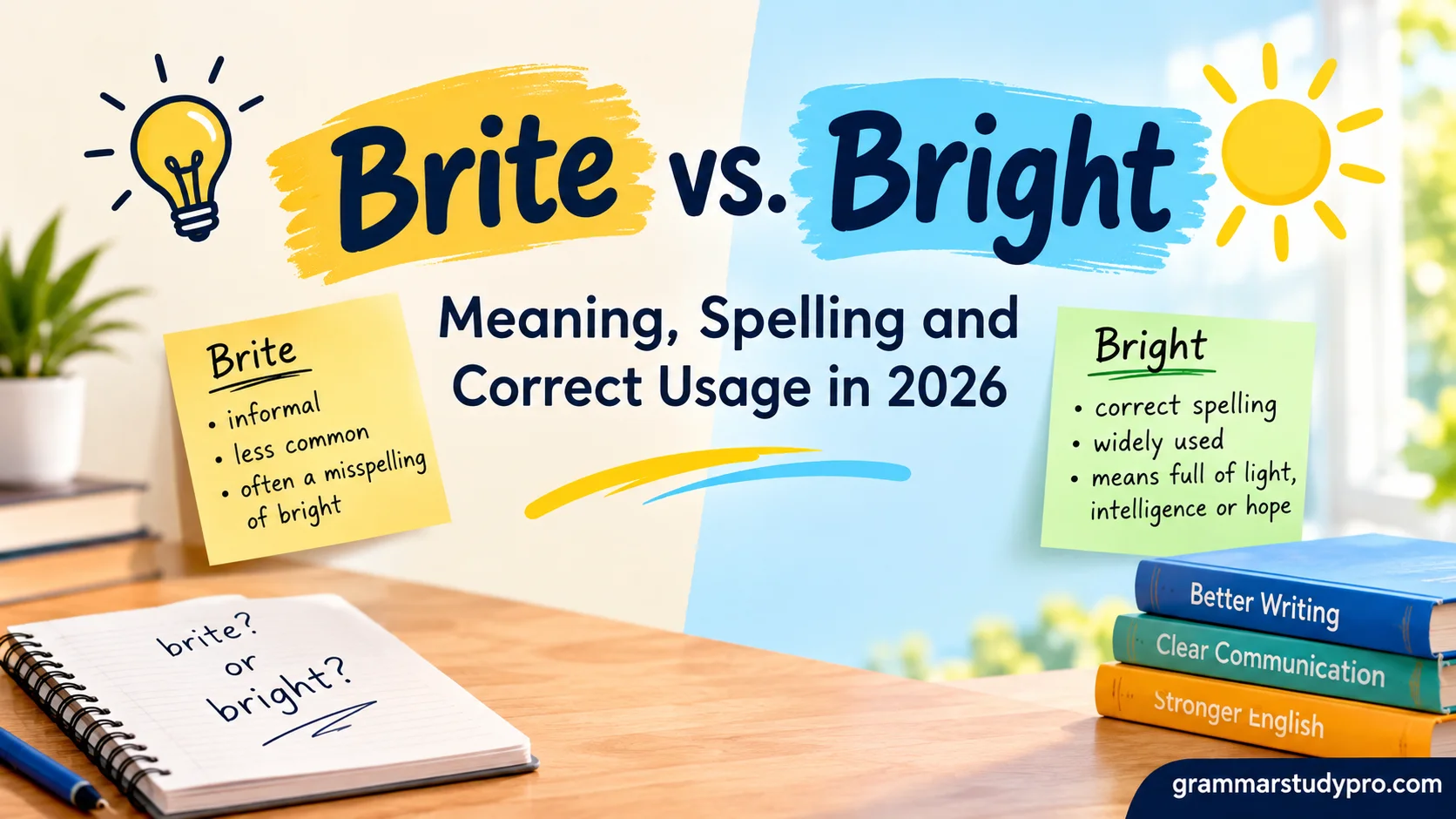
Brite vs. Bright often confuses English students because these similar words can sound identical, but their spelling and uses differ in writing tasks. Their meanings, uses, and spelling depend on standard, formal contexts. Bright is the correct, grammatically accepted spelling and is listed in official dictionaries. It can describe things that emit light, such as the sun today, or an intelligent person. From my teaching experience, I find that learners become easier with this difference through practice and soon understand it as second nature.
The standard spelling Bright belongs in normal English, academic work, professional Communication, and everyday communication. A bright room describes a place connected with light, while choosing the correct choice can completely change the meaning of a sentence and affect its message. The dictionary has recognized this usage, so People who feel Confused by these forms can improve their writing by learning when each spelling is appropriate. By contrast, Brite is a stylized spelling, branded spelling, or playful variation that appears in brand names, products, and historical contexts. For instance, StarBrite Toothpaste and Brite Light use Brite as a product name for a creative effect. It can be acceptable in informal settings, but it does not replace Bright in regular prose.
The spelling convention depends on the purpose, including naming, style, or a brand name. This choice helps learners reduce confusion, use words correctly, enjoy reading, and build confidence. It also helps them remember that word choice can entirely shape the message.
Quick Answer
Bright is the standard English spelling for the ordinary word. Use it when you’re talking about light, colors, intelligence, cheerfulness, or something promising.
Brite can appear as a deliberate spelling in a brand, product, proper name, historical source, or specialized context. It shouldn’t normally replace bright in ordinary English sentences.
For example:
- Correct: The room is bright.
- Correct: She wore a bright red jacket.
- Correct: He’s a bright student.
- Correct: They have a bright future.
- Not standard: The room is brite.
- Not standard: She’s a brite student.
However, if Brite is part of an official name, keep the spelling exactly as the name uses it.
The easiest rule to remember
Use “bright” for the normal English word. Keep “Brite” when it is an intentional name or specialized form.
Comparison Overview
The biggest difference between brite vs. bright isn’t pronunciation. It’s usage and status.
| Feature | Bright | Brite |
| Standard English spelling | Yes | No, not for the ordinary adjective |
| Common everyday word | Yes | No |
| Describes light | Yes | Not normally |
| Describes vivid colors | Yes | Not normally |
| Describes intelligence | Yes | Not normally |
| Describes happiness or hope | Yes | Not normally |
| Common in ordinary writing | Yes | No |
| Can appear in names | Yes | Yes |
| Can appear in branding | Yes | Yes |
| Historical variant | Established form | Documented variant |
| US pronunciation of bright | /braɪt/ | Often represents the same sound |
| Use in school or business writing | Bright | Usually avoid unless it is a proper name |
Cambridge defines bright as an adjective meaning full of light, strong in color, intelligent, or full of hope. It also records noun and other established uses.
Meanwhile, Etymonline identifies brite as a spelling variant of bright. It also traces its appearance in phonetic spelling and advertising to the late 19th and early 20th centuries.
That gives you an important distinction:
Bright is a normal vocabulary word. Brite is usually a context-dependent spelling.
Main Differences Between Brite and Bright
At first glance, the difference appears to be only two letters: bright contains gh, while brite does not.
The real difference goes deeper than spelling.
Bright is the standard English word
Bright belongs to ordinary English vocabulary. You can use it naturally in everyday conversation, academic writing, professional documents, journalism, fiction, and countless other settings.
It works as an adjective in sentences such as:
- a bright room
- a bright color
- a bright student
- a bright idea
- a bright future
- a bright smile
Oxford’s American English dictionary likewise lists bright for meanings involving light, color, cheerfulness, and intelligence.
Brite is usually context-specific
Brite doesn’t normally function as the everyday replacement for bright.
Instead, you might encounter it because someone intentionally chose the spelling for:
- a company name
- a product name
- a trademark
- advertising
- a stylized expression
- a historical spelling
- a specialized term
That difference explains why you might see Brite on packaging while still needing bright in your essay.
The two forms can sound alike
Cambridge gives bright the US pronunciation /braɪt/. The sound begins with /b/, moves through the /r/ sound and the long /aɪ/ vowel, then ends with /t/.
That’s why hearing the word doesn’t tell you whether someone intends bright or a stylized Brite.
English has plenty of spelling traps like this. Think about:
- right / write
- night / knight
- flower / flour
- sea / see
The ear hears the sound. The page has to preserve the correct spelling.
What Does Bright Mean?
Bright has several established meanings. They all connect loosely to the original idea of light, clarity, or something that stands out.
Bright means full of light
This is the most literal and familiar meaning.
A bright room has plenty of light. A bright star shines strongly. Bright sunshine is intense enough to stand out.
Cambridge defines this sense as “full of light” or shining.
Examples:
- The kitchen is bright in the morning.
- We walked outside into bright sunlight.
- The moon looked unusually bright tonight.
- The hallway became bright after someone opened the curtains.
Notice that bright doesn’t necessarily mean white. A blue LED can be bright. A yellow lamp can be bright. Brightness concerns the strength or presence of light rather than one particular color.
Bright describes strong colors
The word also describes colors that are vivid and intense.
For example:
- bright red
- bright yellow
- bright blue
- bright green
- bright pink
Cambridge defines this sense as “strong in color” and provides examples involving bright yellow, red, blue, and other vivid colors.
This creates an important distinction between bright and light.
A color can be light without being especially vivid. Likewise, a color can be bright without being pale.
Imagine two yellow shirts. One is a soft pastel yellow. The other looks almost electric. The second one is more naturally described as bright yellow.
Bright can mean intelligent
English also uses bright to describe someone who learns quickly or understands things easily.
Examples include:
- She’s a bright student.
- He’s a bright kid.
- That was a bright idea.
- The class has several bright students.
Cambridge defines this sense as intelligent and quick to learn.
The figurative meaning isn’t random. English often connects light with understanding. When something becomes clear, you can “see” it. A person who understands quickly can therefore be described as bright.
Bright can mean cheerful or hopeful
The word also describes happiness, optimism, and promising circumstances.
Consider:
- a bright future
- a bright outlook
- a bright and cheerful personality
- things are looking bright
Cambridge specifically defines this sense as being full of hope for success or happiness.
So when someone says, “She has a bright future,” they aren’t talking about sunlight.
They’re talking about promise.
What Does Brite Mean?
The answer needs more nuance than “Brite is wrong.”
In ordinary modern English, brite isn’t the standard spelling of the adjective bright. However, the form itself has a documented history.
Etymonline describes brite as a spelling variant of bright and notes that it appeared in English phonetic spelling reforms during the late 19th century. It also records brite in advertising from at least 1905.
That means calling every appearance of brite a simple typo would be too broad.
Brite in branding
Businesses sometimes alter familiar spellings to create distinctive names.
That’s why a reader may encounter Brite on:
- product packaging
- company websites
- advertisements
- product labels
- organization names
- commercial services
When the spelling forms part of an official name, the unusual spelling is intentional.
For example, if a product’s official name contains Brite, changing it to Bright could change the name rather than correct it.
Brite in historical usage
Historical dictionaries also record brite with meanings that aren’t simply a modern branding trick.
A version of Webster’s 1828 dictionary records brite, or bright, as a verb meaning “to be or become overripe” when referring to wheat, barley, or hops. The entry labels it as provincial English usage.
That historical meaning is uncommon today. Still, it proves that the spelling has appeared in English beyond modern marketing.
Brite in brewing terminology
You may also encounter brite tank or bright beer tank in brewing.
A brite tank is a vessel used after fermentation for processes such as holding, clarification, carbonation, and preparation for packaging. Modern brewing sources use both brite tank and bright beer tank terminology.
This is a good example of why blanket statements can mislead.
If someone writes “the beer went into the brite tank,” they aren’t necessarily making a spelling mistake. They may be using established brewing terminology.
Is Brite a Real Word?
Yes, but context matters.
The better question isn’t simply “Is Brite real?”
Instead, ask:
What role is “Brite” playing in this sentence?
If someone writes:
The bedroom is brite.
They’re probably using a nonstandard spelling of bright.
If a product, company, or organization officially uses Brite in its name, that spelling can be correct for the name.
If you’re reading an old historical text, brite may represent an older or regional usage.
And if you’re reading brewing material, brite may refer to a brewing vessel.
Why “real word” isn’t always a useful test
Language doesn’t work like a simple switch labeled real and fake.
Consider proper names. A company could call itself Brite Solutions. That doesn’t mean brite has suddenly replaced bright throughout English.
Likewise, a brand can deliberately spell a familiar word differently.
The spelling belongs to the name.
The same principle applies to product names. You reproduce the official name rather than silently “fixing” it.
Brite vs. Bright Pronunciation
For most readers, pronunciation is where the confusion begins.
Bright is pronounced /braɪt/ in US English. Cambridge also gives /braɪt/ for UK English.
The sound can be broken into three broad parts:
- /b/ — the initial consonant
- /raɪ/ — the main vowel sequence
- /t/ — the final consonant
The silent gh in bright doesn’t produce a separate modern consonant sound.
That’s one reason the spelling can feel strange to English learners.
You might naturally think:
If I don’t hear “gh,” why should I write “gh”?
Because English spelling preserves history, convention, and word relationships. It doesn’t function as a perfect sound-to-letter code.
Why Does Bright Have “gh”?
The spelling of bright has a long history.
Etymonline traces the modern form to Old English bryht, related to an older Germanic word meaning bright or shining. It connects the word to Proto-Germanic and ultimately to a Proto-Indo-European root associated with shining or brightness.
Over centuries, English spelling changed considerably.
The modern gh doesn’t represent a consonant sound in contemporary American pronunciation. It’s part of the word’s historical spelling development.
This also explains why changing bright to brite can feel logical from a pronunciation standpoint while still being nonstandard in ordinary writing.
English spelling has plenty of historical fingerprints.
Bright simply wears one of them in plain sight.
When Should You Use Bright?
When you’re using the ordinary English word, bright is the form to choose.
Use bright for light
- bright sunlight
- a bright room
- bright headlights
- a bright star
- a bright screen
Use bright for colors
- bright orange
- bright red
- bright green
- bright blue
- bright yellow
Use bright for intelligence
- a bright student
- a bright child
- a bright researcher
- a bright idea
Use bright for happiness or hope
- a bright future
- a bright outlook
- a bright smile
- a bright and cheerful personality
Use bright in established expressions
English has several familiar expressions containing bright.
Examples include:
- bright side
- bright future
- bright idea
- bright and early
- bright-eyed
- bright lights
These expressions use the standard spelling bright.
When Is Brite Appropriate?
The answer depends on the source and context.
Use Brite when it is an official name
If a company, product, organization, or service officially spells its name Brite, reproduce it that way.
For example:
The company is called Brite.
Changing the name to Bright would introduce a factual error.
Use Brite when a source intentionally uses that spelling
Quotations, historical documents, titles, labels, and specialized terminology may preserve brite.
In those cases, the unusual spelling itself can carry information.
Use Brite in specialized terminology when that field uses it
Brewing provides a useful example.
A brite tank is a finishing vessel used for beer after fermentation. Depending on the brewery or source, you’ll also see bright tank or bright beer tank.
Here, context tells you more than a general spelling rule does.
Brite vs. Bright in Formal Writing
Formal writing makes the distinction particularly important.
If you’re writing an essay, report, professional email, article, application, or academic assignment, use bright when you mean the ordinary adjective.
Examples
Correct:
The laboratory has bright lighting.
Correct:
The researchers proposed a bright idea for improving the process.
Correct:
She is one of the brightest students in the class.
Not standard:
The laboratory has brite lighting.
Not standard:
She is one of the britest students in the class.
The issue isn’t that brite sounds informal. The deeper issue is that it isn’t the conventional spelling of the standard adjective.
That’s an important distinction.
You shouldn’t think of bright as “formal” and brite as “casual.” That rule would create more confusion than it solves.
Common Brite vs. Bright Mistakes
These mistakes usually happen because the writer knows the pronunciation but hasn’t internalized the conventional spelling.
| Incorrect in ordinary English | Standard form |
| The room is brite. | The room is bright. |
| She wore a brite dress. | She wore a bright dress. |
| He’s a brite student. | He’s a bright student. |
| That’s a brite idea. | That’s a bright idea. |
| They have a brite future. | They have a bright future. |
| The sun is too brite. | The sun is too bright. |
| I like brite colors. | I like bright colors. |
One important exception
Suppose the sentence refers to a company called Brite.
Then this is perfectly reasonable:
Brite launched a new product this year.
You shouldn’t “correct” the company name to Bright.
Proper names follow their official spelling.
Brite vs. Bright Examples by Context
A context-based table makes the rule much easier to remember.
| Situation | What to use | Example |
| Strong light | bright | The room is bright. |
| Vivid color | bright | She chose a bright blue dress. |
| Intelligent person | bright | He’s a bright student. |
| Intelligent suggestion | bright | That’s a bright idea. |
| Hopeful future | bright | She has a bright future. |
| Cheerful personality | bright | He has a bright, cheerful personality. |
| Official brand name | Official spelling | The product is called Brite. |
| Company name | Official spelling | Brite opened a new office. |
| Historical source | Preserve source spelling | The original text uses brite. |
| Brewing terminology | Field-specific usage | The beer moved to the brite tank. |
The pattern is simple: ordinary meaning calls for bright, while specific naming or specialized context may call for Brite.
Bright as a Grammatical Word
Understanding how bright behaves grammatically makes the spelling easier to remember.
Bright is primarily an adjective
It can come directly before a noun:
a bright room
a bright color
a bright student
It can also appear after a linking verb:
The room is bright.
The colors look bright.
Her future seems bright.
Comparative and superlative forms
The usual comparative and superlative forms are:
- bright
- brighter
- brightest
Examples:
This room is brighter than the other one.
That was the brightest star in the sky.
These forms reinforce the fact that bright operates as a normal English adjective.
Brightly and Brightness
The word also produces common related forms.
Brightly
Brightly is the adverbial form.
Examples:
- The stars shone brightly.
- The flowers were brightly colored.
- The sign was brightly illuminated.
Cambridge lists brightly as the related adverb.
Brightness
Brightness is the noun.
Examples:
- The brightness of the screen hurt my eyes.
- Adjust the brightness before watching the movie.
- The brightness of the colors made the painting stand out.
Cambridge lists brightness as the noun associated with the adjective bright.
Notice that these standard derivatives keep the bright spelling.
Bright in Common Expressions
Some expressions are so familiar that changing the spelling would immediately look odd.
“Look on the bright side”
This expression means to focus on a positive aspect of an unpleasant or difficult situation.
Example:
We missed the train, but let’s look on the bright side.
The phrase uses bright, not brite.
“A bright future”
A bright future is a future that appears promising.
Example:
With her experience and education, she has a bright future ahead.
“A bright idea”
A bright idea is an intelligent or useful idea.
Example:
Installing motion sensors was a bright idea.
“Bright and early”
This expression means early in the morning.
Example:
We left bright and early to avoid traffic.
“The bright lights”
The phrase can refer literally to strong lights. It can also refer figuratively to the excitement or attractions of a city or public life.
Cambridge includes bright lights among established uses of the word.
Brite vs. Bright: A Real-World Case Study
Consider a simple editing scenario.
A writer drafts this sentence:
The new office has brite colors and a bright atmosphere.
At first glance, the sentence seems harmless. Yet the two spellings create an unnecessary inconsistency.
If the writer means vivid colors, the standard sentence is:
The new office has bright colors and a bright atmosphere.
Now imagine a different sentence:
Brite supplied the lighting equipment for the new office.
If Brite is the official company name, changing it would be wrong.
The same spelling can therefore require different treatment depending on what the word represents.
That’s the central lesson.
Don’t judge the spelling in isolation. Identify its function first.
Brite vs. Bright in Brewing
One specialized area deserves separate attention because it demonstrates why simplistic grammar rules can fail.
Brewing sources use the term brite tank for a vessel where finished beer can be held, clarified, carbonated, and prepared for packaging. A modern brewing equipment source describes the brite tank as a post-fermentation vessel rather than a primary fermenter.
Another brewing source uses bright beer tank and explains that it can serve as the final process vessel before packaging or service.
So if you’re reading a brewing manual and encounter brite tank, don’t automatically mark it as a spelling error.
Context matters.
This specialized use also shows why the question “Is Brite a real word?” doesn’t have a useful one-word answer.
Brite vs. Bright and the Problem With Sound-Alike Spelling
English learners often spell words according to how they sound.
That’s understandable.
If you hear /braɪt/, writing brite may seem perfectly logical. After all, English already has words such as bite, site, and quite.
Yet spelling isn’t based only on pronunciation.
The word bright has a conventional spelling that developed through centuries of English history. Etymonline traces it through Old English and earlier Germanic forms.
This is why English learners often need to memorize certain spellings rather than reconstruct them from sound.
A useful mental trick is to connect bright with related forms:
- bright
- brightly
- brightness
- brighter
- brightest
Seeing the family together makes the gh harder to forget.
Brite vs. Bright: Which One Should You Use?
Use this quick decision process whenever you’re unsure.
Ask yourself what you’re trying to write
Are you describing light?
Use bright.
Are you describing a vivid color?
Use bright.
Are you describing intelligence?
Use bright.
Are you describing hope or promise?
Use bright.
Are you writing a normal sentence for school or work?
Use bright.
Are you reproducing an official name that contains Brite?
Keep Brite.
Are you quoting or discussing a historical source?
Preserve the source’s spelling where appropriate.
Are you working with a specialized term such as brite tank?
Follow the terminology used by that field and source.
Bright vs. Brite: What About Casual Texting?
Texting creates another gray area.
People often shorten or alter words in informal digital communication. Someone might write nite instead of night or tho instead of though.
That doesn’t automatically make those spellings standard replacements.
The same principle applies to brite.
If someone texts:
That room is so brite!
The intended meaning is probably obvious.
But if you’re writing a professional message, article, assignment, or report, bright remains the standard choice.
Casual communication can bend spelling. Standard writing still follows conventional forms.
Bright vs. Brilliant vs. Vivid
Understanding related words can sharpen your choice.
Bright vs. brilliant
Both can describe strong light.
The room was bright.
The diamond looked brilliant.
Brilliant can suggest exceptional intensity, sparkle, or striking quality depending on context.
Bright vs. vivid
Both can describe colors.
She wore a bright red dress.
The painting uses vivid colors.
Vivid emphasizes strong visual impact and clarity. Bright often emphasizes intensity or lightness.
Bright vs. smart
When describing intelligence:
She’s a bright student.
She’s a smart student.
These can overlap significantly. Bright often sounds natural when describing someone’s ability to learn and understand quickly. Cambridge lists intelligent, clever, smart, and sharp among related terms.
The choice depends on tone and context.
FAQs
1. Is Bright or Brite the correct spelling?
Bright is the standard and correct spelling in normal English. Brite is usually a stylized spelling used in brand names, product names, or creative contexts.
2. What does Bright mean?
Bright can describe something that gives off or reflects light, such as a bright room or a bright sun. It can also describe an intelligent person.
3. Is Brite a real word?
Brite can appear as a deliberate spelling, especially in brand names and product names. However, it is not normally used instead of Bright in standard English writing.
4. Can I use Brite in formal writing?
Generally, use Bright in formal, academic, and professional writing. Use Brite only when it is part of an official name, brand, product, or title.
5. What is the easiest way to remember Brite vs. Bright?
Remember that Bright is the standard spelling. If you are describing light or an intelligent person, choose Bright. Brite is mainly a stylistic or branded form.
Conclusion
Brite vs. Bright is mainly a question of spelling, usage, and context. Bright is the standard choice for everyday, academic, and professional English, while Brite is generally used for creative, branded, or proper names. Choosing Bright when you need the standard word will help you write clearly and confidently.