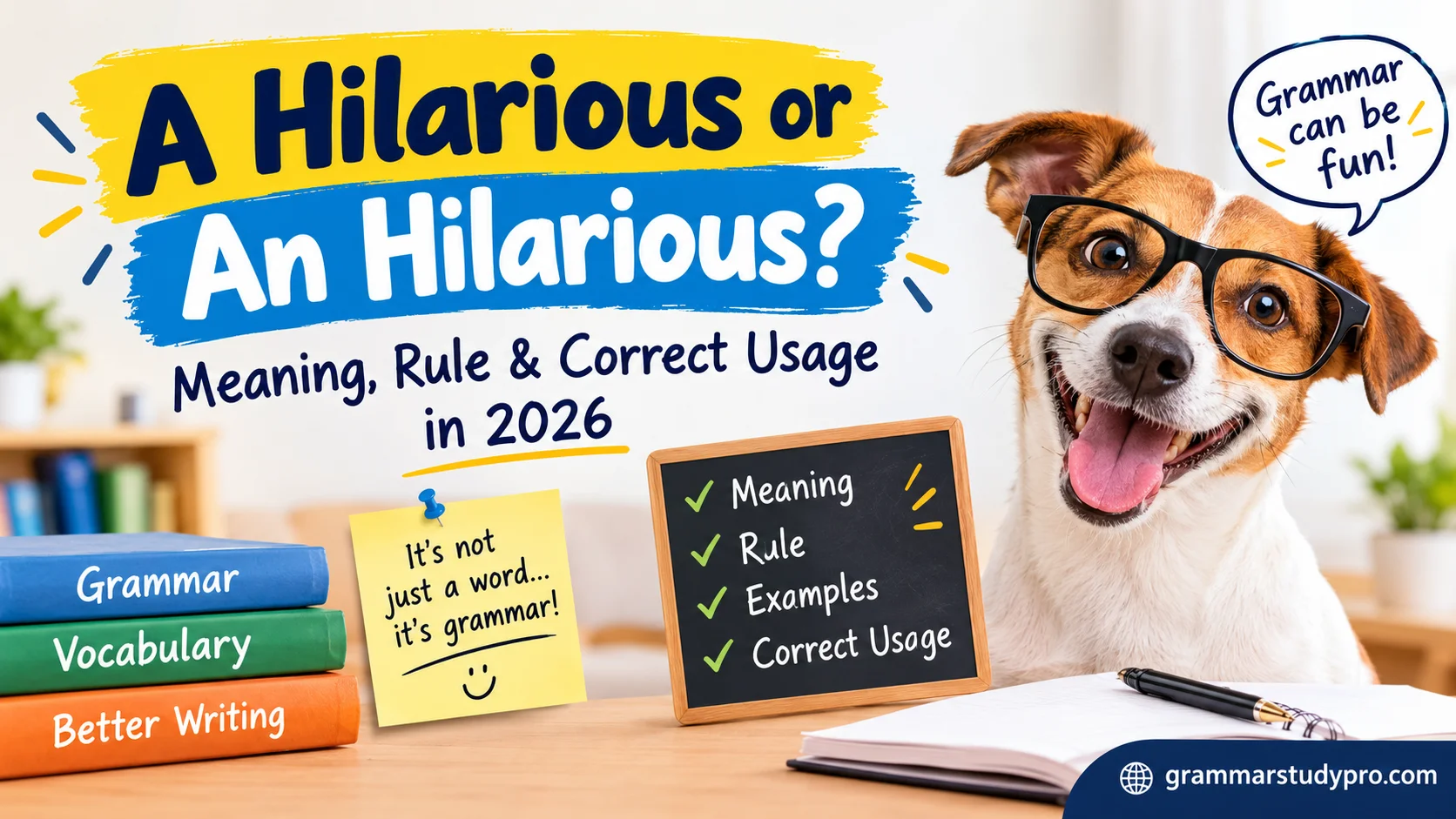
A Hilarious or An Hilarious can seem confusing, but pronunciation makes the correct article easier to choose in everyday English writing and speaking. For fluent English speakers, choosing between a hilarious and an hilarious may feel tricky, especially when different versions appear in books, movies, or online. This grammar detail can catch writers, English learners, and native speakers off guard, creating confusion even when they already understand basic grammar. The simple rule is that English articles depend on the sound that follows, not only the letter or spelling. The debate between an hilarious and a hilarious is a useful example of this rule because hilarious starts with h and is pronounced with a strong h sound, a strong consonant sound, rather than a vowel-sound.
Therefore, the correct choice-between a and an depends on pronunciation, so we say a hilarious joke and a hilarious movie, while an-hilarious and an hilarious do not usually sound natural in standard pronunciation or modern usage. This rule-application and pronunciation-based usage show why English language rules can sometimes feel like a curveball. Even though the English language is living, constantly changing, and adapting, this pattern still holds up today.Remembering the pattern, rather than relying only on memorization, can help users avoid common mistakes, understand the purpose of articles, and make writing smoother and more natural. The same pattern appears in a hotel, a hat, and a hero, where the initial sound is also a consonant. This perfect lesson can strengthen your instinct for grammar and make English’s flow clearer when deciding the right choice. In everyday language, speaking, talking, and writing, remember that a and an are selected by sound. Understanding pronunciation can settle the common debate, explain subtle shifts in usage, and show why vowels and a vowel influence the article choice even when a word begins with H.
Heard in real conversations, the distinction becomes easier to recognize, and English learners who struggle with this simple rule can become more fluent by noticing how words are actually pronounced. This easy rule also explains why a comes before a consonant sound and an before a vowel sound, making the sentence, phrase, and words around an article easier to construct. When things feel wobbly, the best approach is to focus on the sound rather than the written form, because English governs its articles through pronunciation. The perfect example of hilarious makes the right form especially clearer, and this adaptation of pronunciation-based thinking can make the writing of writers and other speakers more confident. The change in understanding may seem small, but the deal is simple: choose the article that matches the sound that follows, and the rule becomes much easier to use.
Quick Answer
“A hilarious” is correct in standard contemporary American English.
The correct construction is:
- a hilarious joke ✅
- a hilarious story ✅
- a hilarious movie ✅
- a hilarious mistake ✅
The incorrect or nonstandard modern construction is:
- an hilarious joke ❌
- an hilarious story ❌
- an hilarious movie ❌
The reason is simple: hilarious begins with a pronounced /h/ consonant sound. Since a comes before consonant sounds, we use a hilarious.
Remember that a/an depends on pronunciation, not spelling.
Compare these examples:
| Phrase | Correct? | Why? |
| a hilarious joke | ✅ | hilarious begins with /h/ |
| an hilarious joke | ❌ | The initial sound isn’t a vowel sound |
| a house | ✅ | The /h/ is pronounced |
| an hour | ✅ | The h is silent |
| an honest person | ✅ | The h is silent |
| a university | ✅ | It begins with a /y/ sound |
So if you’re writing a sentence today, use “a hilarious,” not “an hilarious.”
Comparison Overview
The difference between a hilarious and an hilarious isn’t about the meaning of hilarious. Both constructions attempt to describe something extremely funny. The issue is the article that comes before the adjective.
| Feature | A hilarious | An hilarious |
| Standard modern American English | ✅ Yes | ❌ No |
| Initial sound | Consonant /h/ | Consonant /h/ |
| Article required | a | Not normally an |
| Example | a hilarious story | an hilarious story |
| Recommended in contemporary writing | Yes | No |
| Main reason | hilarious begins with a consonant sound | an normally precedes vowel sounds |
The key distinction is sound rather than the written letter.
For example, hour starts with H in writing. Yet you say “our” rather than “how-er” at the beginning. Because the h is silent, the word begins with a vowel sound. Therefore, an hour is correct.
Hilarious works differently. The H is pronounced, giving the word a consonant opening.
That’s why English says:
- a hilarious comedian
- a hilarious performance
- a hilarious anecdote
but:
- an amusing comedian
- an entertaining performance
- an amusing anecdote
The article changes because the first sound changes.
Main Differences Between A Hilarious and An Hilarious
The biggest difference is straightforward: “a hilarious” follows the standard article rule, while “an hilarious” doesn’t normally do so in modern American English.
A hilarious uses the correct consonant-sound rule
The word hilarious begins with a clearly pronounced /h/ sound.
That makes the construction:
a + hilarious + noun
For example:
- a hilarious joke
- a hilarious story
- a hilarious character
- a hilarious scene
- a hilarious comment
- a hilarious accident
- a hilarious misunderstanding
Notice something important here. The noun doesn’t determine the article.
In “a hilarious story,” the article comes immediately before hilarious. The adjective begins with the /h/ sound, so a is appropriate.
An hilarious doesn’t follow the standard modern rule
The phrase “an hilarious” treats hilarious as though it began with a vowel sound.
It doesn’t in standard pronunciation.
Therefore:
an hilarious story
is not the normal construction for contemporary American English.
You may encounter it in older texts, historical writing, regional usage, or writing influenced by different grammatical traditions. However, seeing an unusual construction doesn’t automatically make it the recommended form today.
For modern American writing, the practical choice is easy:
Use “a hilarious.”
What Does Hilarious Mean?
Before examining the grammar further, it’s worth understanding exactly what hilarious means.
Hilarious is an adjective meaning extremely funny or very amusing. It describes something that causes strong laughter or seems exceptionally funny.
For example:
“That was a hilarious joke.”
The speaker isn’t merely saying the joke was mildly amusing. Hilarious suggests a much stronger reaction.
Consider this rough scale:
| Word or phrase | General strength |
| amusing | Mildly entertaining |
| humorous | Characterized by humor |
| funny | Makes you laugh or seems amusing |
| very funny | Clearly stronger than ordinary “funny” |
| hilarious | Extremely funny |
These aren’t mathematical levels. Context matters. Someone might call a clever comment hilarious even if nobody literally falls over laughing.
Hilarious vs. funny
Funny has a wider range of meanings.
It can describe something that makes you laugh:
“That movie was funny.”
But funny can also mean strange or unusual:
“There’s something funny about this situation.”
Hilarious, on the other hand, usually emphasizes humor.
“That movie was hilarious.”
The second sentence suggests a much stronger comedic reaction.
Hilarious vs. humorous
Humorous sounds more neutral and often more formal.
For example:
“The article contains several humorous observations.”
That doesn’t necessarily mean the observations produced loud laughter.
By comparison:
“The article contains a hilarious story.”
That sentence suggests the story is exceptionally funny.
Why Is It “A Hilarious” Instead of “An Hilarious”?
Here’s where the grammar becomes useful.
English has two indefinite articles:
- a
- an
The traditional rule says:
Use “a” before a consonant sound and “an” before a vowel sound.
The word sound matters enormously.
It’s not:
“Use a before consonant letters.”
And it’s not:
“Use an before words containing vowels.”
English doesn’t work that mechanically.
Instead, listen to the beginning of the word.
Hilarious begins with a pronounced H sound. That’s a consonant sound.
Therefore:
a hilarious
is correct.
The pronunciation makes the rule obvious
Say these phrases aloud:
- a hilarious joke
- a hilarious story
- a hilarious video
You can hear the transition from the article into the h sound.
Now compare:
- an hour
- an honest answer
- an heir
The initial h in these words is silent. The words begin with vowel sounds.
That’s why the article changes.
The Real Rule: A or An Depends on Sound
The a vs. an rule becomes much easier when you stop thinking about letters.
Think about the first spoken sound.
Use “a” before a consonant sound
Examples include:
- a hilarious story
- a funny joke
- a useful tool
- a university
- a European country
- a one-time event
- a house
- a hotel
Some of these words begin with vowel letters. Yet their initial sounds are consonantal.
For example, university begins with a sound similar to “you.”
So we say:
a university
not:
an university
Likewise, one begins with a /w/ sound in normal pronunciation:
a one-time opportunity
Use “an” before a vowel sound
Examples include:
- an amusing story
- an interesting joke
- an unusual situation
- an hour
- an honest answer
- an apple
- an MBA
The spelling varies. The pronunciation determines the article.
How to Pronounce Hilarious
The word hilarious has a pronounced initial H.
Its pronunciation can be represented approximately as:
hi-LAIR-ee-us
The exact phonetic details can vary somewhat by accent, but the important point remains unchanged: the first sound is /h/.
That makes hilarious behave like:
- house
- happy
- helpful
- historic
- hilarious
rather than words such as:
- hour
- honest
- heir
- honor
The first group has a pronounced h. The second group begins with a vowel sound because the h is silent.
A Hilarious in Real Sentences
Understanding the rule is useful. Seeing it in natural sentences makes it stick.
Everyday conversation
“He told me a hilarious story about his first day at work.”
“That was a hilarious mistake.”
“She sent me a hilarious video last night.”
“You should hear the hilarious excuse he gave.”
These sentences all use a hilarious because hilarious immediately follows the article.
Entertainment and media
“We watched a hilarious comedy after dinner.”
“The actor delivered a hilarious performance.”
“The show has a hilarious opening scene.”
“The movie revolves around a hilarious misunderstanding.”
Work and professional contexts
Hilarious isn’t limited to casual conversation.
“The presentation included a hilarious example.”
“The speaker shared a hilarious anecdote.”
“The report describes a hilarious incident from the early testing phase.”
The word can work in professional writing when the subject genuinely calls for a humorous description.
Social media and casual writing
“That is a hilarious meme.”
“What a hilarious reaction!”
“This might be the most hilarious comment I’ve seen today.”
The grammar remains the same even when the tone becomes informal.
A Hilarious Before Different Nouns
A common grammatical structure looks like this:
a + adjective + singular countable noun
With hilarious, you can create many natural phrases:
- a hilarious joke
- a hilarious story
- a hilarious movie
- a hilarious scene
- a hilarious moment
- a hilarious character
- a hilarious comment
- a hilarious incident
- a hilarious mistake
- a hilarious anecdote
- a hilarious situation
- a hilarious conversation
The noun can change. The article doesn’t.
Why?
Because the article sits directly before hilarious.
What happens when another word comes first?
Here’s an especially useful detail:
a hilarious story
But:
an extremely hilarious story
Why did the article change?
Because the article now comes directly before extremely, not hilarious.
Extremely begins with a vowel sound.
So:
- a hilarious story ✅
- an extremely hilarious story ✅
This is one of the clearest demonstrations of the pronunciation rule.
The article responds to the next spoken word.
Can You Use Hilarious Without “A”?
Absolutely.
The adjective hilarious doesn’t always need an article.
Consider:
“The movie was hilarious.”
Here, hilarious appears after the linking verb was. No indefinite article belongs there.
You can also use it with plural nouns:
“They told hilarious stories.”
No a appears because stories is plural.
Compare:
| Construction | Example |
| Singular countable noun | a hilarious story |
| Predicate adjective | The story was hilarious |
| Plural noun | hilarious stories |
| General description | Their stories are hilarious |
This distinction prevents another common mistake: assuming that the word hilarious automatically requires a.
It doesn’t.
The article depends on the larger grammatical structure.
Common Mistakes With A Hilarious
Even simple grammar rules can cause surprisingly persistent errors.
Mistake: “An hilarious joke”
This is the most direct error.
❌ She told an hilarious joke.
✅ She told a hilarious joke.
The reason is pronunciation. Hilarious begins with the consonant sound /h/.
Mistake: Assuming every H word takes “an”
This misconception comes from words such as hour and honest.
But the letter H doesn’t automatically determine the article.
Compare:
- a hilarious joke
- a house
- a hotel
- an hour
- an honest person
- an heir
The deciding factor is whether the h produces a sound.
Mistake: Looking only at spelling
English spelling often behaves like a mischievous map. It points you in the right direction sometimes, then sends you somewhere unexpected.
The letters u, e, o, and h can all create article questions because spelling and pronunciation don’t always line up neatly.
That’s why you need to listen rather than simply inspect the first character.
Mistake: Letting the noun determine the article
Consider:
a hilarious anecdote
Some learners see anecdote and expect an.
But that’s not how the phrase works.
The article directly precedes hilarious, not anecdote.
Therefore:
a hilarious anecdote
is correct.
Compare:
an amusing anecdote
Here, amusing starts with a vowel sound. Therefore, an is appropriate.
A Hilarious vs. An Hilarious in American English
In standard contemporary American English, a hilarious is the normal form.
The same pronunciation-based logic also works in mainstream British English. The initial /h/ in hilarious normally receives pronunciation, so a hilarious is the expected construction.
English has historically shown variation in how speakers handle certain words beginning with h. Some words have also developed different patterns across periods and dialects. However, that historical complexity doesn’t change the practical answer for modern American writing.
If you’re writing:
- an article
- a school assignment
- a business document
- a website
- an email
- a social media post
- a professional report
use:
a hilarious
That is the clear contemporary choice.
Is “An Hilarious” Ever Correct?
This question deserves a nuanced answer.
“An hilarious” can be found in English writing, particularly in older material and some varieties or styles of English. Its presence in a published or historical text doesn’t mean the writer necessarily made a random grammatical mistake.
English article usage has changed over time. Pronunciation has changed too. Writers have also followed different conventions depending on period, region, and editorial tradition.
However, “an hilarious” isn’t the standard modern American English construction.
For contemporary writing, there’s little reason to choose it.
Use:
a hilarious story
rather than:
an hilarious story
If you’re analyzing an old document or quoting historical language, you may encounter the older form. In that context, preserving the original wording can make sense.
That’s different from recommending it as standard modern usage.
Hilarious vs. Very Funny: Does the Article Change?
Changing the intensity of an adjective doesn’t automatically change the article.
Consider:
a funny story
and:
a hilarious story
Both use a because funny and hilarious begin with consonant sounds.
Now compare:
an amusing story
The article changes because amusing begins with a vowel sound.
Here’s the pattern:
| Phrase | Article | Reason |
| a funny story | a | /f/ consonant sound |
| a hilarious story | a | /h/ consonant sound |
| an amusing story | an | vowel sound |
| an entertaining story | an | vowel sound |
The meaning of the adjective matters for vocabulary. The opening sound matters for the article.
A Simple A/An Decision Method
When you’re unsure whether to use a or an, don’t stare at the spelling.
Use this quick process:
Look at the word immediately after the article.
Then:
Say the word aloud.
Next:
Listen to its first sound.
If the sound is consonantal, choose a.
If the sound is vocalic, choose an.
For hilarious:
hilarious → /h/ → consonant sound → a hilarious
For amusing:
amusing → vowel sound → an amusing
For hour:
hour → silent h → vowel sound → an hour
For university:
university → /y/ sound → consonant sound → a university
This method works far beyond hilarious.
A/An Rules You Can Apply Beyond Hilarious
The phrase a hilarious or an hilarious provides a useful lesson in English grammar, but the same principle applies to thousands of other phrases.
Words beginning with pronounced H
Use a:
- a hilarious story
- a happy child
- a helpful employee
- a historic building
- a hotel
- a house
Words beginning with silent H
Use an:
- an hour
- an honest person
- an honor
- an heir
The spelling looks similar. The pronunciation creates the difference.
Words beginning with vowel letters but consonant sounds
Use a:
- a university
- a European country
- a useful idea
- a unique opportunity
- a one-year contract
The opening sounds are consonantal.
Words beginning with vowel sounds
Use an:
- an apple
- an unusual idea
- an interesting book
- an expensive car
- an MBA
- an hour
Again, pronunciation controls the article.
A Hilarious or An Hilarious: Practical Examples
Here are several examples worth remembering.
| Incorrect | Correct |
| an hilarious joke | a hilarious joke |
| an hilarious story | a hilarious story |
| an hilarious movie | a hilarious movie |
| an hilarious mistake | a hilarious mistake |
| an hilarious character | a hilarious character |
| an hilarious scene | a hilarious scene |
| an hilarious anecdote | a hilarious anecdote |
The pattern remains consistent.
Example case study: choosing the article
Imagine you’re writing:
“The comedian told ___ hilarious story about his childhood.”
The missing word comes directly before hilarious.
Say it aloud:
“a hilarious story”
The /h/ sound immediately follows a.
The answer is therefore:
a hilarious story
Now change the adjective:
“The comedian told ___ amusing story about his childhood.”
Amusing begins with a vowel sound.
So the sentence becomes:
an amusing story
The noun didn’t change. The article changed because the adjective’s opening sound changed.
That’s the rule in action.
Quick Grammar Test: A or An?
Try filling in each blank before checking the answers.
- ___ hilarious joke
- ___ honest answer
- ___ hilarious mistake
- ___ hour-long meeting
- ___ unusual situation
- ___ hilarious video
- ___ extremely funny story
- ___ hilarious character
Answers
| Phrase | Answer | Why? |
| ___ hilarious joke | a | /h/ consonant sound |
| ___ honest answer | an | silent h |
| ___ hilarious mistake | a | /h/ consonant sound |
| ___ hour-long meeting | an | silent h |
| ___ unusual situation | an | vowel sound |
| ___ hilarious video | a | /h/ consonant sound |
| ___ extremely funny story | an | extremely begins with a vowel sound |
| ___ hilarious character | a | /h/ consonant sound |
The last two examples are particularly helpful. They show that you must examine the word immediately following the article.
FAQs
Is “a hilarious” or “an hilarious” correct?
A hilarious is the standard choice because hilarious begins with a pronounced consonant sound. We say a hilarious joke and a hilarious movie.
Why do we use “a” before hilarious?
The choice between a and an depends on pronunciation, not simply spelling. Since hilarious begins with a clear h sound, a is used before it.
Is “an hilarious” ever correct?
An hilarious may appear in older writing or some varieties of English, but a hilarious is the usual form in modern standard English.
Does the letter H always require “a”?
No. The article depends on the sound. Words such as a hilarious, a hotel, and a hero use a because the h is pronounced. However, words beginning with a silent h can take an, depending on pronunciation.
How can I remember the rule?
Listen to the first sound rather than looking only at the first letter. Use a before a consonant sound and an before a vowel sound. This simple habit makes the correct choice easier.
Conclusion
A hilarious is the standard and natural form in modern English. The key is pronunciation, not spelling: because hilarious starts with a pronounced h sound, we use a, as in a hilarious joke. Once you focus on the sound that follows the article, this common grammar question becomes much easier to understand and use correctly.