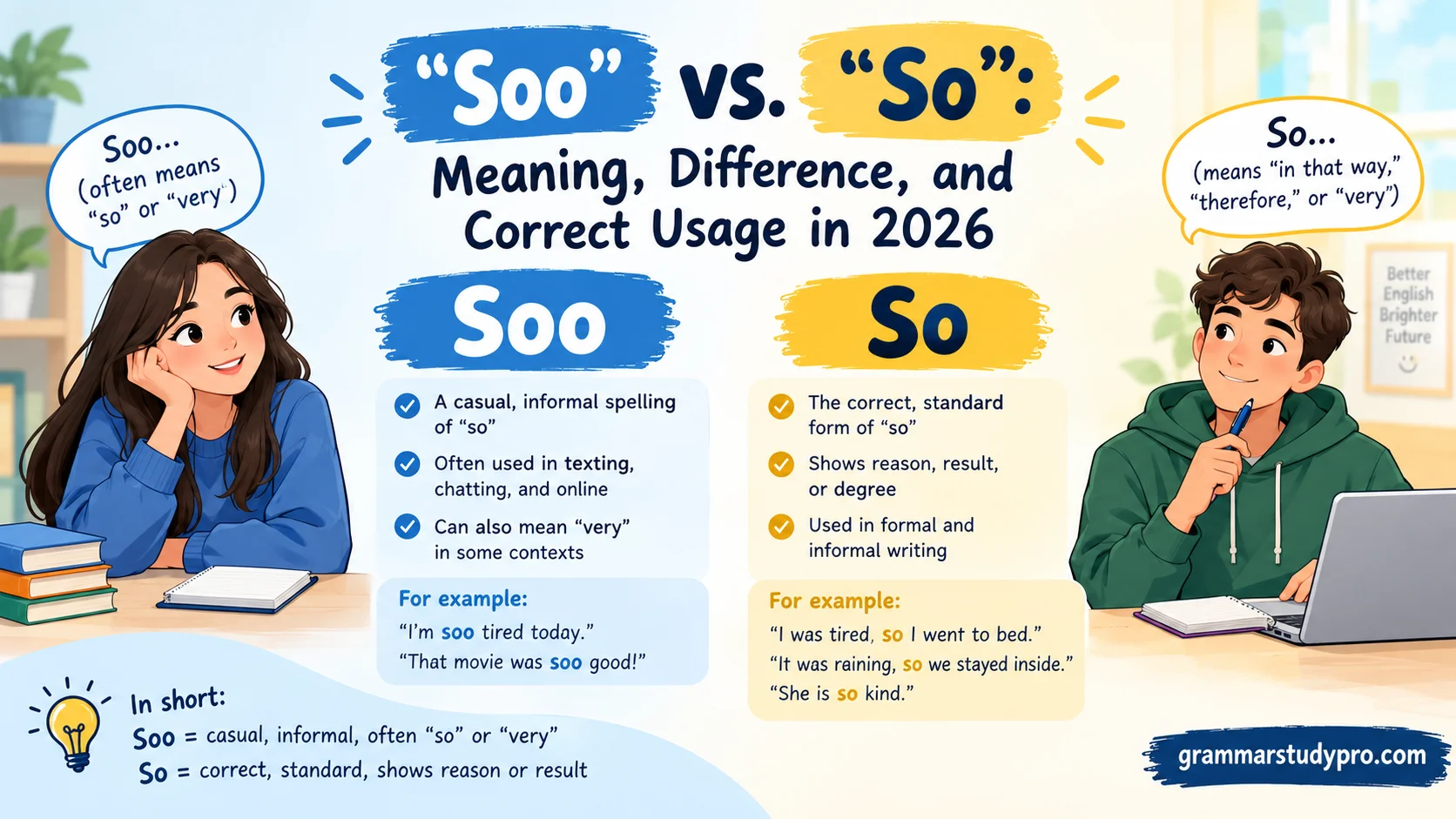
“Soo” vs. “So” can seem confusing because both forms look similar, but they have different uses in English and online communication. So is a standard word and correct word, while soo is an informal spelling and often a stylistic variation used for emphasis. In my experience, people may use soo in a message, comment, or post without treating it as a misspelling, especially when writing online. However, so remains the standard English English word for formal and everyday writing. Understanding this difference helps you write clearly and choose a natural and appropriate form according to the context, including emails, blogs, academic writing, and professional communication. The two forms are not always the same thing, even though they can appear similar.
In the digital world, language evolves rapidly, often shaped by trends, memes, and conversations online. The evolution and emergence of new words reflect an expressive, informal style of communication suited to a fast-scrolling, fast-changing age. People who texted friends may use soo in texting, tweets, or DMs because the extra letters create a playful, exaggerated version of so. What starts as a typo can develop into an expression that adds emotion, humor, or a lighter tone. It can feel fun, modern, and natural in casual settings, but formal contexts such as reports and academic writing usually favor so. This difference shows how modern communication can adapt language without changing the established form used in careful writing.
The interesting shift between soo and so also reveals how meaning, usage, and style can change through everyday communication. The extra o in soo can add feeling, excitement, and emphasis, so people react to it differently. For example, soo funny may sound more emotional, excited, and funny, while so funny sounds more grammatically proper and closer to well-established English. This blend of grammar, emotion, and modern writing reflects how rules reshape through usage. Tone, vibe, and context can make or flip the meaning of a small word. In a niche area of the internet, this alternative form has become an accepted, evolving way to connect, adapt, and stick with the rhythm of the online age.
Quick Answer
“So” is the standard and correct spelling when you mean the ordinary English word.
“Soo” is usually an informal, expressive spelling of “so” used to add emphasis or imitate an elongated pronunciation.
For example:
- Standard: “I’m so excited!”
- Informal: “I’m soo excited!”
- Stronger informal emphasis: “I’m sooo excited!”
The first sentence works in virtually any context. The second and third deliberately alter the spelling to convey emotion.
Cambridge defines so as an English adverb and conjunction with uses that include expressing degree, giving a result, connecting ideas, and referring back to something already mentioned. Oxford likewise documents several standard grammatical uses of so, including degree, similarity, reference to an earlier statement, and informal discourse.
One wrinkle matters: Soo can be a legitimate term in other contexts. Dictionary.com, for example, records Soo as a Canadian noun referring to Sault Ste. Marie. That usage has nothing to do with the informal spelling of so.
So, when comparing soo vs. so as everyday English spellings, the practical rule is simple:
Use “so” for standard English. Use “soo” only when you intentionally want an informal, expressive tone.
Comparison Overview
The easiest way to understand “soo” vs. “so” is to compare their role, spelling, tone, and context.
| Feature | So | Soo |
| Standard English word | Yes | No, when used as an elongated so |
| Standard spelling | Yes | No |
| Formal writing | Appropriate | Generally avoid |
| Academic writing | Appropriate | Generally avoid |
| Business communication | Appropriate | Generally avoid |
| Texting | Appropriate | Common as an expressive spelling |
| Social media | Appropriate | Common as an expressive spelling |
| Main purpose | Grammar and meaning | Emphasis and tone |
| Extra letters | No | Yes |
| Independent grammatical function | Yes | Usually none in this usage |
| Typical tone | Neutral to emphatic | Playful, emotional, dramatic, or exaggerated |
The distinction isn’t really between two standard English words. Instead, you’re usually choosing between a standard word and a deliberately altered spelling.
That matters because spelling carries information beyond dictionary meaning. In a text message, “I’m so happy” and “I’m sooo happy” can communicate different emotional energy even though the underlying statement remains the same.
What Does “So” Mean?
So is a small word with an unusually large workload. English speakers use it in several grammatical roles.
Cambridge lists so as an adverb and conjunction and gives examples involving degree, result, agreement, sentence connection, and purpose.
“So” as an Adverb
One of the most familiar uses of so is to intensify an adjective or adverb.
Examples include:
- “The coffee is so hot.”
- “She was so excited.”
- “He ran so quickly.”
- “That explanation was so helpful.”
Here, so means something like to a very great degree or very. Oxford describes this use as expressing a high degree or extent.
The construction often becomes especially strong when followed by that:
“The room was so crowded that we couldn’t find a seat.”
The first clause establishes the degree. The second explains the result.
“So” as a Conjunction
So can also connect an action or situation with its result.
For example:
“It started raining, so we went inside.”
The first clause gives the situation. The second gives the consequence.
More examples:
- “I was tired, so I went to bed.”
- “The store was closed, so we came back later.”
- “She studied hard, so she passed the exam.”
Cambridge specifically identifies this use of so as a conjunction that introduces a reason-result relationship.
“So” in Short Answers
You also use so to avoid repeating information.
Consider this exchange:
“Do you think they’ll arrive today?”
“I hope so.”
Here, so stands in for the idea already mentioned.
You could repeat the entire thought, but that would sound clumsy. I hope so does the job neatly.
Oxford documents this use of so as a reference to something already mentioned.
Other examples include:
- “I think so.”
- “I believe so.”
- “I suppose so.”
- “I guess so.”
- “If so, let me know.”
“So” for Agreement
Another common structure appears in sentences such as:
- “I love this song.” — “So do I.”
- “She was nervous.” — “So was he.”
- “I’ve finished the work.” — “So have I.”
This construction expresses that the same thing applies to another person.
Cambridge describes this as a use of so meaning that someone else does the same thing or that the same fact applies to them.
“So” as a Discourse Marker
You may also see so at the beginning of a sentence:
“So, what should we do next?”
Here, so doesn’t mean very. It helps move the conversation forward.
It can introduce a question, summarize what came before, or signal a change in topic. Cambridge specifically identifies this as a common use of so in speech.
What Does “Soo” Mean?
When people type “soo” in ordinary online English, they usually aren’t introducing a new grammatical word.
Instead, they’re stretching so visually.
Think about how people naturally speak when they want to emphasize something:
“That was sooooo good!”
The speaker holds the vowel longer. In writing, extra letters imitate that stretched sound.
That’s why you’ll encounter examples such as:
- “That puppy is soo cute.”
- “I’m soo tired.”
- “You are sooo funny.”
- “That was sooo unexpected.”
- “I missed you soo much.”
The spelling tells the reader, Don’t hear this as a flat, ordinary “so.” Hear it with extra emotion.
Is “Soo” a Standard English Word?
When soo is simply being used as an elongated version of so, it isn’t the standard spelling of the English word.
That doesn’t mean every appearance of Soo is an error. Context matters.
Dictionary.com, for example, lists Soo as a noun referring to Sault Ste. Marie in Canadian usage.
Names and other proper nouns can also contain Soo. Therefore, saying that every possible use of “Soo” is wrong would be too broad.
The useful rule is narrower:
If “soo” is intended to mean the ordinary English word “so,” use “so” in standard writing.
Main Differences Between “Soo” vs. “So”
The main difference between soo and so isn’t normally dictionary meaning. It’s register, spelling, and emotional tone.
Standard Spelling vs. Expressive Spelling
So follows conventional English spelling.
Soo deliberately adds a letter to create a visual effect.
Compare:
“That dress is so beautiful.”
with:
“That dress is soo beautiful!”
The second sentence doesn’t necessarily communicate a different fact. It communicates a different attitude toward the fact.
Neutral Tone vs. Emotional Tone
Standard spelling tends to keep the sentence neutral:
“I’m so happy you’re here.”
The elongated version adds more visible enthusiasm:
“I’m soo happy you’re here!”
That difference resembles spoken emphasis. You can say the word normally or draw it out dramatically.
Formal vs. Informal Register
So works in:
- academic writing
- business emails
- reports
- essays
- applications
- professional websites
- everyday conversation
- text messages
Soo is much more limited.
It fits naturally in:
- casual texts
- DMs
- social media comments
- memes
- informal captions
- playful dialogue
The spelling itself signals informality.
Grammar vs. Style
This is perhaps the most important distinction.
So performs grammatical work. It can modify an adjective, connect clauses, refer back to an idea, express agreement, and perform other functions documented by major dictionaries.
Soo, when used as an elongated so, generally doesn’t introduce another grammatical function.
It changes the presentation.
When Should You Use “So”?
If you’re unsure which form to choose, so is the safe standard choice.
Use so when you’re writing anything that needs conventional English spelling.
Use “so” in:
- School assignments
- College papers
- Research writing
- Résumés
- Cover letters
- Business emails
- Reports
- Professional articles
- Formal messages
- Published content
- Customer communication
For example:
Professional:
“Thank you so much for your assistance.”
Not:
“Thank you soo much for your assistance.”
The second version might be perfectly understandable. It simply introduces an unnecessary informal flavor into a professional sentence.
Use “So” When Grammar Requires It
If so connects clauses, extra letters don’t make sense:
“The traffic was heavy, so we arrived late.”
Writing:
“The traffic was heavy, soo we arrived late.”
doesn’t add useful emotional emphasis. It simply makes the conjunction look misspelled.
The same principle applies to:
“I think so.”
and:
“So do I.”
These are established grammatical constructions. Replacing so with soo would turn a standard form into an informal visual variation.
When Is “Soo” Appropriate?
The answer changes when you’re deliberately writing casual dialogue.
Suppose a friend sends you a photo of an adorable puppy.
You might reply:
“That is soo cute 😭”
Nobody reading the message is likely to interpret the extra o as a spelling mistake that changes the underlying meaning. Instead, the stretched spelling signals enthusiasm.
“Soo” Works Best When You Want To:
- exaggerate enthusiasm
- express affection
- sound playful
- show disbelief
- add dramatic emphasis
- imitate spoken language
- make a casual message feel more animated
For instance:
“I’m soo ready for the weekend.”
sounds more expressive than:
“I’m so ready for the weekend.”
The difference is subtle. That’s the point.
“Soo” vs. “Sooo” vs. “Soooo”
Online writing doesn’t stop at one extra o.
You’ll often see:
- so
- soo
- sooo
- soooo
- sooooo
These forms don’t have fixed grammatical definitions. Instead, the additional letters generally intensify the visual effect.
Consider this informal scale:
| Form | Typical impression |
| so | Normal |
| soo | Mild extra emphasis |
| sooo | Stronger emphasis |
| soooo | Dramatic emphasis |
| sooooo | Very exaggerated or playful |
This isn’t a formal linguistic scale. There’s no grammar rule saying that four o’s mean exactly twice as much emphasis as two.
Context does the heavy lifting.
For example:
“I’m so tired.”
sounds ordinary.
“I’m sooo tired.”
sounds dramatically exhausted.
“I’m sooooo tired.”
might sound intentionally comic.
The writer controls the effect.
Why Do People Write “Soo” in Text Messages?
Text has one major limitation: you can’t hear the speaker’s voice.
In conversation, emotion comes through pitch, volume, rhythm, pauses, facial expressions, and vowel length. Text strips most of those cues away.
People compensate creatively.
That’s why digital communication contains forms such as:
- “nooo”
- “yesss”
- “pleeeease”
- “hiiii”
- “sooo”
- “whyyy”
The repeated letters act like tiny stage directions.
They tell you how to hear the message.
“No.”
is flat.
“Nooo!”
can communicate disappointment, disbelief, panic, humor, or playful resistance.
Likewise:
“That’s so cute.”
is straightforward.
“That’s sooo cute!”
feels more animated.
This expressive spelling is one reason soo can feel natural in a casual conversation despite not being the standard spelling.
“So” vs. “Soo” in Texting and Social Media
Digital communication has changed how people think about spelling.
Texting isn’t always trying to imitate a formal document. Instead, it often tries to reproduce the rhythm and personality of speech.
Example: Excitement
Neutral:
“I’m so excited about the concert!”
Informal:
“I’m sooo excited about the concert!”
The second version visually stretches the excitement.
Example: Affection
Neutral:
“You’re so sweet.”
Informal:
“You’re soo sweet.”
Again, the basic proposition stays intact. The emotional texture changes.
Example: Disbelief
“You actually did that? Soo why would you?”
Here, soo can become part of a conversational, drawn-out reaction.
The exact effect depends heavily on context.
Can “Soo” Be Used in Professional Writing?
Generally, no—not when you’re using it as an informal spelling of “so.”
Professional writing benefits from conventional spelling because readers shouldn’t have to decode whether a nonstandard form was intentional.
Compare:
“The results were so impressive that the company expanded the program.”
with:
“The results were soo impressive that the company expanded the program.”
The first sentence sounds polished and neutral. The second sounds like a social-media comment.
That’s not automatically a problem in every imaginable setting. A brand’s deliberately playful social account might choose the second style. A formal report shouldn’t.
Avoid “Soo” in:
- Job applications
- Résumés
- Cover letters
- Business proposals
- Academic papers
- Legal documents
- Research reports
- Formal presentations
- Client correspondence
When your audience expects standard English, so is the straightforward choice.
“So” vs. “Soo” in Different Types of Writing
| Writing context | Recommended form | Why |
| Academic essay | so | Standard English is expected |
| Research paper | so | Formal register |
| Business email | so | Professional tone |
| Résumé | so | Conventional spelling |
| Cover letter | so | Formal presentation |
| Blog article | so | Standard editorial style |
| Text message | so / soo | Depends on intended tone |
| Social media caption | so / soo | Informal expression may fit |
| Comment section | so / soo | Casual context |
| Fiction dialogue | so / soo | Depends on character voice |
| Formal speech | so | Standard wording |
| Casual dialogue | so / soo | Expressive spelling can reflect speech |
The key isn’t simply whether you’re typing on a phone or computer.
Audience and purpose matter more than the device.
Common Mistakes With “Soo” and “So”
Treating “Soo” as a Standard Grammar Form
The most common misunderstanding is assuming that soo is simply another standard spelling of so.
It isn’t.
If you’re writing conventional English, stick with so.
Using “Soo” in Formal Writing
A sentence can contain perfect grammar and still look informal because of one deliberate spelling choice.
For example:
“The findings were soo important to the project.”
The grammar is understandable. The spelling creates the problem.
A polished version is:
“The findings were so important to the project.”
Assuming Extra Letters Change the Dictionary Meaning
Adding another o doesn’t normally transform so into a separate grammatical word.
Instead, it usually signals emphasis.
Think of it like stretching a rubber band. The word remains recognizable while its visual form stretches.
Assuming “Soo” Is Always Wrong
This is the opposite mistake.
Calling every occurrence of Soo incorrect ignores legitimate contexts such as proper names and the Canadian geographic usage recorded by Dictionary.com.
Likewise, informal writing has its own conventions.
A friend texting:
“That puppy is sooo adorable!”
is making a stylistic choice.
That doesn’t mean the same spelling belongs in a university essay.
Overusing Elongated Spellings
Even casual writing can become difficult to read when every word gets stretched:
“I’m soooo soooo excited to see youuuuu!!!!”
One expressive spelling can add personality. Ten of them can make the message feel noisy.
Use the technique like seasoning. A little goes a long way.
“Soo” vs. “So” in Creative Writing and Dialogue
Creative writing is one place where soo can serve a genuine purpose.
A novelist may deliberately use unusual spelling to show how a character speaks.
For example:
“Nooo, don’t leave yet!”
The writer isn’t claiming that nooo is standard spelling. The spelling represents the character’s drawn-out speech.
The same principle can apply to soo:
“You are sooo lucky!”
That might communicate enthusiasm or playful exaggeration.
When Expressive Spelling Helps
It can reveal:
- personality
- age
- emotional intensity
- playfulness
- sarcasm
- dramatic behavior
- conversational rhythm
When It Becomes Distracting
Too much phonetic spelling can slow readers down.
If every line contains stretched vowels, repeated letters, and unconventional spellings, the dialogue may start feeling artificial rather than natural.
The strongest creative use is usually selective.
“Soo” Can Mean Something Else in a Different Context
One important detail often gets lost in simple soo vs. so explanations.
Not every Soo refers to an elongated version of so.
Dictionary.com lists Soo as a Canadian noun referring to Sault Ste. Marie.
You may also encounter Soo in:
- personal names
- surnames
- place names
- organization names
- transliterations
- other languages
- abbreviations or proper names
So the sentence around the word matters.
Compare:
“That puppy is soo cute.”
Here, soo is clearly an informal spelling of so.
Now consider:
“She lives near the Soo.”
That’s a completely different use.
Context prevents the two from being mixed together.
A Simple Way to Choose Between “So” and “Soo”
When you’re unsure, ask one question:
Am I using the extra letters to deliberately create an informal emotional effect?
If the answer is no, use so.
If the answer is yes, and you’re writing casually, soo can work.
Here’s the decision process:
Standard English needed? → Use “so.”
Casual conversation? → Either may work depending on tone.
Trying to stretch the spoken sound? → “Soo” can signal that informally.
Academic or professional writing? → Use “so.”
Writing dialogue? → Choose based on the character’s voice.
That rule covers most everyday situations.
Real-World Usage Examples
The difference becomes much clearer when you see the words in context.
Standard “So”
“The lecture was so interesting.”
“I was hungry, so I ordered dinner.”
“Do you think she’ll come?”
“I hope so.”
“I love this restaurant.”
“So do I.”
“So, what happened next?”
These are all established uses of so documented in major learner and advanced dictionaries.
Informal “Soo”
“That dress is soo cute!”
“I’m soo tired today.”
“You were soo right!”
“This is sooo good.”
“I can’t believe you actually did that. Soo funny.”
These examples use extra letters to create an informal written voice.
Case Study: How One Extra Letter Changes Tone
Consider a simple message:
“I missed you so much.”
It’s warm and direct.
Now stretch the word:
“I missed you soo much.”
The message feels more emotional and conversational.
Stretch it further:
“I missed you sooo much!”
Now the writer appears to be emphasizing the feeling strongly.
Notice what hasn’t changed: the underlying proposition.
The writer still says they missed the person.
What changes is the presentation of emotion.
This is why treating soo as an entirely different English word misses the point. In common online usage, it’s closer to a visual performance of speech.
Is “Soo” Grammatically Correct?
The best answer requires a distinction.
As the standard spelling of the English word “so,” no.
As an intentional informal spelling in casual communication, it can be perfectly understandable and stylistically effective.
Those statements don’t contradict each other.
Language has different registers. A text message, novel, academic paper, and legal contract don’t all follow identical stylistic conventions.
For instance, Oxford labels certain uses of so as informal while still recognizing them as established English usage.
Likewise, informal digital writing often manipulates spelling to convey emotion.
The important thing is knowing when you’re breaking the standard and why.
Is “Soo” a Real Word?
It depends on what you mean by real word.
If you’re asking whether soo is the standard spelling of the English intensifier so, the answer is no.
If you’re asking whether the sequence Soo can appear as a legitimate word, name, or geographic term, the answer is different. Dictionary.com records a Canadian noun use connected with Sault Ste. Marie.
That’s why an absolute statement such as “Soo is never a word” isn’t accurate.
The better rule is contextual:
“Soo” isn’t the standard spelling of English “so” when you’re expressing degree, result, agreement, or another ordinary grammatical function.
FAQs
Is “soo” a correct English word?
Soo is generally not considered a standard English word. It is usually an informal spelling or stylistic form used online to add emphasis, emotion, or a playful tone.
What is the difference between “soo” and “so”?
So is the standard and grammatically accepted form in English. Soo is mainly used in casual digital communication, such as texting, comments, posts, and DMs, where writers may want extra emphasis.
Can I use “soo” in formal writing?
It is better to avoid soo in academic writing, reports, professional communication, and other formal contexts. Use so instead because it is the established English form.
Why do people write “soo” online?
People often write soo to express stronger emotion, excitement, humor, or emphasis. The extra o can make a phrase feel more expressive, playful, or conversational.
Is “soo funny” grammatically correct?
“So funny” is the standard form in English. “Soo funny” can be understood in casual online communication, but it is an informal stylistic choice rather than standard grammar.
Conclusion
The difference between “soo” and “so” mainly comes down to standard English versus informal online expression. So is the correct and well-established word for everyday, formal, academic, and professional writing. Soo, on the other hand, is an evolving internet-style variation that people use to add emotion, emphasis, humor, or a playful tone. Knowing when to use each form helps you communicate clearly while still understanding how modern digital language continues to change.