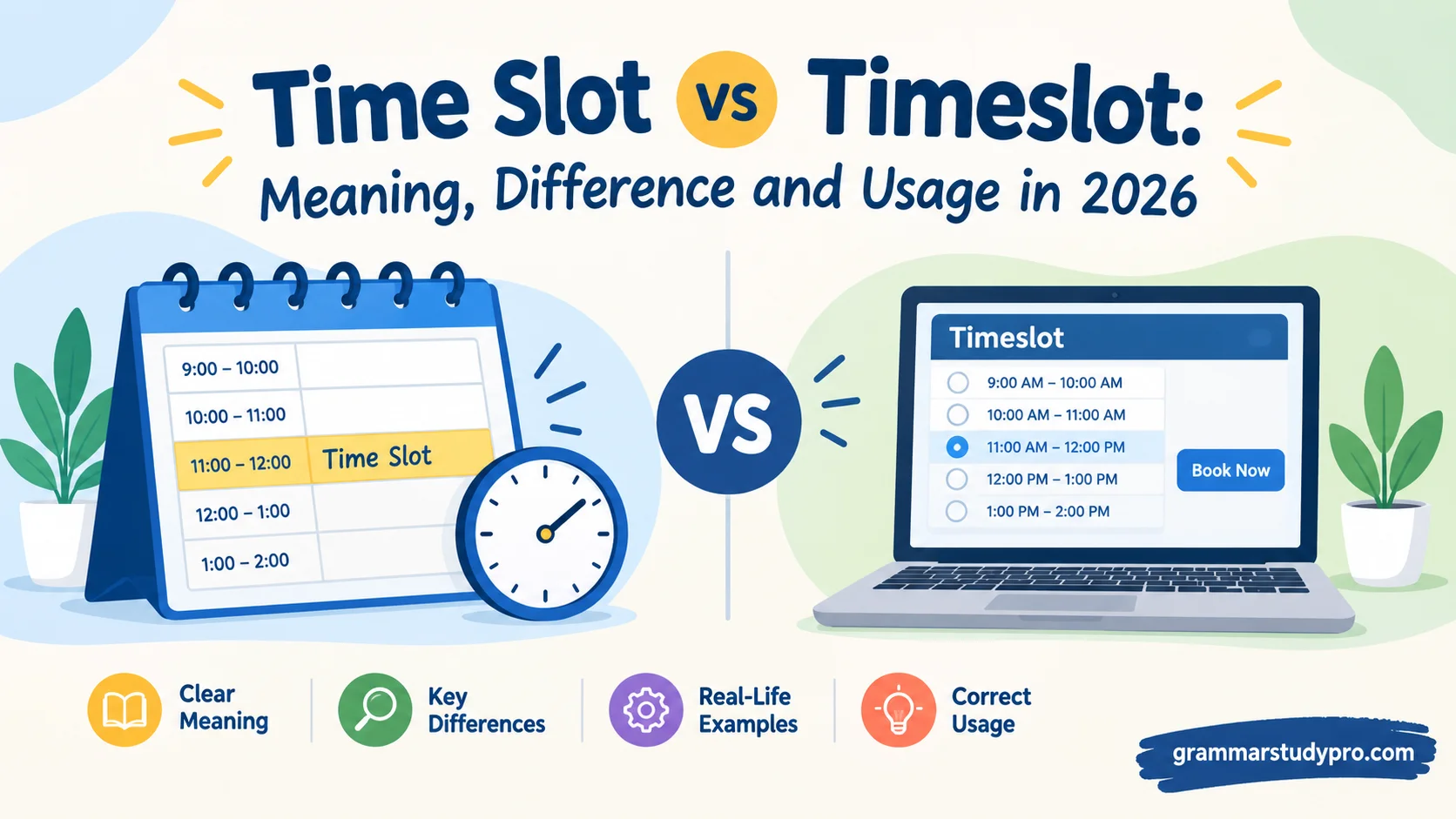
Time Slot vs Timeslot can confuse writers, but standard English usually prefers time slot for formal writing.
The difference between time slot and timeslot is mainly a spacing issue, yet it can create big confusion for writers, students, professionals, and editors. In standard English, time slot is the two words form and is generally considered grammatically correct, professionally accepted, and preferred in formal writing. Timeslot, as one word, often appears as an informal variant in digital interfaces, booking apps, applications, schedules, emails, blogs, and other online content. Both versions may seem reasonable, and people sometimes use them interchangeably, but professional documents, academic papers, business communications, journalism, and other forms of professional communication usually follow the established form. From a professional writing perspective, using time slot can improve clarity, confidence, and credibility.
The same form also fits common English word formation, grammar, punctuation, and proper English conventions. Major dictionaries and style guides help establish accepted usage, while editors rely on editorial standards and established editorial standards when preparing an article, guide, or other documents. In 2026, time slot remains the correct form for most formal situations, although timeslot can still appear in digital products and interfaces. The hyphen or hyphenated form is not normally required for this noun, so unnecessary punctuation should be avoided. Understanding the word, its meaning, and its forms also helps prevent common grammar mistakes and supports accepted writing standards. The wider Language pattern shows how English compound words can evolve.
A phrase may begin as separate words, develop a hyphenated form, and eventually become a single word, although that process takes time. The difference between Timeslot and Time Slot is therefore connected to established conventions, standards, and context, rather than a major difference in meaning. Whether you are producing academic work, business communications, formal communication, or simple communication about a booking, the correct, grammatically sound choice is normally time slot. In formal situations, especially when following standard usage, time slot is the safer choice, while timeslot may still occur in informal or digital settings.
Quick Answer
Time slot is the best default choice in standard US English.
A time slot means a particular period reserved or available for an activity. For example, you might book a 30-minute time slot for a doctor’s appointment or receive a one-hour time slot for a job interview.
Timeslot has the same basic meaning when people use it as a closed compound. You’ll see it in some software, scheduling systems, websites, and informal digital writing. However, the two-word time slot remains the safer choice for polished general writing.
Time-slot is different. The hyphenated form isn’t normally needed when time slot functions as an ordinary noun. Hyphenation can become relevant when words work together as a compound modifier, so the exact sentence matters.
The simplest rule
Use “time slot” when you want the conventional form for general and professional writing.
For example:
- Correct and standard: Please choose a time slot.
- Common variant: Please choose a timeslot.
- Usually unnecessary: Please choose a time-slot.
Cambridge Dictionary defines time slot as a time when something can happen or is planned to happen, particularly when several possible times exist. Its US pronunciation is listed as /ˈtaɪm ˌslɑːt/.
Comparison Overview
The difference between time slot vs timeslot isn’t really about meaning. It’s mainly about spelling, convention, and context.
| Feature | Time slot | Timeslot |
| Spelling | Two words | One word |
| Basic meaning | A designated period of time | Generally the same |
| Standard general usage | Preferred | Less conventional |
| Professional writing | Recommended | Usually avoid unless required by terminology |
| Business communication | Recommended | Understandable but less conventional |
| Scheduling software | Common | Also appears |
| Informal digital writing | Common | Common enough to encounter |
| Plural | Time slots | Timeslots |
| Hyphenated form | Usually unnecessary | Not applicable |
| Meaning difference | None normally | None normally |
The important point is that time slot and timeslot aren’t normally two different concepts. If someone asks you to select a timeslot, they almost certainly mean the same thing as a time slot.
The spelling changes. The underlying idea doesn’t.
What Does “Time Slot” Mean?
A time slot is a specific period allocated or made available for something.
Cambridge defines the expression as a time when something can happen or is planned to happen. Its examples include television programming and scheduled activities.
Think of a daily calendar divided into pieces.
You might have:
- 9:00–9:30 a.m. for a meeting
- 10:00–11:00 a.m. for an appointment
- 1:00–2:00 p.m. for lunch
- 3:00–4:00 p.m. for an interview
Each reserved period can be described as a time slot.
The word slot already has a time-related meaning. Cambridge also defines slot as an amount of time officially allowed for a particular event or an amount of time available for an appointment or delivery.
That’s why you can use slot by itself when the context makes the meaning obvious.
For example:
I have an open slot at 3 p.m.
You can also be more specific:
I have an open time slot at 3 p.m.
Common uses of “time slot”
You can use the phrase for almost any scheduled activity:
- Appointments: Choose a time slot for your consultation.
- Meetings: We have a 45-minute time slot available.
- Interviews: The recruiter offered three interview time slots.
- Classes: Students can register for an afternoon time slot.
- Deliveries: Your package has been assigned a delivery time slot.
- Events: Each speaker receives a 20-minute time slot.
- Television: The program moved to a later time slot.
- Conferences: Each presenter receives a designated time slot.
- Online bookings: Select an available time slot before checkout.
The phrase works because it treats time almost like a limited resource. A schedule has only so much room. Each activity gets its own piece.
Is “Time Slot” One Word or Two?
In standard general usage, time slot is written as two words.
It functions as a noun phrase in which time modifies slot. The phrase identifies a slot associated with a particular period.
For example:
I booked a time slot for Thursday.
Here, slot is the noun. Time tells you what kind of slot you’re talking about.
This pattern isn’t unusual in English. Consider similar expressions:
- parking space
- meeting room
- office building
- lunch break
- school bus
- time zone
- work schedule
English contains thousands of open compound expressions like these.
Over time, some compounds become hyphenated or closed into a single word. English spelling isn’t frozen in place. However, the fact that a closed form appears doesn’t automatically make it the preferred spelling in every context.
That’s exactly where time slot vs timeslot gets interesting.
Is “Timeslot” Correct?
Timeslot is understandable and does appear in actual English usage.
That deserves more nuance than simply calling it a spelling error.
People use timeslot in scheduling software, digital interfaces, technical documentation, online forms, and informal communication. The closed spelling has become familiar enough that most English speakers can understand it immediately.
However, real-world usage and standard editorial preference aren’t always identical.
A word can appear frequently in websites and software without becoming the preferred form for edited general English. Product terminology can also follow an organization’s internal style rather than a general dictionary convention.
For that reason, the safest approach is contextual:
- Writing an article? Use time slot.
- Writing a business email? Use time slot.
- Writing an academic paper? Use time slot.
- Creating a software interface? Follow the product’s established terminology.
- Referring to a branded feature called “Timeslot”? Preserve the official name.
- Quoting someone who wrote “timeslot”? Don’t silently change the original wording if the exact quotation matters.
So the useful answer isn’t “nobody uses timeslot.”
They do.
The useful answer is that time slot is the conventional default for standard writing.
Main Differences Between Time Slot and Timeslot
The biggest difference between time slot vs timeslot is their written form and level of conventionality.
Time slot is the open form
Time slot consists of two separate words.
Examples:
Please select a time slot.
We have several time slots available tomorrow.
Your interview time slot is confirmed.
This is the form readers are likely to expect in carefully edited general English.
Timeslot is the closed form
Timeslot combines the two words.
Examples:
Please select a timeslot.
The system automatically assigns each timeslot.
Your selected timeslot has expired.
The meaning remains clear. The main difference is that the writer has treated the expression as a closed compound.
Time-slot is the hyphenated form
The hyphenated version deserves separate treatment because writers sometimes add a hyphen simply because the expression contains two words.
That’s not a good general rule.
I booked a time slot.
is the normal construction.
However, compound modifiers can sometimes require hyphenation for clarity. The grammatical structure matters more than memorizing a blanket rule.
The important lesson is simple:
Don’t automatically turn “time slot” into “time-slot.”
Why Do People Write “Timeslot”?
The closed spelling didn’t appear from nowhere.
English frequently turns familiar word combinations into compounds. Sometimes the change happens gradually as speakers encounter the expression again and again.
Digital technology can accelerate that process.
Scheduling software often uses compact labels such as:
- Timeslot
- Date
- Duration
- Availability
- Booking
- Start time
A software developer may also create database fields such as timeslot, although programming conventions aren’t evidence of standard English spelling.
The same thing happens with product terminology. A company may decide that its scheduling feature is called Timeslot. Once customers see that label repeatedly, the spelling begins to look completely natural.
That doesn’t necessarily mean the closed form should replace the open form everywhere.
A useful distinction
Software terminology answers one question:
What does this product call the feature?
Standard English answers another:
How should this expression normally be written in general prose?
Those questions can have different answers.
What Do Dictionaries Say About “Time Slot”?
Dictionary evidence gives the open form strong support.
Cambridge Dictionary has a dedicated entry for time slot and defines it as a time when something can happen or is planned to happen, especially when several possible times exist.
Cambridge also lists time slot alongside the broader noun slot. Its entry for slot describes a specific amount of time allowed for an event or available for an appointment, delivery, or similar activity.
The dictionary’s examples are useful because they show the expression across different contexts:
- television programming
- appointments
- conferences
- technical communication
- scheduled activities
That matters more than a simple dictionary definition. It shows how the expression functions naturally in real sentences.
What about “timeslot”?
The closed form appears in actual writing, especially online and in specialized contexts. However, you shouldn’t assume that every dictionary treats the closed form as an independent standard entry simply because you encounter it frequently.
This is an important point when researching language.
Usage frequency, dictionary status, and editorial preference aren’t interchangeable measurements.
A spelling can be widely understood while remaining less conventional in edited prose.
Time Slot vs Timeslot in American English
For American English, time slot is the straightforward choice for standard professional writing.
Cambridge’s US dictionary entry explicitly lists the American pronunciation of time slot and gives examples from US sources such as CNN, CNET, Fast Company, and The Verge.
That provides useful evidence beyond an isolated grammar rule. The phrase appears naturally across American journalism, technology, business, and entertainment writing.
Examples in US English
Please choose your preferred time slot.
The interview has been scheduled for the 2 p.m. time slot.
The show moved to a later time slot.
We have two time slots available next week.
These sentences sound natural because the open form fits ordinary American usage.
Time Slot vs Timeslot in Professional Writing
Professional writing rewards clarity and consistency.
That’s why time slot makes a strong default for:
- business emails
- reports
- proposals
- academic papers
- websites
- customer support messages
- newsletters
- published articles
- company documentation
Suppose you’re sending a customer this message:
Please choose an available time slot for your appointment.
Nothing distracts the reader.
Now compare:
Please choose an available timeslot for your appointment.
The second sentence still communicates perfectly well. Yet the closed spelling may look less conventional to an editor who expects the open form.
There’s no benefit in introducing that uncertainty when the standard two-word form already works.
Professional writing rule
When you control the wording, use “time slot” unless your organization’s style guide or product terminology specifies otherwise.
That rule is practical rather than dogmatic.
Time Slot vs Timeslot in Digital Products
Digital products are where the distinction becomes less clear.
A booking platform might display:
Select a timeslot.
Another might display:
Select a time slot.
Both interfaces are understandable.
If you’re designing a product, consistency matters more than switching between forms randomly.
For example, imagine a booking application that uses Timeslot on one screen, time slot in another, and time-slot in its help documentation.
The user doesn’t need a grammar lecture to notice something feels inconsistent.
A clear style system would choose one convention and apply it consistently.
Product terminology checklist
If you’re writing interface copy, decide:
- What term does the product use?
- Does the same term appear throughout the interface?
- Does the help center use the same spelling?
- Does the marketing website match the product?
- Does the spelling agree with your editorial style guide?
- Is the label short enough for the available screen space?
The final choice should be deliberate.
Time Slot Plural: “Time Slots” or “Times Slots”?
The standard plural of time slot is:
time slots
Not:
times slots
The plural marker belongs on slot, which is the noun being counted.
Correct examples
- one time slot
- two time slots
- several time slots
- morning time slots
- available time slots
- flexible time slots
For the closed form, the corresponding plural would be timeslots when that spelling is being used.
Why “times slots” doesn’t work
Think of the structure:
time + slot
You aren’t counting “times.” You’re counting slots.
So:
one time slot
two time slots
is the natural grammatical pattern.
Time Slot vs Timeframe vs Appointment Slot
These expressions overlap, but they don’t mean exactly the same thing.
| Term | Meaning | Example |
| Time slot | A designated period for something | Choose a 30-minute time slot. |
| Timeframe | A broader period within which something happens | The project has a two-week timeframe. |
| Appointment slot | A period specifically available for an appointment | The clinic has an appointment slot at 3 p.m. |
| Time period | A general span of time | During this time period, access is restricted. |
| Delivery window | A period during which delivery is expected | Your delivery window is 2–4 p.m. |
Here’s the easiest way to picture the difference.
A timeframe is the larger container.
A time slot is a defined piece inside that container.
For example:
The hiring process will take place within a two-week timeframe. Candidates can choose a 30-minute interview time slot.
The two terms work together because they describe different levels of scheduling.
How to Use “Time Slot” in a Sentence
The phrase works naturally in many settings.
Appointments
Please select a time slot for your appointment.
Business meetings
We have a 45-minute time slot available on Thursday.
Job interviews
The recruiter offered four interview time slots.
Classes
Students can choose a morning or afternoon time slot.
Deliveries
Your delivery time slot is between 1 p.m. and 3 p.m.
Conferences
Each speaker has a 20-minute time slot.
Television
The program received a new evening time slot.
Online reservations
Choose an available time slot before confirming your reservation.
Notice how little effort the reader needs to understand the phrase. That’s one reason the established form works so well.
Is “Time-Slot” Correct?
The hyphenated spelling is where many quick grammar explanations become too absolute.
For the ordinary noun, time slot is the normal choice:
I booked a time slot.
We need another time slot.
Several time slots are available.
You don’t need the hyphen simply because two words appear next to each other.
However, English hyphenation can change when multiple words function together as a modifier before another noun. The correct treatment depends on the complete construction and the style guide you’re following.
Consider:
The system manages time-slot assignments.
Here, time-slot functions as a compound modifier before assignments. A writer may use a hyphen to make that relationship immediately clear.
However, don’t turn that observation into a universal rule that every occurrence before a noun must be hyphenated. English style guides handle compound modifiers with context-sensitive rules.
The safest practical rule remains:
Use “time slot” as the ordinary noun. Check your style guide when the phrase becomes part of a compound modifier.
Common Mistakes With Time Slot and Timeslot
Treating “timeslot” as a completely different concept
It usually isn’t.
When someone writes timeslot, they generally mean the same thing as time slot.
Assuming every closed compound is automatically wrong
English contains many compounds whose spelling has changed over time.
Usage develops.
Calling every nonstandard or less conventional form “incorrect” can hide that reality.
Adding a hyphen automatically
Two adjacent words don’t automatically need a hyphen.
Use the grammatical structure to determine whether a compound modifier needs one.
Writing “times slots”
The standard plural is time slots.
Mixing spellings throughout one document
If your document uses time slot in one paragraph and timeslot in the next, readers may wonder whether you’re referring to different things.
Usually, you’re not.
Pick a form and stay consistent.
Assuming SEO determines correct spelling
Search behavior can tell you what people type into search engines. It doesn’t determine standard English usage.
If people search for timeslot, that doesn’t mean you should replace time slot everywhere.
A well-written article can naturally address both variants while using the standard form consistently.
Case Study: A Scheduling Website
Imagine a company that lets customers book home-service appointments.
The booking process offers:
- Monday, 9–10 a.m.
- Monday, 10–11 a.m.
- Monday, 1–2 p.m.
- Tuesday, 9–10 a.m.
The website could describe these choices as time slots.
Choose a time slot
That wording works naturally in customer-facing copy.
Now suppose the company’s internal software calls each database object a timeslot.
There’s no contradiction.
The database field can use the developer’s naming convention while the customer-facing interface uses the editorially preferred time slot.
This illustrates an important principle:
Code conventions and human-language conventions don’t have to match word for word.
A programmer might write:
while the interface says:
Choose an available time slot.
One serves the machine. The other serves the reader.
Case Study: Television Scheduling
Television provides another classic use.
A network might assign a program a particular evening time slot. That slot determines when the program airs within the schedule.
For example:
The network moved the series to a later time slot.
The phrase isn’t describing a generic period such as “the next few weeks.” It’s describing a designated position in a programmed schedule.
Cambridge’s examples specifically include television programming and references to programs competing within a particular time slot.
The same concept extends to radio, conferences, classes, and organized events.
Wherever a schedule divides available time into planned positions, time slot fits naturally.
Time Slot vs Timeslot: Common Questions
Is “time slot” one word?
No. The conventional spelling is time slot, with a space between the two words.
Is “timeslot” wrong?
Not necessarily. Timeslot appears in real-world English, particularly in digital and specialized contexts. Time slot is the safer conventional choice for general professional writing.
Which is correct: time slot or timeslot?
Use time slot as your default in standard US English.
Is “time-slot” correct?
The ordinary noun is normally written time slot. A hyphen can sometimes appear when the expression functions as part of a compound modifier, depending on the sentence and style guide.
What is the plural of time slot?
The standard plural is time slots.
Can you say “a time slot”?
Yes. It’s a countable noun phrase.
I reserved a time slot.
She offered me a time slot.
Can “slot” mean time by itself?
Yes. Slot can refer to an amount of time available or allocated for an event, appointment, delivery, or other activity.
Is “time slot” formal?
It works perfectly well in professional and formal contexts.
Can “timeslot” appear in business writing?
It can, and readers will understand it. However, time slot is the more conventional choice when you’re writing polished general business English.
Why do some websites write “timeslot”?
Some websites, applications, and organizations adopt the closed spelling as their terminology. Digital products also tend to create compact labels and internal naming conventions.
Should SEO content use “timeslot”?
Include the variant naturally when it matches a genuine search question. However, there’s no need to force it into every heading or sentence. Time slot should remain the primary form when following standard usage.
Time Slot vs Timeslot: Which Should You Use?
The practical answer depends on what you’re writing.
| Writing situation | Best default |
| Business email | time slot |
| Academic paper | time slot |
| Professional article | time slot |
| Customer support message | time slot |
| Marketing copy | time slot |
| General website content | time slot |
| Formal report | time slot |
| Scheduling software UI | Follow the product’s terminology |
| Internal database field | Follow coding conventions |
| Quoted source | Preserve the original wording |
| Branded feature name | Preserve the official name |
For ordinary prose, the decision is pleasantly simple:
Write “time slot.”
You don’t need to overthink it.
FAQs
Is “time slot” or “timeslot” correct?
Time slot is the standard two-word form used in formal English. Timeslot may appear in digital interfaces and informal writing, but time slot is generally preferred in professional contexts.
Is “timeslot” one word?
Yes, timeslot is written as one word. However, it is less established in standard formal usage than time slot.
Should “time slot” be hyphenated?
Usually, no. The standard noun form is time slot, not time-slot. A hyphen may be appropriate in a different grammatical construction when the phrase functions as a compound modifier.
Why do websites and apps use “timeslot”?
Digital products often use timeslot because compound words can evolve through common usage. Its appearance in apps or online systems does not necessarily make it the preferred form for formal writing.
Which form should I use in professional writing?
Use time slot in professional documents, academic papers, business communications, journalism, and other formal contexts. It follows the more established standard English usage.
Conclusion
The difference between time slot and timeslot mainly concerns spelling and established usage. Time slot remains the safer choice for formal and professional writing because it follows the conventional two-word form. Timeslot can still appear in digital interfaces, booking systems, and informal content, but writers should consider their audience and writing context before using it. When clarity and standard English matter, choosing time slot keeps your writing simple, professional, and consistent.