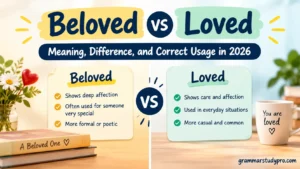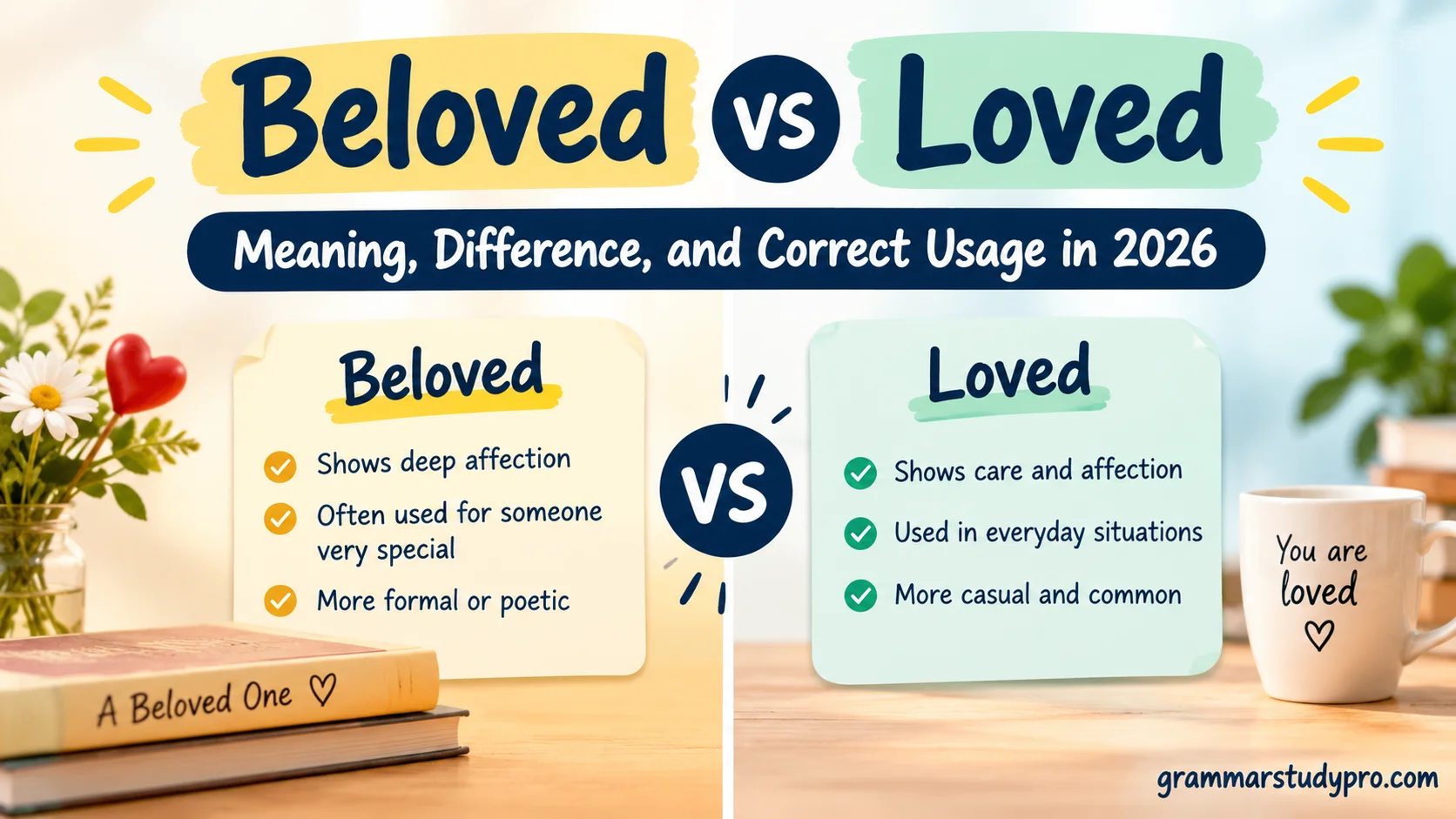
Beloved vs Loved explains how one word expresses deep affection, while the other fits everyday feelings, actions, relationships, and experiences. Have you ever wondered which word best describes someone special? Both words express affection, but their meaning, tone, and usage differ. Beloved is an adjective that describes a person or thing you love deeply. It often shows strong devotion, emotional attachment, and a greater intensity of love. For example, your parents, spouse, husband, wife, partner, or children may be your beloved ones. These English adjectives share a meaning, but they aren’t always interchangeable. Understanding this main difference helps you choose the correct word in everyday English.
The word meaning, adjective usage, and contextual meaning explain why beloved often sounds more heartfelt and deeply cherished than loved. You might describe a cherished family member, favorite hometown, respected teacher, or cherished person as beloved. These descriptive words express closeness, fondness, endearment, and an emotional connection. Meanwhile, loved has broader uses in everyday communication, including feelings, relationships, experiences, and past events. For example, “She is a beloved teacher” highlights her importance, while “Her students loved her” describes their feelings. You can also say that someone loved a movie, place, or experience. However, “I beloved that movie” is incorrect usage because beloved doesn’t work as a verb. This grammatical usage distinction matters in written English, spoken English, essays, emails, and personal messages.
When making a word comparison, remember that beloved and loved are more than simple synonyms. Their linguistic differences, semantic differences, and emotional intensity depend on the context and your intended expression. Beloved often describes someone deeply cherished, treasured, and valued, while loved can express care, caring, strong affection, and meaningful relationships. Both words describe people and things, including family members, friends, teachers, and favorite places, but you shouldn’t automatically replace one with the other. During language learning, comparing the same sentences can help you understand the distinction and improve word choice, sentence structure, and natural writing. Consider the relationship, intensity, and tone of voice before choosing either word. This approach reduces common confusion and makes your personal writing more precise, heartfelt, and natural.
Quick Answer
Beloved vs loved: Beloved means deeply loved, cherished, or held dear. Loved means cared for or held in affection, and it also serves as the past tense and past participle of the verb love.
Use beloved when you want to emphasize that someone or something holds a special place in people’s hearts. Use loved when describing affection generally or expressing an action involving love.
Examples:
- Beloved: My beloved grandmother taught me the value of kindness.
- Loved: My grandmother loved spending time in her garden.
- Loved as an adjective: The child felt loved and protected.
- Beloved as a noun: He wrote a heartfelt letter to his beloved.
Both words can express deep affection. The main difference lies in how you use them and what you want to communicate.
Comparison Overview
The following table highlights the most important differences between beloved and loved.
| Feature | Beloved | Loved |
| Meaning | Deeply cherished or dearly loved | Held in affection or cared for |
| Main grammatical role | Adjective; sometimes noun | Verb form; also adjective |
| Emotional tone | Often heartfelt, affectionate, or sentimental | Flexible, from casual affection to profound love |
| Common contexts | Tributes, dedications, descriptions, and literary writing | Conversations, relationships, stories, and everyday writing |
| Use with people | A beloved parent or friend | A loved child or a person who is loved |
| Use with places | A beloved hometown | A town that people loved |
| Use with past actions | Doesn’t function as the simple past tense of love | “I loved the book.” |
| Common expression | My beloved | Loved ones |
| Example | She is a beloved member of the community. | She is loved by her community. |
The key distinction is that beloved often highlights a person’s special value or cherished status. Loved communicates affection more broadly and also performs essential grammatical functions.
For example, “He is a beloved teacher” describes how people regard him. “His students loved him” tells you how they felt about him, perhaps during a particular period in the past.
Neither word automatically expresses stronger feelings. Context determines the emotional weight of the sentence.
Main Differences Between Beloved and Loved
Although beloved and loved share a common meaning, several differences affect how you use them. The most important distinctions involve meaning, emotional tone, grammar, and context.
Difference in Meaning
The word beloved describes someone or something that people cherish deeply. It often suggests a special emotional connection or a lasting place in someone’s heart.
The word loved communicates affection more generally. It can describe romantic feelings, family relationships, friendships, favorite activities, and even things you enjoyed in the past.
Consider these examples:
- Beloved: Our beloved grandfather brought the family together every Sunday.
- Loved: Our grandfather loved telling stories about his childhood.
- Loved: The children felt loved and safe in their home.
The first sentence highlights the grandfather’s importance to the family. The second describes something he enjoyed doing. The third describes the affection and security the children experienced.
According to Cambridge Dictionary’s definition of beloved, the word means being loved very much. This definition captures its central meaning without suggesting that loved always expresses weaker feelings.
Difference in Emotional Tone
Sometimes, the difference between these words is less about meaning and more about how a sentence feels.
Beloved often sounds warmer, more heartfelt, or more ceremonial. Writers frequently choose it when describing someone whose presence has made a lasting impression.
For example:
- “She was a beloved member of our community.”
- “She was loved by everyone in her neighborhood.”
Both sentences express affection. However, the first emphasizes her cherished place in the community, while the second directly states that people felt affection for her.
Here’s an important point: beloved doesn’t automatically mean more loved than loved. Someone can be deeply loved without anyone describing them as beloved.
For instance, a parent might tell a child, “You are loved more than you know.” That sentence communicates profound affection without using the word beloved.
Difference in Formality and Style
The setting often influences which word sounds most natural.
Beloved appears frequently in tributes, memorials, dedications, biographies, and expressive writing. It can make a description feel thoughtful or respectful.
Examples include:
- Our beloved teacher inspired generations of students.
- The author dedicated the novel to her beloved husband.
- Residents gathered to remember their beloved community leader.
By contrast, loved works comfortably in almost every kind of writing. You can use it in a casual text, a school essay, a personal letter, or a professional story.
Examples:
- I loved your presentation.
- She felt loved by her family.
- We loved visiting that little bookstore.
However, beloved isn’t limited to formal writing. A romantic partner might write, “Good night, my beloved,” to express affection in a poetic way. The phrase simply sounds more literary than “Good night, my love.”
Difference in Grammar
Grammar creates one of the clearest distinctions between beloved and loved.
Loved is the simple past tense and past participle of the verb love. It can also function as an adjective.
Examples:
- Simple past: I loved that book.
- Present perfect: I have loved this song for years.
- Passive construction: The author was loved by her readers.
- Adjective: He felt loved and appreciated.
Beloved usually functions as an adjective. It can also function as a noun referring to a person who is deeply loved.
definition in the Cambridge English Dictionary+2
Examples:
- Adjective: She is a beloved author.
- Adjective: They returned to their beloved hometown.
- Noun: He bought a gift for his beloved.
Notice that you cannot substitute beloved for the verb loved in every sentence.
Incorrect: “I beloved the concert.”
Correct: “I loved the concert.”
The first sentence fails because beloved doesn’t serve as the standard simple past-tense verb in modern English. The second uses the correct verb form.
Difference in Everyday Use
In daily conversation, loved usually sounds more natural when describing an experience, feeling, or action.
You might say:
- “I loved the food at that restaurant.”
- “She loved playing the piano.”
- “We loved spending time with our cousins.”
Using beloved in those sentences would change the structure or meaning.
For example, “She loved playing the piano” describes an activity she enjoyed. “Her beloved piano stood beside the window” describes an instrument she cherished.
The difference is subtle but important. Loved often tells you what someone felt or did, while beloved often describes something they cherish.
What Does Beloved Mean?
Beloved means deeply loved, dearly cherished, or held especially dear. It describes a person, place, animal, or thing that matters greatly to someone.
The word often conveys more than ordinary liking. It suggests that the subject has a meaningful place in someone’s life, memories, or community.
For example, a beloved teacher might influence students long after they graduate. A beloved family home might hold decades of memories. A beloved pet might become an important part of everyday family life.
The word can describe personal affection as well as widespread admiration. A public figure may be beloved by millions of people, while a family member may be beloved by only a few close relatives.
Examples of Beloved in Sentences
Here are five examples that show how the word works in different contexts.
1. My beloved grandmother taught me how to bake.
The word expresses affection and highlights her importance to the speaker.
2. The town honored its beloved teacher.
This sentence suggests that the teacher held a special place in the community.
3. They returned to their beloved hometown.
Here, beloved describes a place connected to affection and personal memories.
4. Their beloved dog greeted them at the door.
The word shows that the animal is a cherished family member.
5. She dedicated the novel to her beloved.
In this sentence, beloved functions as a noun referring to someone she loves deeply.
These examples demonstrate that beloved isn’t restricted to romantic relationships. You can use it for anyone or anything that holds special value.
How Beloved Works as a Noun
Although beloved usually appears as an adjective, it can also function as a noun.
When used as a noun, it refers to a person who is deeply loved. The phrase my beloved often appears in romantic, poetic, or literary writing.
Examples:
- He wrote a poem for his beloved.
- She waited patiently for her beloved to return.
- The letter began with the words, “To my beloved.”
This use is grammatically correct, but it may sound formal or old-fashioned in everyday American English. In a casual conversation, people might say my partner, my love, or the person I love instead.
For a romantic message, choose the expression that matches your relationship and personality. My beloved feels expressive and poetic, while my love sounds more conversational.
What Does Loved Mean?
Loved is the past tense and past participle of the verb love. It describes affection that someone felt, an experience they enjoyed, or a person or thing that receives love.
Unlike beloved, the word fits several common grammatical patterns. That flexibility makes it especially useful in everyday speech and writing.
For example, “I loved the movie” describes your reaction to a film. “She felt loved” describes her emotional experience. “They have loved each other for years” connects past affection with the present.
Examples of Loved in Sentences
These examples demonstrate the word’s different uses.
1. I loved the story’s unexpected ending.
Loved is the simple past tense of the verb love.
2. She felt loved by her friends.
Loved describes the affection she received.
3. They loved spending time together.
The word describes an activity they enjoyed.
4. The song was loved by generations of listeners.
This sentence uses the past participle in a passive construction.
5. He has always loved his childhood home.
The present perfect construction connects his affection over time with the present.
The examples show why loved is more versatile grammatically than beloved. It can describe feelings, actions, experiences, and relationships across different time frames.
Common Expressions With Loved
English speakers use loved in many familiar expressions. Understanding these phrases will help you write more naturally.
| Expression | Meaning | Example |
| Loved ones | People close to you whom you care about | She spent the holiday with her loved ones. |
| Well-loved | Widely appreciated or cherished | That well-loved story remains popular. |
| Much-loved | Greatly appreciated or cherished | The school celebrated its much-loved principal. |
| Feeling loved | Experiencing affection and care | He felt loved and supported. |
| Loved by everyone | Describes someone who receives widespread affection | The friendly coach was loved by everyone on the team. |
The expression loved ones deserves special attention. It commonly refers to family members, partners, close friends, and other important people in your life.
For example, “Spend time with your loved ones” sounds natural in everyday American English. You can also say “spend time with your beloved family,” but that version carries a more expressive tone.
Both can be correct. The best choice depends on the sentence and the effect you want to create.
When Should You Use Beloved or Loved?
Choosing between beloved and loved becomes easier when you consider what your sentence needs to express. Ask yourself whether you’re describing someone cherished, talking about a feeling, or explaining something that happened in the past.
Use Beloved for Someone or Something Deeply Cherished
Choose beloved when you want to highlight a special emotional connection or someone’s importance to a person or group.
Examples:
- The school remembered its beloved principal.
- She returned to her beloved hometown after twenty years.
- Their beloved cat slept beside the fireplace.
- The community celebrated its beloved local artist.
In each sentence, beloved describes someone or something that holds special value. It adds warmth without requiring a long explanation of the relationship.
This makes the word especially useful in biographies, dedications, tributes, and personal stories.
Use Loved for Everyday Affection
When you want to express affection in a straightforward way, loved is usually the better choice.
Examples:
- Her parents loved her unconditionally.
- I loved the thoughtful gift you gave me.
- He knew his friends loved him.
- We loved the time we spent together.
These sentences communicate their meaning clearly. You don’t need the more expressive word beloved to make your feelings meaningful.
For example, “I loved the dinner you prepared” sounds natural in a message to a friend. “I beloved the dinner you prepared” is grammatically incorrect.
Use Loved When Talking About Past Feelings
The simple past tense is another reason to choose loved.
When describing something you enjoyed or someone you cared about in the past, use loved as the verb.
Examples:
- I loved reading adventure novels as a child.
- She loved her first apartment.
- They loved visiting their grandparents every summer.
- We loved the concert last weekend.
You cannot replace the verb loved with the adjective beloved and keep the same grammatical structure.
Compare these sentences:
- Correct: I loved that restaurant.
- Correct: That restaurant was beloved by local residents.
- Incorrect: I beloved that restaurant.
The first sentence describes a personal experience. The second describes the restaurant’s cherished status among local residents.
Use Beloved in Tributes and Memorials
Beloved often appears in writing that honors someone’s life, work, or influence. Its tone suits occasions when a simple description doesn’t fully capture the person’s importance.
Examples:
- In loving memory of our beloved father.
- She will always be remembered as a beloved teacher.
- The city mourned the loss of its beloved mayor.
- His beloved friend delivered a moving tribute.
Such expressions communicate affection and respect. They can also acknowledge the lasting impact someone had on others.
However, loved works well in tributes, too. “He was loved by his family and friends” is direct, sincere, and grammatically correct.
The choice depends on the message. Use beloved when you want a more commemorative tone, and use loved when a straightforward statement feels more appropriate.
Use Beloved in Romantic or Literary Writing
When writing a romantic message, beloved can express deep affection with a poetic touch.
Consider these examples:
- My beloved, I cherish every moment we share.
- She wrote a letter to her beloved before leaving town.
- He called her his beloved companion.
In ordinary conversation, you might express the same feelings differently:
- My love, I cherish every moment with you.
- I wrote a letter to the person I love.
- She’s my favorite person to spend time with.
Neither style is inherently better. A heartfelt message should sound natural for the person sending it and the person receiving it.
If you usually speak casually, my love may feel more genuine than my beloved. If you enjoy romantic or literary language, my beloved may suit you perfectly.
Beloved vs Loved: Correct Usage Examples
Sometimes, the easiest way to understand a word is to see it in context. The following paired examples demonstrate when each word fits and why.
| Example with beloved | Example with loved | Explanation |
| She is a beloved teacher. | Her students loved her. | The first describes her cherished status; the second describes their feelings. |
| He returned to his beloved village. | He loved living in that village. | The first describes the village; the second describes his experience. |
| Their beloved dog slept nearby. | They loved their dog dearly. | The first describes the dog as cherished; the second states the owners’ feelings. |
| She wrote to her beloved. | She loved him deeply. | The first uses beloved as a noun; the second uses loved as a verb. |
| The beloved tradition continued. | The community loved the tradition. | The first describes the tradition; the second describes the community’s response. |
| He was a beloved public figure. | Millions of people loved him. | Both express widespread affection, but their grammar differs. |
Notice that the words sometimes describe nearly identical situations. The difference often lies in the sentence’s focus rather than a completely different meaning.
A Practical Case Study: Choosing the Right Word
Imagine you’re writing a short paragraph about a retired teacher named Mrs. Carter.
You could write:
“Mrs. Carter was a beloved teacher who encouraged students to believe in themselves. Her former students loved visiting her after graduation. She had always loved teaching, even during the most difficult school years.”
Each sentence uses a related word for a different purpose.
- Beloved teacher describes how students and the community regarded her.
- Loved visiting describes an activity her former students enjoyed.
- Loved teaching uses the simple past-tense verb to describe her feelings about her work.
Replacing every instance of loved with beloved would make the paragraph awkward or grammatically incorrect. Good writing depends on choosing the word that fits each sentence.
Common Mistakes When Using Beloved and Loved
Even confident English speakers can confuse these words when they focus on meaning alone. Paying attention to grammar and context prevents the most common errors.
Using Beloved as a Replacement for Every Form of Loved
One of the clearest mistakes is using beloved as a regular verb.
Incorrect: “I beloved the book you recommended.”
Correct: “I loved the book you recommended.”
Why? Beloved usually works as an adjective or noun in modern English. It isn’t the ordinary simple past-tense form of love.
If you’re describing something you enjoyed, choose loved. If you’re describing something deeply cherished, beloved may fit.
Assuming Beloved Always Means More Love
Although beloved often sounds more emphatic, it doesn’t provide an exact measure of affection.
For example, “She is deeply loved by her family” can express profound affection. Calling her “a beloved member of the family” emphasizes her cherished place within it.
Both sentences communicate warmth. Neither automatically proves that the feelings in one sentence are stronger.
Assuming Beloved Is Only for Romantic Partners
Beloved can describe romantic partners, but its meaning extends much further.
Correct examples include:
- A beloved sister
- A beloved teacher
- A beloved family pet
- A beloved hometown
- A beloved community leader
The word describes deep affection or special value, not a specific type of relationship.
Using Beloved When an Everyday Verb Is Needed
Incorrect: “We beloved spending time together.”
Correct: “We loved spending time together.”
You could also write, “Spending time together was one of their beloved traditions,” although that sentence expresses a different idea.
The first sentence describes an activity people enjoy. The second describes a cherished tradition.
When you’re unsure, identify the role the word must play. If the sentence needs a past-tense verb, loved is the correct choice.
Synonyms for Beloved and Loved
Both words have several synonyms, but their alternatives don’t always work in the same grammatical situations. Choose a synonym based on the meaning and tone you want.
Synonyms for Beloved
| Synonym | Meaning | Example |
| Cherished | Deeply valued and cared for | She kept a cherished photograph of her mother. |
| Dear | Loved or held in affection | He was a dear friend. |
| Adored | Loved very much | The children adored their grandfather. |
| Treasured | Considered especially valuable | She treasured the letters he sent. |
| Precious | Extremely valuable or important | Their time together was precious. |
These alternatives help you express different shades of affection. Cherished emphasizes emotional value, while adored often conveys intense affection. Treasured can also describe memories and possessions.
Synonyms for Loved
| Synonym | Meaning | Example |
| Cared for | Received affection or attention | She knew that her family cared for her. |
| Cherished | Held dear | He cherished their friendship. |
| Adored | Loved intensely | She adored her little brother. |
| Valued | Considered important | The team valued his contribution. |
| Held dear | Considered emotionally important | He held those childhood memories dear. |
Remember that synonyms don’t always fit the same sentence structure. For example, you can say, “I loved the book” or “I adored the book.” However, “I cherished the book” may suggest emotional attachment rather than simply enjoying its contents.
FAQs
1. What is the main difference between beloved and loved?
Beloved usually describes someone or something deeply cherished, while loved has broader uses. For example, “She is a beloved teacher” expresses deep respect and affection, while “Her students loved her” describes their feelings.
2. Are beloved and loved interchangeable?
Not always. Both words express affection, but they differ in grammar and tone. You can say “my beloved family” or “my loved ones,” but you cannot use beloved as a regular verb.
3. Can I use beloved to describe a person?
Yes. You can use beloved to describe a person you deeply cherish, such as a parent, spouse, partner, child, friend, or respected teacher. The word often conveys strong emotional attachment and lasting affection.
4. Is beloved an adjective or a verb?
Beloved usually functions as an adjective, as in “a beloved author.” It can also serve as the past participle of belove, a rare verb. In everyday English, however, people generally use loved to express the action of loving someone or something.
5. Which word should I use in everyday English?
Use loved when describing feelings, actions, experiences, or past events. Choose beloved when you want to emphasize deep affection, special importance, or a cherished connection. For example, “I loved the movie” is correct, while “She was a beloved friend” highlights a meaningful relationship.
Conclusion
Understanding beloved vs loved helps you express affection more clearly and naturally. Both words communicate love, but they carry different meanings and grammatical uses. Beloved often emphasizes deep affection and the special place someone holds in your life, while loved works in a wider range of everyday sentences.
When choosing between them, consider the context, intended meaning, and tone. With practice, you’ll find it easier to use both words correctly in conversations, essays, emails, and personal messages.