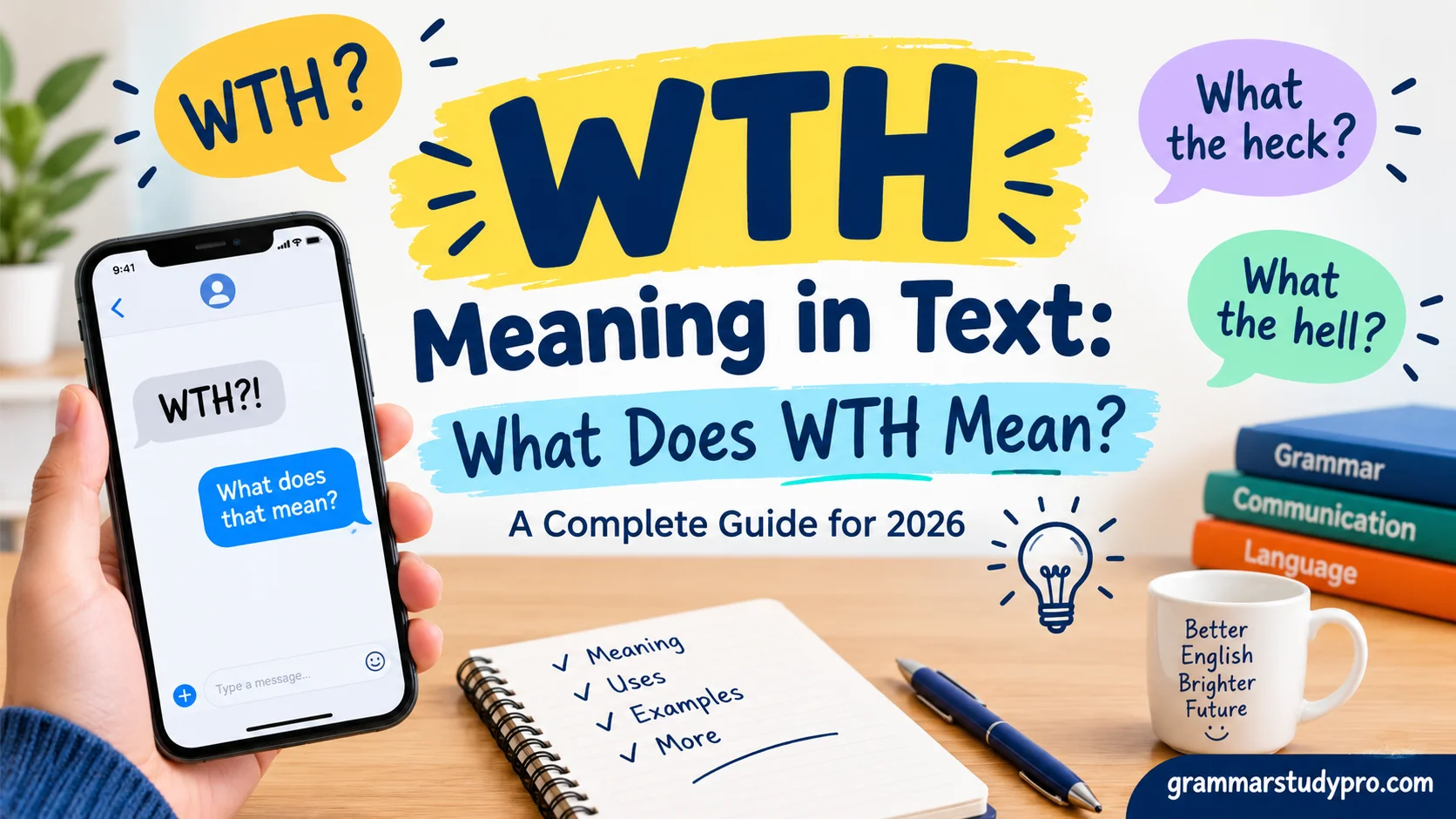
WTH Meaning in Text explains how people use this popular acronym to express surprise, confusion, disbelief, or frustration in everyday online conversations. WTH stands for “What the Hell” or “What the Heck,” making it a short, expressive phrase that is easy to type when texting friends, replying to messages, or reacting to social media posts. You may encounter this internet slang on TikTok, Snapchat, Instagram, WhatsApp, gaming chats, group conversations, and direct messages (DMs). Its usage has grown alongside digital communication, messaging apps, and modern texting habits. Although WTH is informal language, understanding its meaning helps you communicate naturally and recognize the emotions behind a message.
The meaning of WTH depends on the context, situation, and sender’s tone. For example, “WTH happened?” might express surprise at unexpected news, while “WTH are you doing?” could suggest anger, impatience, or genuine irritation. Sometimes, the phrase sounds amused or joking; in other situations, it communicates annoyance or shock. “What the Hell” usually carries stronger language, whereas “What the Heck” offers a softer, more polite alternative. In everyday English, the phrase can work as an intensifier, adding emotional weight to a reaction or rhetorical question. Paying attention to surrounding words, conversational tone, and the relationship between people can help prevent misunderstandings and incorrect text interpretation.
Consider these real chat examples: “WTH, that’s amazing!” communicates excitement, while “WTH is going on here?” can express confusion or disbelief. Although the acronym contains just three letters, its emotional meaning can change significantly across online conversations, social media comments, and private messages. For correct usage, consider the sender’s intention, the conversational context, and the level of formality.
Quick Answer: What Does WTH Mean in Text?
WTH usually means “What the hell?” in texting and online conversations.
It can also be understood as “What the heck?”, particularly when someone wants a milder expression.
People commonly use WTH to show:
- Surprise: “WTH? You actually bought it?”
- Confusion: “WTH are you talking about?”
- Disbelief: “WTH! Did that really happen?”
- Annoyance: “WTH is taking so long?”
- Amusement: “WTH 😂”
- Shock: “WTH just happened?”
WTH is informal slang. It generally belongs in casual conversations rather than formal writing.
What Does WTH Stand For?
The most common expansion of WTH is “what the hell.”
Here, “hell” doesn’t refer to a literal place. Instead, it works as an intensifier. English speakers use “the hell” after question words to add emotional force.
For example:
“What are you doing?”
is relatively neutral.
“What the hell are you doing?”
is much more forceful.
The second version can communicate surprise, frustration, disbelief, or anger. Dictionary.com specifically identifies “what the hell” as an intensifying expression used in questions and reactions.
WTH Can Also Mean “What the Heck”
Some people interpret WTH as “what the heck.”
“Hell” and “heck” aren’t identical words. However, heck is an established euphemistic alternative to hell, and dictionaries describe it as a mild expression of annoyance, surprise, or irritation.
That’s why WTH can work in two closely related ways:
| WTH expansion | Typical effect |
| What the hell? | Stronger, more emphatic |
| What the heck? | Milder, more family-friendly |
The abbreviation itself doesn’t tell you which version the sender had in mind.
What Does WTH Mean in a Text Message?
In texting, WTH functions primarily as an emotional reaction rather than a literal question.
Imagine someone tells you they accidentally bought concert tickets for the wrong city. You might reply:
“WTH 😂”
You’re not necessarily demanding a detailed explanation. You’re reacting to something unexpected.
That distinction matters because internet slang often compresses a full sentence into a quick emotional signal. WTH does exactly that.
WTH Can Express Surprise
Someone tells you they just quit their job without warning.
Text:
“WTH? You actually quit?”
Here, WTH communicates surprise.
WTH Can Express Confusion
Suppose someone sends you an explanation that makes absolutely no sense.
“WTH are you talking about?”
In this situation, WTH emphasizes confusion.
WTH Can Express Disbelief
A friend tells you they paid $800 for something that normally costs $50.
“WTH?!”
The sender is expressing disbelief rather than simply asking for information.
WTH Can Express Frustration
Someone has been waiting for an order that keeps getting delayed.
“WTH is going on with this order?”
Now the abbreviation carries irritation.
WTH Can Be Playful
A friend sends you an absurd photo.
“WTH 😂”
The laughing emoji changes the atmosphere. The reaction may be closer to “What on earth?” than genuine anger.
WTH Meaning Depends on Context
Here’s the tricky part: WTH doesn’t have one fixed emotional tone.
The surrounding words, punctuation, emojis, and relationship between the people can all change how it sounds.
Consider these examples:
| Message | Likely tone |
| WTH? | Confusion or surprise |
| WTH! | Shock or frustration |
| WTH?! | Strong disbelief |
| WTH 😂 | Amused disbelief |
| WTH… | Disappointment or confusion |
| WTH are you doing? | Possible irritation |
| WTH, that’s amazing! | Excited surprise |
Punctuation acts almost like body language in text. A question mark can make WTH sound inquisitive. An exclamation mark adds emotional force. An emoji can soften the message or make the reaction obviously playful.
That’s why reading only the abbreviation can lead you astray.
What Does “WTH?” Mean?
When someone sends only “WTH?”, they’re usually reacting to something immediately before it.
For example:
Person A: “I accidentally sent the email to everyone in the company.”
Person B: “WTH?!”
Person B probably expresses shock or disbelief.
Now consider another situation:
Person A: “The appointment moved to 4 a.m.”
Person B: “WTH?”
Here, confusion is more likely.
The letters haven’t changed. The context has.
What Does “WTH!” Mean?
Adding an exclamation mark generally makes the reaction more forceful.
For example:
“WTH! That was the craziest ending ever.”
This doesn’t necessarily sound angry. It could communicate excitement or astonishment.
By contrast:
“WTH! Why would you do that?”
sounds much more confrontational.
The sentence following WTH often provides the strongest clue.
What Does “WTH 😂” Mean?
The combination of WTH and a laughing emoji often signals humorous disbelief, surprise, or playful confusion.
For example:
“You really wore that to the wedding? WTH 😂”
The sender probably isn’t furious. They’re teasing or reacting humorously.
Still, don’t treat emojis as an absolute code. Someone can use a laughing emoji while feeling uncomfortable or sarcastic. The conversation around it matters.
Is WTH a Bad Word?
WTH itself isn’t a swear word in the same way as writing out a strong profanity. However, when it means “what the hell,” it represents an expression containing a mild swear or profanity.
The word hell has several ordinary meanings in English. In expressions such as “what the hell,” dictionaries classify it as an informal intensifier that can add force to questions or emotional statements.
That makes WTH relatively mild compared with stronger internet abbreviations.
A useful way to think about it:
WTH → mild/informal
WTF → considerably stronger/vulgar
That distinction doesn’t mean everyone will find WTH acceptable. Standards vary by age, workplace, family, culture, and personal preference.
Is WTH Rude or Offensive?
WTH can be rude, but it isn’t automatically rude.
Tone does the heavy lifting.
Compare these:
“WTH 😂 You actually did it!”
This sounds playful.
“WTH are you doing?”
This could sound annoyed.
“WTH is wrong with you?”
That version is much more confrontational because it directly targets another person.
The relationship matters, too. A close friend might interpret WTH as harmless banter. A manager, client, teacher, or stranger may read the same message differently.
When there’s any doubt, use clearer and more neutral wording.
WTH vs. WTF: What’s the Difference?
People frequently confuse WTH with WTF, but they aren’t equivalent in strength.
WTH generally expands to “what the hell” or “what the heck.”
WTF generally means “what the fuck.”
Dictionary.com defines WTF as an abbreviation used to express reactions such as anger, impatience, and surprise in digital communication.
Here’s the practical distinction:
| Expression | Common expansion | General intensity |
| WTH | What the hell / what the heck | Mild to moderate |
| WTF | What the fuck | Stronger and more vulgar |
| OMG | Oh my God | Usually surprise or excitement |
| SMH | Shaking my head | Disapproval or disbelief |
| WYD | What are you doing? | Casual question |
| IDK | I don’t know | Uncertainty |
These aren’t rigid emotional categories. Context can make any expression sound warmer, harsher, funnier, or more sarcastic.
WTH vs. WTF Example
Consider:
WTH happened?
This can sound like ordinary surprise.
Now compare:
WTF happened?
The second version generally carries more profanity and emotional intensity.
If you’re unsure which one to use, WTH is the less vulgar option.
What Does WTH Mean on Social Media?
The meaning of WTH usually stays consistent across social platforms.
You may encounter it in:
- Instagram comments
- TikTok comments
- Snapchat messages
- Facebook posts
- Reddit discussions
- Discord chats
- Group messages
- Direct messages
A comment such as “WTH 😂” under a bizarre video usually communicates amused disbelief.
A comment such as “WTH is happening?” can express confusion about an unfolding event.
The platform doesn’t fundamentally change the definition. The conversation does.
WTH Examples in Real Conversations
Seeing the abbreviation in realistic situations makes its meaning easier to recognize.
Surprise
Alex: “I bought a new car yesterday.”
Sam: “WTH? You didn’t even tell me!”
Here, WTH communicates genuine surprise.
Confusion
Alex: “The event starts at 3 a.m.”
Sam: “WTH? I thought it started at 3 p.m.”
The sender is confused about the information.
Disbelief
Alex: “He sold his gaming PC for $20.”
Sam: “WTH?!”
The response communicates disbelief.
Frustration
Alex: “The delivery has been delayed for another week.”
Sam: “WTH is going on?”
Here, WTH expresses annoyance.
Humor
Alex: “I just accidentally joined my boss’s family group chat.”
Sam: “WTH 😂”
The reaction is clearly humorous.
Excitement
Alex: “Guess who just won the competition?”
Sam: “WTH! You did?!”
This example shows that WTH doesn’t necessarily communicate negativity. Surprise can be positive.
What Does WTH Mean From a Guy or Girl?
There isn’t a separate standard meaning of WTH based on gender.
If a guy sends “WTH?”, it generally means the same thing as when a girl sends it. The important clues come from the conversation, not the sender’s gender.
For example, someone might write:
“WTH 😂 You actually said that?”
That could be playful teasing.
Someone else might write:
“WTH are you doing?”
That could indicate irritation.
Trying to decode WTH based solely on whether the sender is male or female usually adds unnecessary guesswork.
Look at the words around WTH instead.
What Does WTH Mean in a Conversation?
When WTH appears in an ongoing conversation, look at the message immediately before it.
That previous message often explains the reaction.
If the sender is confused
They may want clarification.
Possible response:
“I meant that the meeting was moved to Friday.”
If they’re surprised
They may simply need confirmation.
Possible response:
“Yep, it’s true. I wasn’t expecting it either.”
If they’re annoyed
Address the problem rather than arguing about the abbreviation.
Possible response:
“Sorry. I should’ve told you earlier.”
If they’re joking
You can respond with the same playful energy.
Possible response:
“😂 I know. It was completely ridiculous.”
The best response depends on what WTH is reacting to.
How Should You Respond When Someone Texts “WTH?”
A good response doesn’t require decoding the abbreviation like a secret cipher. Start with the situation.
If they seem confused
Explain what you meant.
If they seem surprised
Confirm or explain the unexpected information.
If they seem angry
Address the actual issue.
If they’re joking
A playful reply usually works better than a formal explanation.
If you’re unsure
Ask a simple question:
“Haha, what part?”
That gives the sender room to clarify their reaction without turning a tiny abbreviation into a major misunderstanding.
Can WTH Mean Something Else?
Yes, abbreviations can have different meanings in specialized fields.
However, ordinary texting is different from technical acronym lists. If someone writes WTH in a casual text, “what the hell” or “what the heck” is the interpretation that fits the context most naturally.
That distinction matters because acronym websites sometimes list obscure professional, organizational, or technical expansions. Those meanings don’t automatically apply to casual messaging.
In everyday conversation, context should take priority over an obscure acronym expansion.
Is WTH Appropriate in Formal Writing?
Generally, no.
WTH is informal shorthand. It belongs naturally in casual digital communication rather than formal prose.
Avoid it in:
- Academic papers
- Job applications
- Business reports
- Formal letters
- Legal documents
- Professional proposals
- Official correspondence
Instead, write exactly what you mean.
For example:
| Casual | More formal |
| WTH happened? | What happened? |
| WTH is going on? | What is happening? |
| WTH are you talking about? | Could you clarify what you mean? |
| WTH?! | That’s unexpected. |
The goal isn’t to make every sentence sound stiff. It’s to match the language to the audience.
Is WTH Appropriate at Work?
Workplace communication sits somewhere between casual texting and formal writing.
If your team regularly uses slang in an internal chat, someone might use WTH without causing any concern. However, external communication deserves more caution.
Avoid WTH in messages to:
- Customers
- Clients
- Job candidates
- Senior executives
- Business partners
- People you don’t know well
For example, sending a coworker:
“WTH happened to the spreadsheet? 😂”
might be perfectly normal in a relaxed team chat.
Sending a client:
“WTH happened to your payment?”
is another story.
Professional communication benefits from precision. When a neutral alternative works just as well, there’s little reason to gamble on tone.
WTH Capitalization and Punctuation
You’ll see WTH written in several ways.
WTH
The standard uppercase abbreviation.
wth
Lowercase often feels more casual or conversational.
Wth
Mixed capitalization appears occasionally, although it isn’t particularly meaningful.
WTH?
Usually a question, reaction, or request for explanation.
WTH!
Often stronger surprise, excitement, or frustration.
WTH?!
Combines questioning with strong emotion.
WTH…
Can suggest disbelief, disappointment, awkwardness, or hesitation.
These aren’t strict rules. Texting doesn’t have a universal punctuation dictionary. The surrounding words still matter most.
Why Do People Use WTH Instead of Writing It Out?
The answer is simple: speed and tone.
Texting encourages compact language. Abbreviations let people communicate reactions quickly without typing a full phrase.
WTH also creates a little emotional distance. Writing the full phrase can feel more direct. The abbreviation can make the reaction feel lighter, especially in casual conversations.
For example:
“What the hell?!”
looks more explicit.
“WTH?!”
feels more like digital shorthand.
That difference is subtle, but people notice it.
A Practical Guide to Understanding WTH
When you see WTH in a message, use this quick process:
Look at the previous message → check punctuation → notice emojis → consider the relationship → interpret the tone.
For example:
“WTH 😂”
The laughing emoji strongly suggests a playful or amused reaction.
Compare that with:
“WTH are you doing?”
The direct question could signal frustration.
Now consider:
“WTH?! That’s incredible!”
The following sentence reveals that the reaction is positive excitement.
This approach works better than assuming every WTH means anger.
FAQs
1. What does WTH mean in text?
WTH means “What the Hell” or “What the Heck” in text messages. People use it to express surprise, confusion, disbelief, or frustration during online conversations.
2. Does WTH mean What the Hell or What the Heck?
WTH can represent both phrases. “What the Hell” sounds stronger, while “What the Heck” is a milder alternative for people who prefer softer language.
3. Is WTH rude to use in a text message?
WTH can sound rude or aggressive depending on the situation. It is generally more acceptable among friends, but it may seem disrespectful in professional conversations or when speaking to someone you do not know well.
4. What does WTH mean on Snapchat, Instagram, and WhatsApp?
On Snapchat, Instagram, and WhatsApp, WTH usually has the same meaning: “What the Hell” or “What the Heck.” The sender may use it to react to surprising news, confusing messages, unexpected photos, or unusual situations.
5. How should you reply when someone texts WTH?
Your response depends on the sender’s tone and the situation. If the person seems confused, explain what happened. If they sound surprised, you can clarify the situation or respond casually with something like, “I know, right?” If they seem annoyed, ask politely what is bothering them.
Conclusion
Understanding WTH Meaning in Text helps you recognize emotions and intentions in everyday digital communication. This popular abbreviation can express surprise, confusion, disbelief, or frustration, depending on the context and the sender’s tone. While WTH is common in casual conversations, choosing between
“What the Hell” and the softer “What the Heck” can make a difference in how your message sounds. Pay attention to the situation, consider your audience, and choose your words carefully to communicate clearly without causing unnecessary misunderstandings.